Monday, March 16, 2020

A Virtual Environmental Film Festival

Due to concerns related to COVID-19,  The Environmental Film Festival in the Nation’s Capital (DCEFF) is cancelling all events scheduled for March 12-22, 2020. In the wake of the cancellation, DCEFF will host a “virtual” festival beginning next week, featuring select 2020 films to be viewed online. 

“We did not come to this decision lightly, but the safety of our audience, local and out of town participants, volunteers, partners, and staff is our number one priority,” says Executive Director, Christopher Head. “Given the situation, we felt this was our only viable option.” 

DCEFF also plans to host a smaller version of the Festival in the fall, which will feature the 2020 Award winners, among others. Other Festival screenings will also be planned for later in the year.
Starting on March 17, go to https://dceff.org/ to see which film are available for online viewing currently. Some will be at a nominal fee, but many will be free.
We reviewed a few of the films (below). Feel free to share your reviews and thoughts on these film in the comments field below.

Sustainable Islands / Duurzame Eilanden
Review by Charlotte Parker Dulany

Co-presented with the Embassy of the Kingdom of the Netherlands, Dutch director Eef de Graaf created “Sustainable Islands” to show how the Dutch Wadden Islands are working toward a more sustainable, zero-emissons future. The short film runs for 73 minutes in a documentary style built on global perspectives. Driven by personal stories, the film follows individuals dedicated to green environmental practices to lessen the human ecological impact. Projects include improving water quality and adding affordable energy, both of which require immense attention and collaboration of different organizations.
   Set to an upbeat soundtrack, The director, Graaf, shows beautiful landscapes and insider looks at discussions with the officials who have the power to implement sustainable changes. Graaf was educated in film by renowned Dutch filmmaker Frans Zwartjes while at school in Groningen; all of her films have been featured at the Rotterdam film festival. She now owns a film production company in Zierikzee, Holland.

About the reviewer:
Charlotte Parker Dulany is a senior multiplatform journalism major graduating from the University of Maryland in May. She is an intern this spring semester with Washington Gardener.

Farmscape Ecology
Review by Kathy Jentz

Director Jon Bowermaster profiles Farm Hub (http://hvfarmhub.org/), a small team of ecologists, herpetologists, micro-biologists, ornithologists, hydrologists, and farmers in New York’s Hudson Valley. They are researching the “the interface between farming and wild nature.” The tests shown include till versus no-till farming, monitoring the level of beneficial insects in the fields, and measuring soil microbiology health.
   This short film tackles many issues and is not able to go deeply into them, but it is a good overview of the questions we are asking now and where horticultural/agricultural research is headed. I will be curious to hear the Farm Hub's results in 5-10 years.
  Visually, the film is well-done. I especially enjoyed the filmmakers use of drone footage to show the fields from above and give a bird's eye view of the farm.

About the reviewer:
Kathy Jentz is the editor and founder of the Washington Gardener.

Fantastic Fungi
Review by Kathy Jentz
Fantastic Fungi has been experiencing sold-out screenings and lively panel discussions across the country. The film is “a consciousness-shifting documentary that takes us on an immersive journey through time and scale into the magical earth beneath our feet.” Featured in the film are scientists and mycologists like Paul Stamets, along with best-selling authors Michael Pollan, Eugenia Bone, and Andrew Weil.
   The director. Louie Schwartzberg, is a masterful cinematographer. His time-lapse, high-speed, and macro close-up techniques are simply breath-taking. (I highly recommend also watching his TED talks and clips on Youtube.) Beyond the visuals, the film challenges your preconceptions about mushrooms and particularly about their use in healing. The research in “magic mushroom” use in alleviating anxiety in terminally ill cancer patients is particularly fascinating. I found the interviews quite moving and uplifting.
   The film has a light tone and treats some serious issues quire casually. It should be viewed with an open mind. If you have teenagers, I would recommend watching it as a family and discussing the various issues afterwards together. 

About the reviewer:
Kathy Jentz is the editor and founder of the Washington Gardener.

Sunday, March 15, 2020

Daffodils Delight on Bloom Day


It is Garden Blogger's Bloom Day again! On the 15th of each month, we gardeners with blogs share a few bloom photos from our gardens. 

Here in the Mid-Atlantic USA (USDA zone 7) on the DC-MD border, we had a fairly mild winter and are now having an early spring.

I have a multitude of blooms, even the Lilacs are starting to bud up. With such a wealth of choices, I thought I'd share a few of my favorite daffodils in the collage above, Here is my list of everything that is in flower in my garden today:

- Viola and Pansies- Alyssum- Scilla
- Puschkinia
- Veronica
- Vinca groundcover- Hellebores
- Crocus- Grape Hyacinth (Muscari)
- Dutch Hyacinth- Daffodils
- Primrose
- Forsythia
- PJM Rhododendrons

- Winter Jasmine (ending)
- Pieris japonica
- Mahonia
Saucer Magnolia tree 'Jane'- Flowering Plum tree 'Thundercloud'

Podcast Episode 2: A Discussion on the Green Matters Symposium, a novel “The Overstory,” and Doug Tallamy's “Nature’s Best Hope”


‪Listen to the most recent episode of our podcast posted on March 14, 2020.

This episode includes a chat with Kit Gage, a Chesapeake Bay Landscape Professional, about the recent Green Matters Symposium, the novel “The Overstory,” and  Doug Tallamy's “Nature’s Best Hope.” 

Our Plant Profile in this episode is on the cool-season annual Sweet Alyssum.

The episode is posted at: https://anchor.fm/kathy-jentz/episodes/March-14--2020-eatace

We are also available on -


  • Google Podcasts at this link, either now or soon (note that currently, this link will only work on Android devices)
We welcome your questions and comments. 
You can leave a voice mail message for us at: https://anchor.fm/kathy-jentz/message  
Note that we may use these messages on a future episode.

And YOU can become  a listener supporter for as little as $0.99 per month! See how at: https://anchor.fm/kathy-jentz/support. 


Friday, March 13, 2020

Public Gardens Still Open During the Coronavirus Crisis

UPDATE: This is a listing of DC-area public gardens. We track their closed/open status during the coronavirus. Most all have opened fully and most have their indoor spaces open as well. Some have online time ticketing.  Check their links below to confirm their hours and open status before visiting them.
Adkins Arboretum - Programs are suspended. Grounds will remain open. If the entrance gates are closed, visitors may park along the edge of the drive and enter on foot between dawn and dusk.

AHS River Farm - Grounds open now - Mon-Fri 9am-5pm. Closed weekends.

American University's Arboretum & Gardens - Open.

Annmarie Sculpture Garden  - Open grounds and buildings closed. Free admission.

Audubon Naturalist Society's Woodend Nature Sanctuary and Rust Nature Sanctuary - Grounds are open.
Bishop's Close at the National Cathedral - All Cathedral tours, programs and concerts will be suspended. The Cathedral is closed, but the grounds and the Bishop's Close garden are open.

Blandy Experimental Farm - Grounds open from dawn to dusk. Buildings closed (including restrooms) and events canceled through May 15.
Brookside GardensClosing the buildings and canceled events, but the gardens remain open during daylight hours. Note new parking policy: "Brookside Gardens is reducing parking at the Visitors Center to control overcrowding. While outdoor spaces in the Gardens remain open, guidelines are in place for social distancing and the ban on groups of ten or more. Do not park in nearby neighborhoods, along Glenallan Avenue."

Chanticleer - Re-opened on June 27 to the general public.

Cylburn GardensClosing the buildings and postponed events, but the gardens remain open during daylight hours.

Delaware Botanic Gardens - Closed.
Dumbarton Oaks - The museum and garden are all closed. Public events are canceled through the end of May. The adjacent Dumbarton Oaks Park is open.

Franciscan Monastery - Buildings are closed and most tours/events are canceled. The grounds and gate are open from 9am to 3pm daily.
Glenstone Re-opened. Limited indoor gallery access.
Green Spring Gardens Open grounds and buildings closed

Hill Center at the Old Naval Hospital 
 - Grounds open.
The Hillwood Museum - Re-opened June 27 with timed-entry reservations.

Lewis Ginter Botanical Gardens - Closed. 
Re-opening to the public on July 16.
Kenilworth Aquatic Gardens - Grounds re-opened from from 8am to 4pm daily. Buildings closed. Social distancing measures in place.
Ladew Topiary Gardens - Re-opened June 4 to members only by advance reservation.

Longwood Gardens Re-opened.

Meadowlark Botanical Gardens Grounds open.

McCrillis House and Gardens - The gate and grounds are open.


Monticell0 Re-opened.

Mt. Cuba - Re-opened June 17.

Mt. Vernon - Re-
opened June 21.

National Gallery of Art Sculpture Gardens - Reopened on Saturday, June 20, open from 11am–4pm daily.

Riversdale Buildings closed, grounds open.
Smithsonian Gardens - Reopened.

Tregaron Conservancy - Grounds open.
Tudor Place - Reopens on August 6. Register now for free, timed tickets TH-SUN from noon to 4 p.m. buff.ly/3fPDlCl

University of Maryland's Arboretum & Botanical Gardens - Open.
US Botanic Garden - The conservatory is closed and canceled events, but the ungated grounds and Bartholdi Park are open.

US National Arboretum -  Expanded opening on 7/27 with restrictions: Monday-Friday from 1-5pm and Saturdays – Sundays: 8am-5pm. 

William Paca House: Mansion closed, garden is open three days per week for self-guided tours on Thursday through Saturday, 10am-2pm, while docents lead themed tours at 11 a.m. and 1 p.m.
This listing is current as of 12n Monday, 8/24/20.
Please let us know if you have any further updates.


For more information about these locations and many other local public gardens, see our past issues' DayTrip columns in Washington Gardener Magazine.

Fenton Friday: An Early Start

Radish seedlings up.
This is start of my weekly reports each Friday for the 2020 growing season of what is going on in our community garden plot, where we grow mostly edible plants.

This year, spring has arrived at least a month earlier than usual, so the interns and I started seeds inside under grow-lights and directly sown into the garden in early-mid February. We started Radishes and Beets in the plot and did Sugarsnap peas, Sweet Peas (not edible), and Larkspur flowers in both the plot and inside under lights.

The Peas (both edible and ornamental) are starting off fairly well and the radish seedlings are up, but the rest have not made an appearance. I fear the soil was either too cold for them or the seed packs were just duds.

This week, I also planted cut-and-come-again Lettuce and a 'Purple Moon' Kale directly from seed.

Sweet Pea seedling tendrils emerge.
Wintering over from last year in the plot, I have Garlic, Strawberry plants, Kale, Cilantro, Carrots, Yarrow, Chives, and a bit of Spinach. The Calendula appears to have bitten the dust, so I may start new ones.

Soon, Asparagus should be popping up too. I am keeping a close eye on that as I would like the eat some soon!

Next week, I'll need to do a bit of weeding and clean-up in the beds. I plan to add some more cool-season plants including Parsnips and Kohlrabi. If I can find where I stashed those seed packs!


What are you planting this month in your edible garden?

About Fenton Friday: Every Friday during the growing season, I'll be giving you an update on my community garden plot at the Fenton Street Community Garden just across the street from my house in zone 7 Mid-Atlantic MD/DC border. I'm plot #16. It is a 10 ft x 20 ft space and this is our 8th year in the garden. (It opened in May 2011.) See past posts about our edible garden by putting "Fenton" into the Search box above.

Wednesday, March 11, 2020

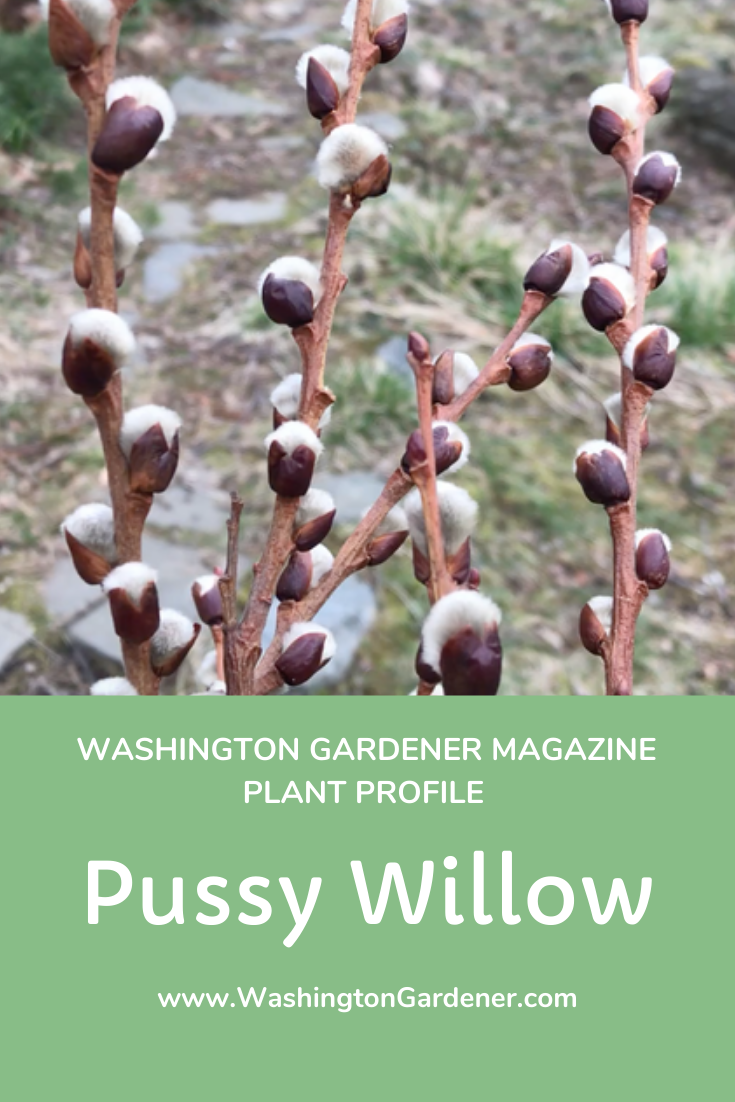
Plant Profile: Pussy Willows (Salix discolor)


The American Pussy Willow (Salix discolor) is a harbinger of spring. It makes a great decoration indoors or stuck in amongst other early spring flowers in a container. Yes, I said “other” flowers as the fluffy catkin is actually the flowering part of this plant.

Like its willow relatives, the Pussy Willow sends out deep tap roots and prefers a wet soil location. It also likes full sun and some room as it can get up to 20 feet high and 12 feet wide.

Pruning is advisable to control the size and shape of the Pussy Willow, which can be trained into either a tree or shrub form. You will want to prune it by taking cuttings for display indoors. Cut them before the yellow pollen appears and do not put them in water. They will dry and stay nice for several years.

To propagate and pass-along new Pussy Willow plants to others, just cut a branch in spring and stick it cut-end down into a pot of soil. It will quickly take root and can then be planted outside.

Another benefit to this native shrub is that it is the host plant of two native butterflies – the Mourning Cloak and the Viceroy – whose caterpillars sustain themselves on Pussy Willow foliage.

There are also non-native Pussy Willows that have been cultivated to produce a range of different catkin colors from the Japanese pink Pussy Willow (Salix gracilistyla) 'Mount Aso' to the sleek, black Pussy Willow (Salix gracilistyla) 'Melanostachys'.

Try planting a Pussy Willow in your garden today – you can grow that!

The video was produced by Washington Gardener Magazine and edited by intern Emily Coakley.

If you enjoy this video, please give it a thumbs up and subscribe to our Youtube channel (thank you!)

Remember to TURN ON notifications to know when our new videos are out

FIND Washington Gardener Magazine ONLINE
WashingtonGardener.blogspot.com
http://twitter.com/WDCGardener
https://www.instagram.com/wdcgardener/
facebook.com/WashingtonGardenerMagazine


Saturday, March 07, 2020

GardenDC Podcast Debut: Episode 1


‪Listen to the debut episode of my GardenDC podcast including a discussion with garden writer Marianne Willburn about the Philadelphia Flower Show, rose pruning, Edgeworthia, March gardening tasks, and more.

The episode is posted at: 
https://anchor.fm/kathy-jentz/episodes/March-7--2020-ebb59b


In the next few days it will also be shared on Spotify, Apple Music, and wherever you listen to your podcasts.

We are now on -

  • Google Podcasts at this link, either now or soon (note that currently, this link will only work on Android devices)

We welcome your questions and comments.
You can leave a voice mail message for us at: https://anchor.fm/kathy-jentz/message 
Note that we may use these messages on a future episode.


And YOU can become  a listener supporter for as little as $0.99 per month! See how at: https://anchor.fm/kathy-jentz/support. 


Wednesday, March 04, 2020

Plant Profile: Japanese Apricot (Prunus mume)


Prunus mume, commonly called Japanese apricot, are often mistaken for their cousins, the Japanese cherry tree.  However, the Japanese apricot blooms much earlier – usually from February to March in the Mid-Atlantic region. The Prunus mume flowers have more rounded petals than cherry blossoms and they are more fragrant as well.

It is native to China, Korea, and Japan. (You will also here it referred to as the Chinese plum or Japanese plum.)  This small tree grows to about 15-20 feet tall. It is winter hardy to USDA Zones 6-8. It prefers average soils with medium moisture that are well-drained, acidic loams.  It will not do well in heavy clay and poorly drained wet soils. Japanese apricot likes a location in full sun to part-shade, with best flowering in full sun.

The Japanese apricot is primarily grown for ornamental purposes, especially for those late winter blooms.  The flowers are followed by small, greenish-yellow fruits. The apricots ripen in summer and are technically edible, though very bitter if eaten straight from the tree. The fruits may be harvested for use in making jams and preserves.  In Japanese cuisine, the Prunus mume fruits are made into a mouth-puckering sour and salty pickled fruit treat.

This tree requires little care and if you need to prune it ever, do so immediately after it finishes flowering.

Try planting a Japanese Apricot tree in your garden today – you can grow that! 

The video was produced by Washington Gardener Magazine and edited by intern Emily Coakley.
If you enjoy this video, please give it a thumbs up and subscribe to our Youtube channel (thank you!)
Remember to TURN ON notifications to know when our new videos are out
FIND Washington Gardener Magazine ONLINE
WashingtonGardener.blogspot.com
http://twitter.com/WDCGardener
https://www.instagram.com/wdcgardener/
facebook.com/WashingtonGardenerMagazine


Sunday, March 01, 2020

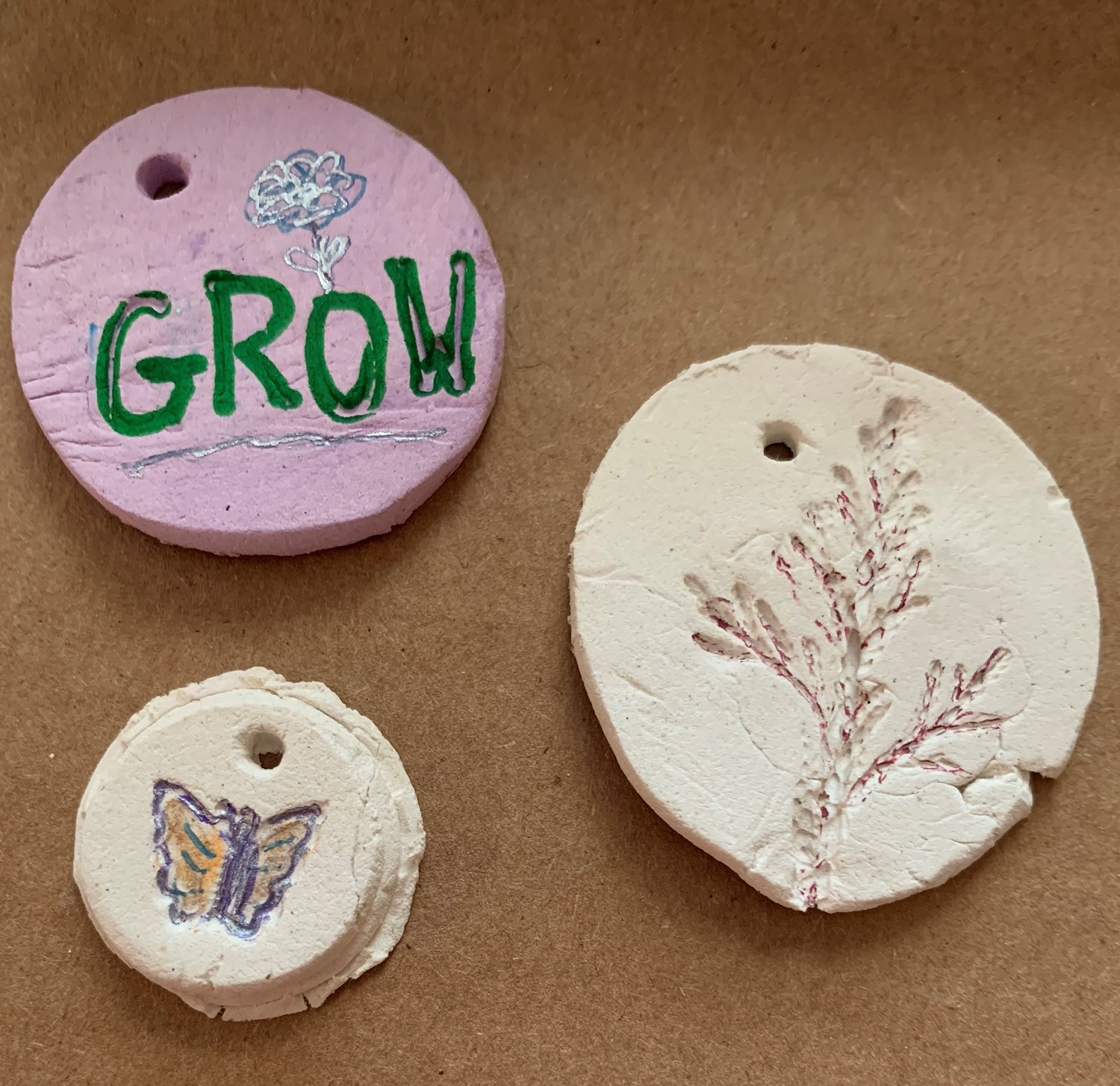
DIY: Stamped Relief Jewelry


If you are a baker, you probably have everything you need to make this craft on-hand. The only special material is the paper clay, which is amazingly easy to work with and does not require baking or any other treatment.

Level: easy
Cost: minimal
Use: holiday/gift/self

Materials:
Wax Paper
Paper Clay
Rolling Pin
Acrylic Craft Paint
Biscuit Cutter
Baking Sheet
Spatula
Skewer
Butterfly/Nature-shaped Stamps
Plant Stamps
Alphabet Stamps
Earring or Necklace Jump-rings
Cording
Gel Pens
Plant Sprigs from Your Garden (like rosemary)

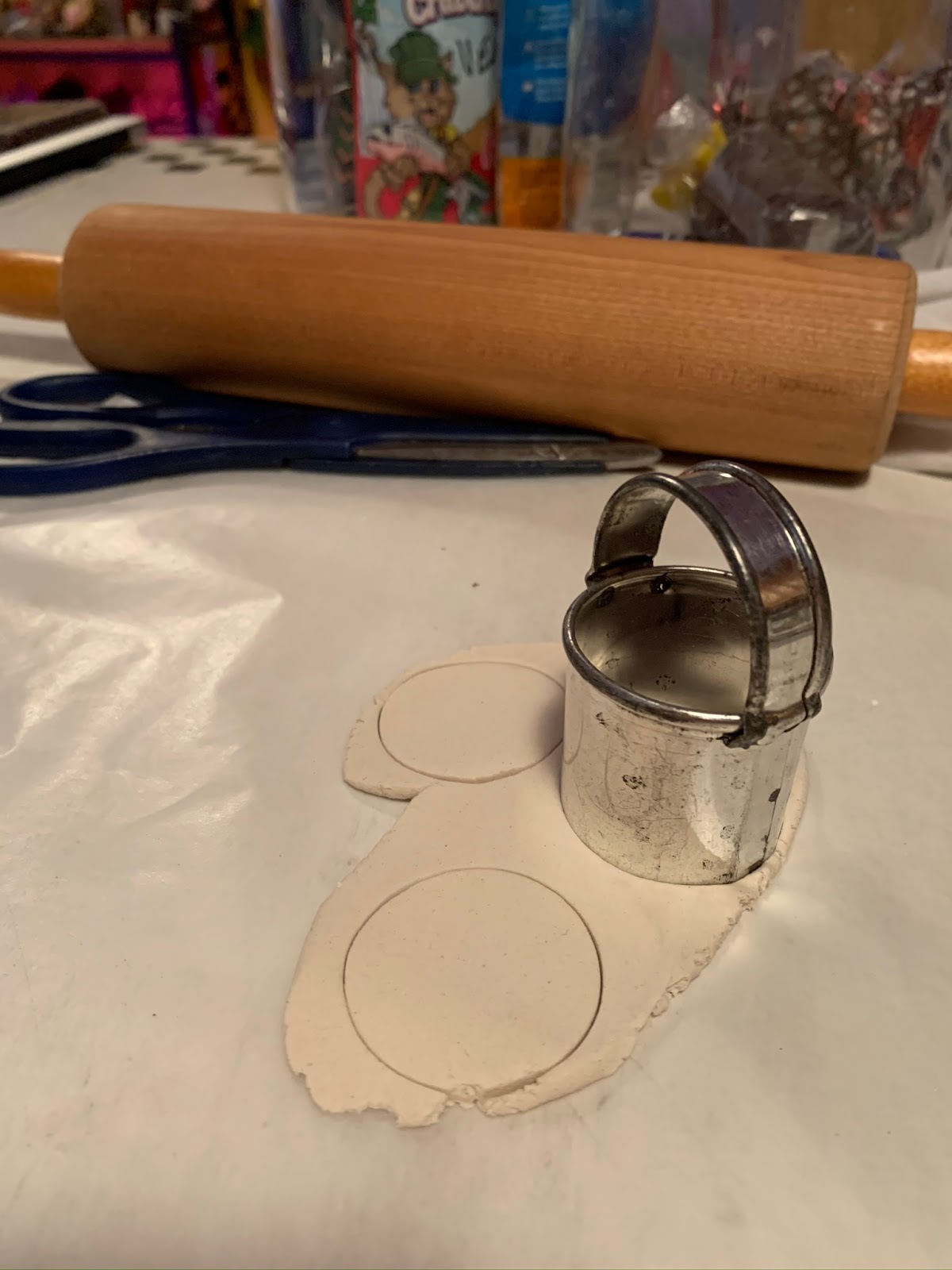
Step 1: On a sheet of wax paper, Take a section of paper clay and roll it out like a cookie dough. 

Step 2: Cut out circles with biscuit cutters. (For the smaller, earring-size circles we used a bottle cap.)

Step 3: Punch a hole at the top of the circle with the flat end of a skewer.

Step 4: Press in designs on the circles with plant sprigs or craft stamps. This may take a bit of practice to perfect as you don't want to press too hard and leave an impression from the edge of the stamps. (See tips below.)


Step 5: Carefully move the circles on the wax paper to a baking sheet and put another piece of waxed paper on top.  Then layer on a few books.

Step 6: Let dry for a week or so. 

Step 7: Paint or decorate as desired. We used gel pens, which helped with precision.

Step 8: String cord through the hole and tie the ends to wear as a necklace. Use a jewelry kit to put a jump-ring through the hole and create earrings. 

Tip 1: If you press in a sprig, use the skewer to gently lift it up so you don't damage your design. 

Tip 2: Each circle has two sides, so you can practice on one side and do your final design on the other. 

Tip 3: If you really dislike your design, just ball up the clay and re-roll it and start again at step 1.

Tip 4: The weight prevents warping as the circles dry, but don't make it too heavy as to squash your designs!

Optional: If you want color in your dough, add in a few drops of acrylic craft paint and knead it into the dough well. Note that this may take 5-10 minutes of kneading to thoroughly distribute the color.

This post contains affiliate links, which means that if you click on one of the product links, I’ll receive a few pennies from Amazon.

This is a monthly blog series on DIY projects for the beginning home gardener. Look for the other installments in this DIY blog series by putting "DIY" in the search box here at washingtongardener.blogspot.com


Wednesday, February 26, 2020

Gnomes and Fairies -- Oh My!


If you follow me on social media or this blog for a while, you've seen glimpses of my Gnome and Fairy collections. I am always on the look out for new characters to add to my garden. Here are a few fun ones from Twig & Flower. I think my favorites are the Ohm Gnome and the two fairy sisters with their ginger cat. Pictured above and below, they are posing in a couple spots in my late winter garden with their friends.

Twig & Flower has a store on Amazon.com where you can order these at: https://amzn.to/397iQh2

AND they have offered our followers 10% off when you use the code "10Washington" This offer will be good until 3/21/2020!


By the way, while you are over their shopping on Amazon. The Washington Gardener Amazon Store is at www.amazon.com/shop/wdcgardener - scroll down and hit "Fave Gardening Tools" for some of my tried-and-true garden helpers.

Featured Post

Holiday Gifts for Gardeners ~ Top Gardening Gifts ~ 21+ Cool Gardening Gift Ideas

The holiday season is here and I bet you have a gardener on your gift list, so we've   updated   our annual a Holiday Gifts for Gardener...

Most Popular Posts