In the December 2022 issue of Washington Gardener Magazine, reviewer Jim Dronenburg wrote, "... even if you never intend to have, wear, or grow an orchid, it is a fascinating read."
Our Fall 2023 club meeting will be on Thursday, November 30 from 6:30-8pm ET via Zoom.
The Washington Gardener Magazine's Garden Book Club meets quarterly via Zoom and is free and open to all. We will announce the details of each upcoming meeting about two months in advance. Please check back on this blog for schedule updates and announcements.
Want to read ahead? The next book club selections are
Winter 2023/24 - American Roots by Nick McCullough, Allison McCullough, and Teresa Woodard
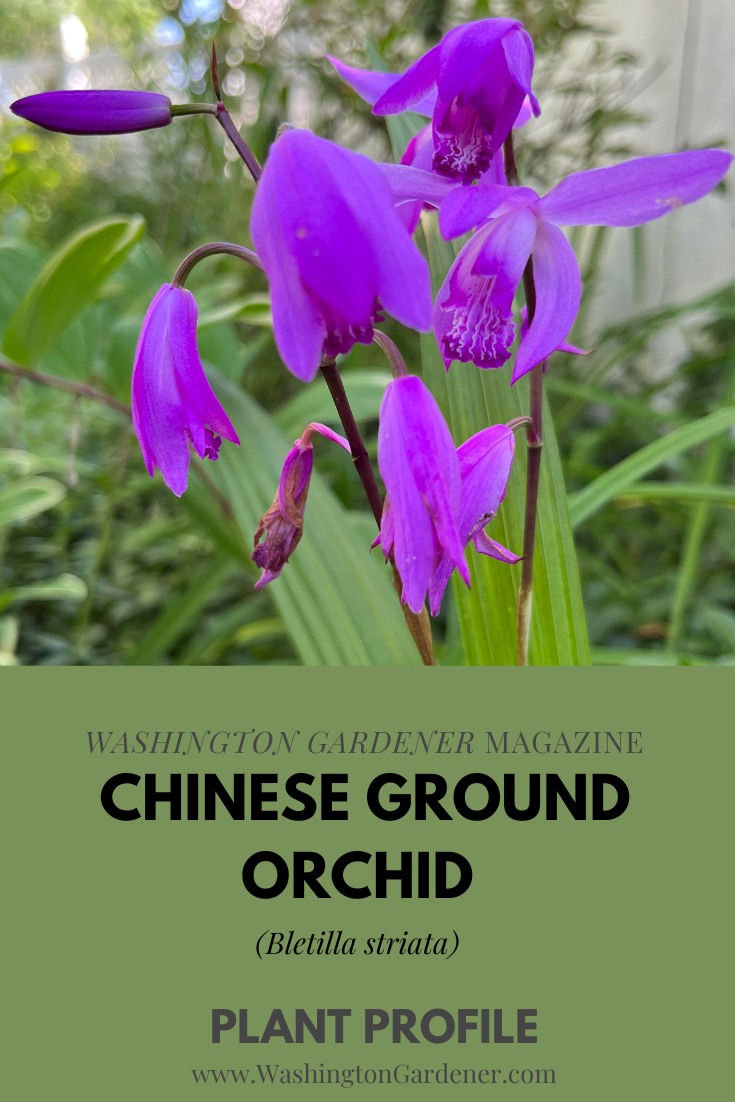
Bletilla (Bletilla striata) is also known as Chinese
ground orchid, Urn orchid, or Hyacinth orchid. This beautiful perennial plant
is known for its pink, purple, or white flowers that resemble a Cattleya
orchid. It is in fact a hardy terrestrial orchid.
It stays in bloom for several weeks in the
garden and makes a great cut-flower. This is an easy-to-grow and
low-maintenance plant. When not in bloom, the plant has elegant
tall, accordion-pleated foliage to admire.
Bletilla prefers to be planted in
well-draining soils amended with composted material. Give it a top dressing of
shredded leaves in spring and fall. It likes consistent moisture but not to sit
in wet ground. It does well in part shade out of the harsh afternoon sun.
It is hardy to USDA zones 5-8 and it is
reported to be deer-resistant.
Bletilla forms clumps over time that can be
divided and moved around the garden. Plant them shallowly (about one to three
inches in depth). It is best to buy mature plants. If you purchase them from
bare-root pseudobulbs, note that a new planting can take two to five years to
bloom.
Bletilla: You Can
Grow That!
The
video was produced by Washington Gardener Magazine as part of our Plant
Profile series for Mid-Atlantic USA gardeners.
Video, audio, and text by Kathy Jentz
➤ If you
enjoy this video, please give it a thumbs up and subscribe to our
Youtube channel (thank you!)
➤Remember
to TURN ON notifications to know when our new videos are out
This episode, we have a wide-ranging conversation with plantswoman Carol Allen about Orchids, Insects, Hummingbirds, and more. The plant profile is on Common Milkweed and I share why gardening has real value.
BTW, YOU can become a listener supporter for as little as $0.99 per month!See how at: https://anchor.fm/kathy-jentz/support.
The U.S. Botanic Garden
(USBG) presents Orchid Spectrum running through April 8, 2018. This annual
orchid exhibit, in partnership with Smithsonian Gardens, highlights the world's
largest plant family and the USBG's most extensive plant
collection.
Found on every
continent except Antarctica, orchids showcase a wide spectrum of diversity in
color, shape, size, habitat, scent, and many other aspects. Explore thousands
of amazing orchid blooms arranged in captivating displays, and appreciate many
unique, rarely seen orchids from the USBG's and Smithsonian Gardens' extensive
plant collections.
The exhibit celebrates
orchids through a large orchid arch filled with over 700 orchids, a hanging
curtain of colorful orchids overhead, a large orb made from 90 orchid plants,
more than 1,000 orchids mounted vertically on palms and columns in the Tropics
house. Throughout the Conservatory, discover stories such as orchid fragrances
from enticing to grotesque, the diversity of orchid habitats, conservation of
rare and endangered orchids, the spectrum of North American native orchids,
modern orchid growing techniques, and more.
During Orchid
Spectrum, the U.S. Botanic Garden will offer orchid-themed programs and
activities for adults and children, including orchid care demonstrations and
workshops, art and photography workshops, lectures on orchid diversity,
conservation, and more. Visit www.USBG.gov/OrchidSpectrum to
learn more about the exhibit and associated programs.
The U.S. Botanic
Garden is open to the public, free of charge, every day of the year from 10
a.m. to 5 p.m. The Conservatory is located at 100 Maryland Ave. SW, on the southwest side of
the U.S. Capitol. Visitors are encouraged to use Metrobus and Metrorail. More
information is available at www.USBG.gov.
View more photos from the exhibit here on our Facebook page.
It is a myth that all orchids are necessarily hard-to- grow,
expensive, and are only safe in the hands of experienced gardeners. The most
commonly available orchids are the Phalaenopsis or Moth Orchids. These
so-called “grocery store” orchids are tolerant of the conditions inside most
homes and make ideal “beginner” plants for first-time orchid growers. They are
also quite inexpensive now due to cloning or tissue-culture reproduction, which
has really brought down the prices of these plants in the last decade.
They have long-lasting blooms, often going for several
months. The height of their natural bloom season is from November through
March, but you will find them for purchase forced into bloom at all times of
the year.
Phalaenopsis orchids need lots of air movement, even
moisture, and several hours of indirect (but bright) sunlight each day. Avoid
direct sunlight, which is too harsh for them.
They prefer temperatures no lower than 60 and not much
higher than 85 degrees. They dislike sudden temperature changes. Cold
temperatures will cause the leaves to turn yellow and drop. If this occurs,
remove the yellow foliage and continue caring for the plant normally.
Water them when dry and allow the soil to dry out between
watering. The plant uses more water when
it is in flower. However, it does store moisture in its canes, and can
withstand short dry periods. Add a weak solution of liquid orchid fertilizer to
the water, but cut that back during its blooming time.
And whatever you do, don’t add ice! Despite what the
marketers tell you, these tropical plants do not appreciate freezing cold water
on their root zones.
Repot them every year or two in a slightly larger pot and
use a potting mix specifically formulated for orchids. Your orchids will also
appreciate a “summer vacation” outside in a lightly shaded spot, just remember
to bring them inside before a frost.
To see other videos in our Plant Profile series., go to: ~ Japanese Anemones - click here ~ Asters - click here ~ Toad Lily- click here ~ Pink Muhly Grass - click here
All who are involved with You Can Grow That! (YCGT!) believe that plants and gardening enhance our quality of life. We want people to be successful with what they grow and to become more aware of the many gifts that horticulture brings. Find out more at http://www.youcangrowthat.com/.
Our February 2012 Washington Gardener Magazine Reader Contest winners are:
~ Judy Thomas
~ Madeline Caliendo
~ Judith Daniel
~ Janet Benini
Janet said, "My favorite orchid is the purple paleopsis that I've had for 6 or 7 years. This year it has THREE spikes with a total of 16 blossoms (so far). It's in a window with a plant light above and a humidifier nearby and seems to be very happy! Thanks for the great work you do. I always look forward to receiving my Washington Gardener."
Judy T. noted, "Naming my favorite orchid is like naming my favorite child, near impossible. But I will share an orchid that I find fascinating, that I have never seen except in photographs: the ugly, Warty Hammer Orchid: it has an impossibly cool pollen-delivery method. I learned about it though John Alcock's An Enthusiasm for Orchids' Sex and Deception in Plant Evolution 2006, Oxford University Press."
They each receive two passes (valued at $44) to Orchids Galore! at the Lewis Ginter Botanical Gardens in Richmond, VA. Orchids Galore! running from March 10 - April 22. Hundreds of orchids will dazzle the senses with color, fragrance and beauty throughout the Garden’s Conservatory. Discover how orchids traveled from native habitats to become a popular fixture in many homes, including tales of plant explorers who traveled far and wide to collect these enchanting plants. Learn about current issues related to conservation and saving wild orchids threatened with extinction due to habitat loss and over-collection.
For our February 2012 Washington Gardener Magazine Reader Contest, Washington Gardener is giving away two sets of four passes each to Orchids Galore! at the Lewis Ginter Botanical Gardens in Richmond, VA. Orchids Galore! runs from March 10 - April 22.
Hundreds of orchids will dazzle the senses with color, fragrance and beauty throughout the Garden’s Conservatory. Discover how orchids traveled from native habitats to become a popular fixture in many homes, including tales of plant explorers who traveled far and wide to collect these enchanting plants. Learn about current issues related to conservation and saving wild orchids threatened with extinction due to habitat loss and over-collection.
To enter to win one of the four sets of two passes (valued at $40), send an email to WashingtonGardener@rcn.com by 5:00pm on February 29 with “Orchids Galore” in the subject line and tell us: what is your favorite orchid. In the body of the email, please also include your full name and mailing address. The winner will be announced and notified by March 2.