Friday, November 18, 2022

Fenton Friday: Frosty Returns

The parsley seedlings are up (see pic at right)! I cannot believe it as I had not expected to see them emerge for several more weeks after all the dire warnings about how slow it is to germinate.  

This week, the freezing temps settled in. The Dahlias, Celosia, and Zinnias are all toast. The Marigolds are barely hanging in. We pulled out the Biquinho peppers and the Okra and put a heavy layer of straw over that vacant bed. 

More Black Spanish winter radishes were harvested with just a few left in the ground to get a bit bigger. The Kale, Broccoli, Swiss Chard, and Peas are still all growing well.

Next week is Thanksgiving so we'll see if anything from the garden plot makes it to our holiday tables.

How did your garden do this week with the freezing temps? Are you done with your edible garden for the season?


About Fenton Friday: Every Friday during the growing season, I'll be giving you an update on my community garden plot at the Fenton Street Community Garden just across the street from my house in zone 7 Mid-Atlantic MD/DC border. I'm plot #16. It is a 10 ft x 20 ft space and this is our 11th year in the garden. (It opened in May 2011.) See past posts about our edible garden by putting "Fenton" into the Search box above.

Wednesday, November 16, 2022

American Persimmon Tree Plant Profile

American Persimmon Tree Plant Profile

American Persimmon Tree (Diospyros virginiana) is a small fruit tree that is native to most of the Eastern and Midwestern United States. It is also known as the Common Persimmon, Eastern Persimmon, Possum Apple, Possumwood, Winter Plum, Jove's Fruit, or Native Persimmon.

It grows best in moist, sandy soils, but it is fairly adaptable. It can tolerate light shade. You will need a nearby male tree to have a fruiting female one, though there are native cultivars available now that are bred to be self-fertile including  ‘Yates’, ‘Prok’, and ‘Meade’.

This highly ornamental tree has oval leaves that are a glossy dark-green. They turn golden yellow in the fall before dropping. The bark is dark gray and has an interesting texture that resembles alligator hide.

The persimmon tree’s fruit becomes orange to reddish-purple when it is ripe. Do not consume it until it has matured fully and you’ll know when it is ripe as the fruits will fall to the ground. Those who try to eat the fruits before they are ready learn their lesson as the bitter and astringent tannins will pucker up their mouths in a very unpleasant way.

The fruit is difficult to store and transport so you will not commonly find it for sale. If you are lucky enough to gather enough, it is used to make syrups, jellies, and puddings.

Persimmons are also consumed by birds, deer, raccoon, opossum, and fox.

The tree can be propagated from seeds or root cuttings. Due to its deep tap root, it is difficult to move or transplant it once it is established.

American Persimmon Tree: You Can Grow That!

The video was produced by Washington Gardener Magazine as part of our Plant Profile series for Mid-Atlantic USA gardeners.

Audio and text by Kathy Jentz

Video and editing by Brandie Bland

For much more about growing persimmons, see: 

https://washingtongardener.blogspot.com/2021/11/gardendc-podcast-episode-82-persimmons.html

 If you enjoy this video, please give it a thumbs up and subscribe to our Youtube channel (thank you!)

Remember to TURN ON notifications to know when our new videos are out

 FIND Washington Gardener Magazine ONLINE

WashingtonGardener.blogspot.com

http://twitter.com/WDCGardener

https://www.instagram.com/wdcgardener/

~ Facebook.com/WashingtonGardenerMagazine

~ Podcast: GardenDC

PIN THIS FOR LATER!

Monday, November 14, 2022

Saturday, November 12, 2022

GardenDC Podcast Episode 128: Ornamental Grasses and Sedges

In this episode of GardenDC: The Podcast about Mid-Atlantic Gardening, we talk with Shannon Currey of Izel Plants all about ornamental grasses and sedges. The plant profile is on American Persimmon Trees and we share what's going on in the garden as well as some upcoming local gardening events in the What's New segment. We close out with Doug Oster, who shares the Last Word on his Daffodil Obsession.

BTW, YOU can become a listener supporter for as little as $0.99 per month! See how at: https://anchor.fm/gardendc/support.

Show Notes:
01:06 Introducing Shannon Currey of Izel Plants 01:50 Shannon's career trajectory from people to plants 04:51 What goes into being "grass-like" 07:15 What's growing in Shannon's garden 09;30 Grasses vs Sedges 14:05 What to look for vis a vis grasses and sedges 18:40 Are there any native edible grasses 20:40 How to care for lackluster plantings 22:31 "If you baby them, you actually cause them to grow really lushly and then flop over. The better approach is actually you put them in a tough spot." -Shannon 25:30 Pet peeves and ideal conditions 32:00 what to do about cutting and weeding grass 35:33 ‘Pink Muhly’ 36:56 ‘Little bluestem’ 39:22 ‘Mexican feather grass’ 40:56 'Pennsylvanica' 42:07 Shannon's favorites 43:58 Non-native shout outs 47:43 How to get in touch with Shannon 48:41 "Grasses are a great way to have landscapes that do more for us ecologically. They are a good solution for a lot of common environmental challenges.” -Shannon 49:04 This week's plant profile is… American Persimmon Tree! 51:13 What's new in the garden? Bulbs, Lettuce, and late bloomers 51:43 What's going on around town? Gardening club, online workshop, horticulture classes, and holiday happenings 55:47 The Last Word – My Daffodil Obsession by Doug Oster

If you liked this episode, you may also enjoy listening to:

We welcome your questions and comments! You can leave a voice mail message for us at: https://anchor.fm/gardendc/message Note that we may use these messages on a future episode.

And be sure to leave us a 5-star review on your favorite platform so other gardeners can find us too!

Episode Credits:
Host and Producer: Kathy Jentz
Editing: Brandie Bland
Show Notes: Jaime Breeden

PIN THIS FOR LATER!

Friday, November 11, 2022

Fenton Friday: Lettuce Rejoice!

This week, I harvested a bag full of the 'Bauer' lettuce that I planted around September 23. I also discovered some Arugula had reseeded itself under the thick stand of Zinnias and grown very well in their shadow. (This might be a technique to actually duplicate next summer!) I cut a few leaves from the Arugula and hope to add them to a pizza this weekend.

We had another very balmy weather week. Today it is raining and I am thankful for that as the cistern at the garden is empty and will not be refilled anymore until next spring, so any water we want to put on our seedlings and plants has to be carried in -- which is not a fun chore.

We harvested some more of the Biquinho peppers and the Okra put out a few flowers -- but I think those are both going to be pulled this week looking at the cold forecast in store for us. 

The Kale, Broccoli, Swiss Chard, and Peas are all growing well. They are mostly under cover cloths or in protected spots, so I'm not too worried about them and the coming frost/freezes.

About Fenton Friday: Every Friday during the growing season, I'll be giving you an update on my community garden plot at the Fenton Street Community Garden just across the street from my house in zone 7 Mid-Atlantic MD/DC border. I'm plot #16. It is a 10 ft x 20 ft space and this is our 11th year in the garden. (It opened in May 2011.) See past posts about our edible garden by putting "Fenton" into the Search box above.

Wednesday, November 09, 2022

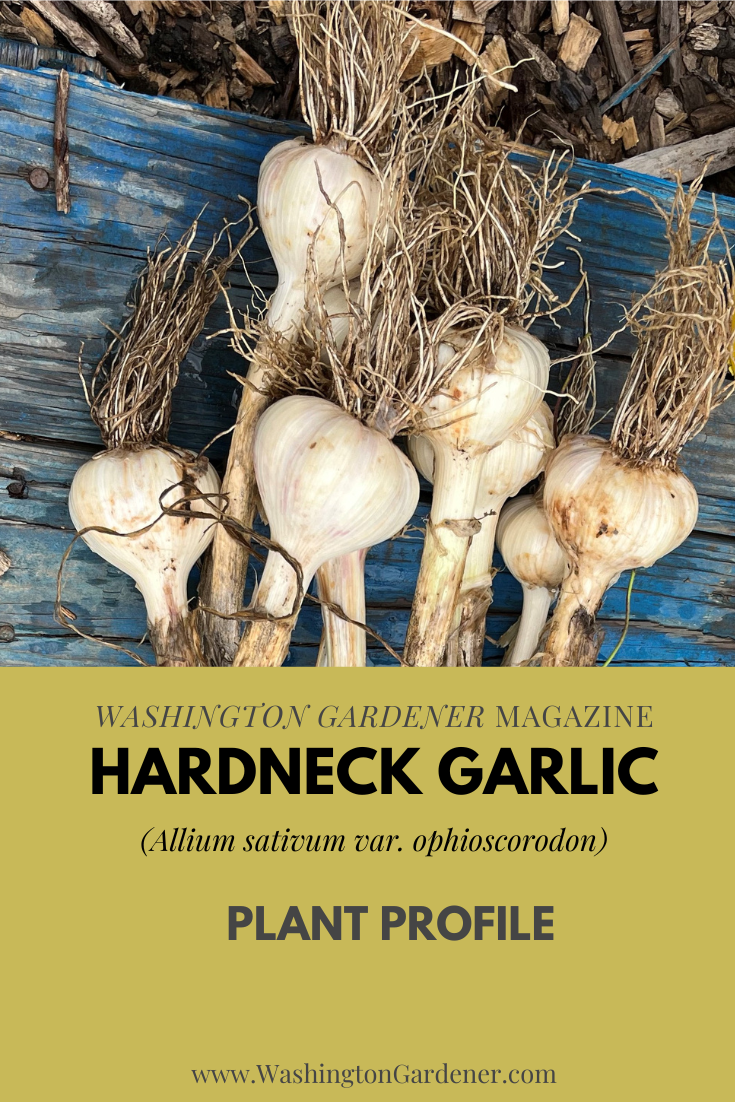
Garlic Plant Profile

Garlic Plant Profile

Garlic is an edible member of the onion family and one of the easiest plants to grow. Its region of origin is unclear, but it has been grown in Europe and the Mediterranean for thousands of years.

Hardneck garlic types (Allium sativum var. ophioscorodon) do best in the Mid-Atlantic where there’s a real winter and distinct four seasons. ‘Purple Stripe’, ‘German White’, and ‘Music’ are some reliable varieties.

Around the end of October, plant your seed garlic in well-draining soil in full sun. Insert the cloves root-side down (pointy-side up) about 6 inches apart on center, burying the tips about 2 inches down. Green shoots will come up in a few weeks; mulch around them with straw. Keep the bed weed-free so the garlic can develop a healthy root system.

Hardneck garlic will form curling scapes by mid-May. Cut them off and use in recipes as you would scallions or garlic. This will direct the plants energy into making a larger bulb, rather than flowering and forming seeds.

The bulbs are usually ready to harvest by the end of June when most of the lower leaves have browned. The upper ones can still look green. Be careful when harvesting garlic as those bulb heads are more delicate than they seem. Choose an overcast day when the soil is dry. Loosen the soil with a digging fork, inserting it well away from the heads, then lift them out of the ground gently and shake off any excess soil.

Let the whole plants dry in a single layer out of the sun, where it’s warm, but not too hot. When the outer skin turns papery after a couple weeks of curing, brush off as much dirt as possible and clip off the shaggy roots.

The ideal temperature for storing garlic is between 55 and 70 degrees F, with moderate humidity and good air circulation (in other words, not in plastic bags) and out of direct sunlight.

Garlic: You Can Grow That!

The video was produced by Washington Gardener Magazine as part of our Plant Profile series for Mid-Atlantic USA gardeners.

Audio and text by Kathy Jentz

Video and editing by Brandie Bland


 If you enjoy this video, please give it a thumbs up and subscribe to our Youtube channel (thank you!)

Remember to TURN ON notifications to know when our new videos are out

 FIND Washington Gardener Magazine ONLINE

WashingtonGardener.blogspot.com

http://twitter.com/WDCGardener

https://www.instagram.com/wdcgardener/

~ Facebook.com/WashingtonGardenerMagazine

~ Podcast: GardenDC

PIN THIS FOR LATER!

Tuesday, November 08, 2022

Groundcover Revolution: How to Use Sustainable, Low-Maintenance, Low-Water Groundcovers to Replace Your Turf


Tired of spending your weekends mowing, trimming, and edging? Then it's time to say goodbye to your standard grass lawn and join the Groundcover Revolution!

Turns out you're not alone in your desire to ditch the lawn and replace it with something prettier, more diverse, lower maintenance, welcoming to pollinators, and good for Earth's climate health. Reducing the lawn is among the biggest trends in homeownership, with an endless stream of homeowners looking for an eco-friendly alternative to a traditional turfgrass lawn. In the last few years alone, over 23 million American adults converted part of their lawn to a natural landscape, and now they're looking to do even more.

The biggest challenge to adopting this new ideal of the perfect lawn? Knowing how and when to replace your turf, and which plants are the best ones for the jobGroundcover Revolution is here with all the answers you need (and some you didn't even know you needed!).

Those answers include:

  • How replacing a lawn with groundcovers reduces resource consumption on a significant level
  • Why groundcovers require far less long-term maintenance than turf after establishment
  • The many additional benefits of groundcovers, including erosion control, a reduction in chemical usage, a boost in biodiversity, and mitigation of climate change as a carbon sink
  • The ways groundcovers overcome challenges such as tree roots, compacted soils, poor drainage, and dense shade
  • The step-by-step mechanics of how to get rid of your lawn, how to place and plant groundcovers from seeds, plugs, or transplants, and how to care for your new "quilted lawn" once it's in place


Also included are 40 in-depth profiles of plants that are perfect choices for replacing a grass lawn. There are options for sun, for shade, for dry and wet sites, and for various climates around the globe. There are choices that bloom, options that are evergreen, and selections that are deer resistant. Author Kathy Jentz has also included an incredibly useful chart that gives you all the specifics on each of the 40 choices for quick reference and to make your groundcover selection process even easier.

Don't let a lack of information stop you from creating the no-mow groundcover lawn of your dreams. Join the revolution and say goodbye to the burden of lawn care and hello to summer weekends relaxing by the pool or camping with family and friends. Whether you want to replace the entire lawn or just reduce the amount of land dedicated to turf, it's time to usher in a new and improved idea of what a beautiful lawn should be.


It is available for pre-order now at https://amzn.to/3fIdLo6
If you'd rather not order from Amazon, you can order it also at https://bookshop.org/a/79479/9780760378151

Saturday, November 05, 2022

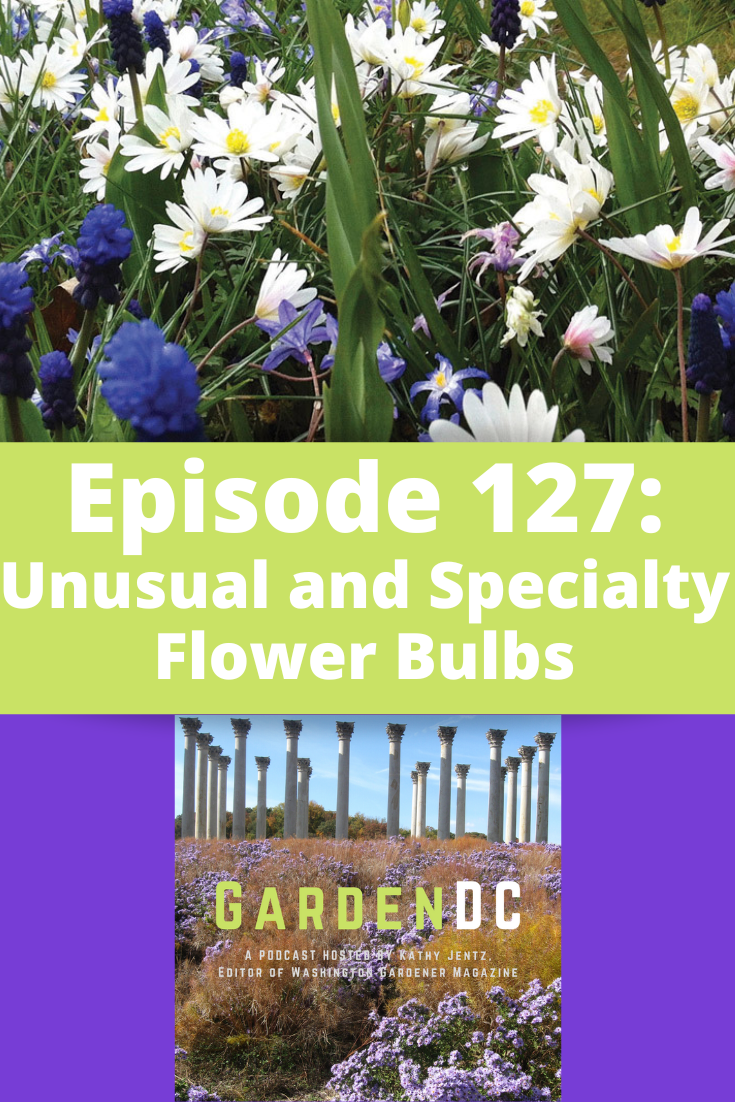
GardenDC Podcast Episode 127: Unusual and Specialty Flower Bulbs with Brent Heath

In this episode of GardenDC: The Podcast about Mid-Atlantic Gardening, we talk with Brent Heath of Brent and Becky's Bulbs all about lesser-known bulbs. The plant profile is on Garlic and we share what's going on in the garden as well as some upcoming local gardening events in the What's New segment. Dr. Allan Armitage shares The Last Word on Joe-Pye Weed. He is also offering a discount for free domestic shipping starting on November 7, 2022, and expiring on December 6, 2022, at allanarmitage.net enter code LAST WORD at checkout.


BTW, YOU can become a listener supporter for as little as $0.99 per month! See how at: https://anchor.fm/gardendc/support.

Show Notes: 01:17 Introducing Brent Heath of Brent and Becky's Bulbs 02:14 A brief history of Brett and Becky's bulbs 05:18 What's growing down there like? 08:43 What makes a specialty bulb? 10:31 Colchicum 12:35 Fall crocus / saffron crocus 15:50 Cyclamen 19:47 Snowdrop / Galanthus 21:13 "We tend to forget about the leaves. The leaves are the cake; the flowers are just the icing." -Brent 24:11 Sternbergia / Autumn Daffodil 27:12 Alliums 35:47 Anemones 41:06 Arum 43:12 Camassia flower 46:13 Eranthis to Eremurus to Fritillaria 57:07 How to get in touch with Brent 1:00:32 “Plant a lot of bulbs, harvest a lot of smiles. If more people planted bulbs, I believe we could have world peace.” -Brent: 1:01:00 This week’s plant profile… Garlic! 1:03:23 What’s new in the Garden? Nippon daisy, black spanish radish, and white german garlic 1:04:01 What’s going on around town? Pumpkin smash, Online talks, Christmas at Longwood, and wreath workshopsat Tudor Place 1:07:29 The Last Word on Joe-Pye Weed from Dr. Allan Armitage

If you liked this episode, you may also enjoy listening to:


We welcome your questions and comments! You can leave a voice mail message for us at: https://anchor.fm/gardendc/message Note that we may use these messages on a future episode.

And be sure to leave us a 5-star review on your favorite platform so other gardeners can find us too!

Episode Credits:
Host and Producer: Kathy Jentz
Editing: Brandie Bland
Show Notes: Jaime Breeden

PIN THIS FOR LATER!

Featured Post

Holiday Gifts for Gardeners ~ Top Gardening Gifts ~ 21+ Cool Gardening Gift Ideas

The holiday season is here and I bet you have a gardener on your gift list, so we've   updated   our annual Holiday Gifts for Gardeners ...

Most Popular Posts