Thursday, May 21, 2020
Win Bloomables Plants from Star Roses in the May 2020 Washington Gardener Reader Contest
For our May 2020 Washington Gardener Reader Contest, Washington Gardener is giving away three (3) different Bloomables plants chosen by Star Roses to one lucky winner (prize value: $90)!
Win a selection of plants from Star® Roses & Plants new Bloomables® collection! With more than 35 varieties of Star Roses’ best flowering roses and woodies to choose from, these varieties are easy to grow and offer high rewards in the garden. Bloomables have it all: Bright colors, unique textures, and of course, amazing blooms, make this collection stand out! Check out the collection at www.bloomables.com.
To enter to win the set of three Bloomables from Star Roses plants, send an email to WashingtonGardenerMagazine@gmail.com by 5:00pm on Sunday, May 31, with “Bloomables from Star Roses” in the subject line and in the body of the email. Tell us what your favorite article was in the May 2020 issue and why. Include your full name and address. Winners will be announced on June 1.
UPDATE: The winner chosen at random from the submitted entries is Barbara Delaney of
Bethesda, MD. Congratulations, Barbara!
Wednesday, May 20, 2020
Plant Profile: Fringetree (Chionanthus virginicus)
The Fringetree is a small tree that is native to the
Eastern United States.
The “fringe” of this tree refers to the long, white,
clusters of drooping flowers in late spring. They are mildly fragrant and give
it its alternate common name of “Old Man’s Beard.”
It prefers moist, but well-draining and fertile soil. It
flowers best in full-sun to part-shade. It typically reaches between 12 to 20
feet tall.
Deer love to munch on it, so keep it protected while it
is still young and small. Once it gains its height, the deer cannot reach those
yummy leaves.
This tree seldom needs pruning and is tolerant of air
pollution, so it makes a good choice for urban gardens.
A Fringetree can be male or female—the male version being
the one with slightly showier flowers. The female tree’s flowers, if fertilized,
produce clusters of olive-like fruits in late summer that are a desirable food
source for birds and wildlife.
Fringetree looks especially beautiful set against a
backdrop of dark evergreen trees and its white blossoms practically glow in the
moonlight.
There is a Chinese fringetree (Chionanthus retusus) that is
very similar in appearance to our native species. The native one has smooth
bark, while the Asian one has bark with furrows of dark brown
and light gray.
Fringetree - You Can Grow That!
Read more about Fringetree in the November 2014 issue of Washington Gardener Magazine.
The video was produced
by Washington Gardener Magazine.
➤ If you enjoy this video, please give it a thumbs up
and subscribe to our Youtube
channel (thank you!)
➤Remember to TURN ON notifications to know when our new
videos are out
➤ FIND Washington Gardener Magazine ONLINE
~ Facebook.com/WashingtonGardenerMagazine
Tuesday, May 19, 2020
May 2020 issue of Washington Gardener Magazine – Harvest Times, Low-Maintenance Perennials, Native Twinleaf, and much more…
Inside this issue:
·
When is the Right Time to Harvest?
·
7 Perennials that Work Hard for YOU
·
The Science Behind the Smell of Spring
·
New Tomato Virus Alert
·
10 Tips for Growing Victory Gardens in
Containers
·
What to Do in the Garden this Month
·
Native Twinleaf: A Plant Fit for a President
· Mill Pond Garden: A Tiny Treasure in Delaware
· Longwood Gardens Selects Two Locals as Fellows
·
and much more…
Note that any submissions, event listings, and
advertisements for the June 2020 issue are due by June 5.
>> Subscribe
to Washington Gardener Magazine today to have the monthly publication sent to your inbox as a PDF
several days before it is available online. You can use the PayPal (credit
card) online order form here: http://www.washingtongardener.com/index_files/subscribe.htm
Help Us Stay Out of Spam Folders!
The following things will help Washington Gardener avoid your spam folder.
~ Add washingtongardenermagazine@gmail.com to
your address/contact list.
~Mark as "not spam" or "never block
sender" if found in your spam folder.
Upcoming Webinars: Can’t Fail Container Gardening and Winning the War on Weeds
Webinar: Can’t Fail Container Gardening Basics and Beyond
Wednesday, May 27 at 7:00pm ET via Zoom
Instructor: Kathy Jentz, Editor of Washington Gardener Magazine
Wednesday, May 27 at 7:00pm ET via Zoom
Instructor: Kathy Jentz, Editor of Washington Gardener Magazine
Introductory Fee: $10From what type of soils to use to what plants do best in our
region, Kathy will cover the basics of growing successful container plantings.
She will also cover both ornamental and edible containers as well as the different
styles and fashions in container gardening.
Register at: https://py.pl/2WL7ArxVKnM
Webinar: Winning the War on Weeds
Register at: https://py.pl/2WL7ArxVKnM
Saturday, June 6 at 10:00am – 11:30am ET via Microsoft Teams
Instructor: Kathy Jentz, Editor of Washington Gardener Magazine
Fee: $10 / Discounted Fee for FOBG Members: $8
Tired of fighting the never-ending weed war year after year in your garden? Fear no more as this workshop will explore proven ways to combat weeds and keep them controllable, while still being able to enjoy your garden. This talk will also review a list of the "Dirty Dozen" weeds, which are the worst challenges to fight off in our local gardens. Learn labor-saving tools, best timing for maximizing efforts and tips for preventing future weeds.Saturday, May 16, 2020
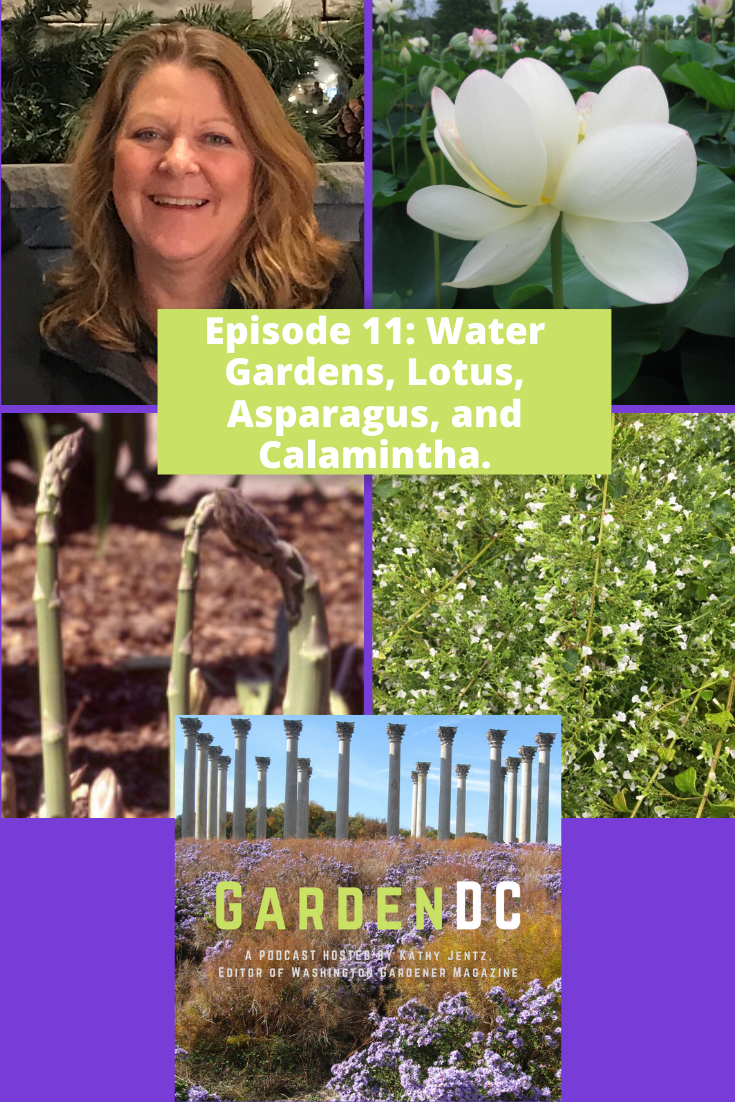
GardenDC Podcast Episode 11: Lotus, Harvesting Asparagus, and a Profile of Calamintha
This episode, we chat with Kelly Billing of Water Becomes a Garden about Lotus, and I answer a listener question on harvesting Asparagus. The plant profile is on Calamintha (Calamintha nepeta).
![]() |
| Kelly Billing and her lotus rt |
BTW, YOU can become a listener supporter for as little as $0.99 per month!See how at: https://anchor.fm/kathy-jentz/support.
It is also available on -
- RadioPublic: https://radiopublic.com/
gardendc-G2ql5V
- Breaker: https://www.breaker.audio/
gardendc
- PocketCasts: https://pca.st/9phvd8bk
- Google Podcasts at this link, either now or soon (note that currently, this link will only work on Android devices)
We welcome your questions and comments!
You can leave a voice mail message for us at: https://anchor.fm/kathy-jentz/message Note that we may use these messages on a future episode.
You can also read more about Kelly in the August 2018 issue of Washington Gardener Magazine.
Pin this for later:
Friday, May 15, 2020
Fenton Friday: A Leap Forward
![]() |
| first ripe strawberry of the season |
The peas are flowering and I cannot wait for those pods!
The strawberries are ripening and because I have zero patience, I grabbed that first one and ate it already. It was a tad under-ripe, but still darn good!
I cut enough spinach and lettuce for a lunch salad earlier this week. I should be able to do two more cuttings (at least) until those are spent.
The carrots and the beets are forming nicely. I will dig a few in a few weeks to test them out for size.
Unfortunately, that does mean many of the cool season vegetables are now bolting (going to flower) -- that includes the kale, cilantro, and radishes. I will let the radishes set seed so I can collect them to plant next year. for giving away at SeedSwapDay, and for trying in a salad -- as I've heard the radish seeds are edible, though have not eaten them myself.
![]() |
| pea plants flowering |
![]() |
| Radished bolting |
![]() |
| 'Satina' seed potatoes |
One of the highlights of the week was receiving a small box of 'Satina' seed potatoes ordered from the Maine Potato Lady by our Washington Gardener Magazine "EdbleHarvest "columnist Elizabeth Olson. I hope to plant them early next week.
The other nice surprise was finding several ladybugs around my plot -- maybe another plot owner released them?
![]() |
| ladybug |
About Fenton Friday: Every Friday during the growing season, I'll be giving you an update on my community garden plot at the Fenton Street Community Garden just across the street from my house in zone 7 Mid-Atlantic MD/DC border. I'm plot #16. It is a 10 ft x 20 ft space and this is our 8th year in the garden. (It opened in May 2011.) See past posts about our edible garden by putting "Fenton" into the Search box above.
A Warm Welcome to Bloom Day!
![]() |
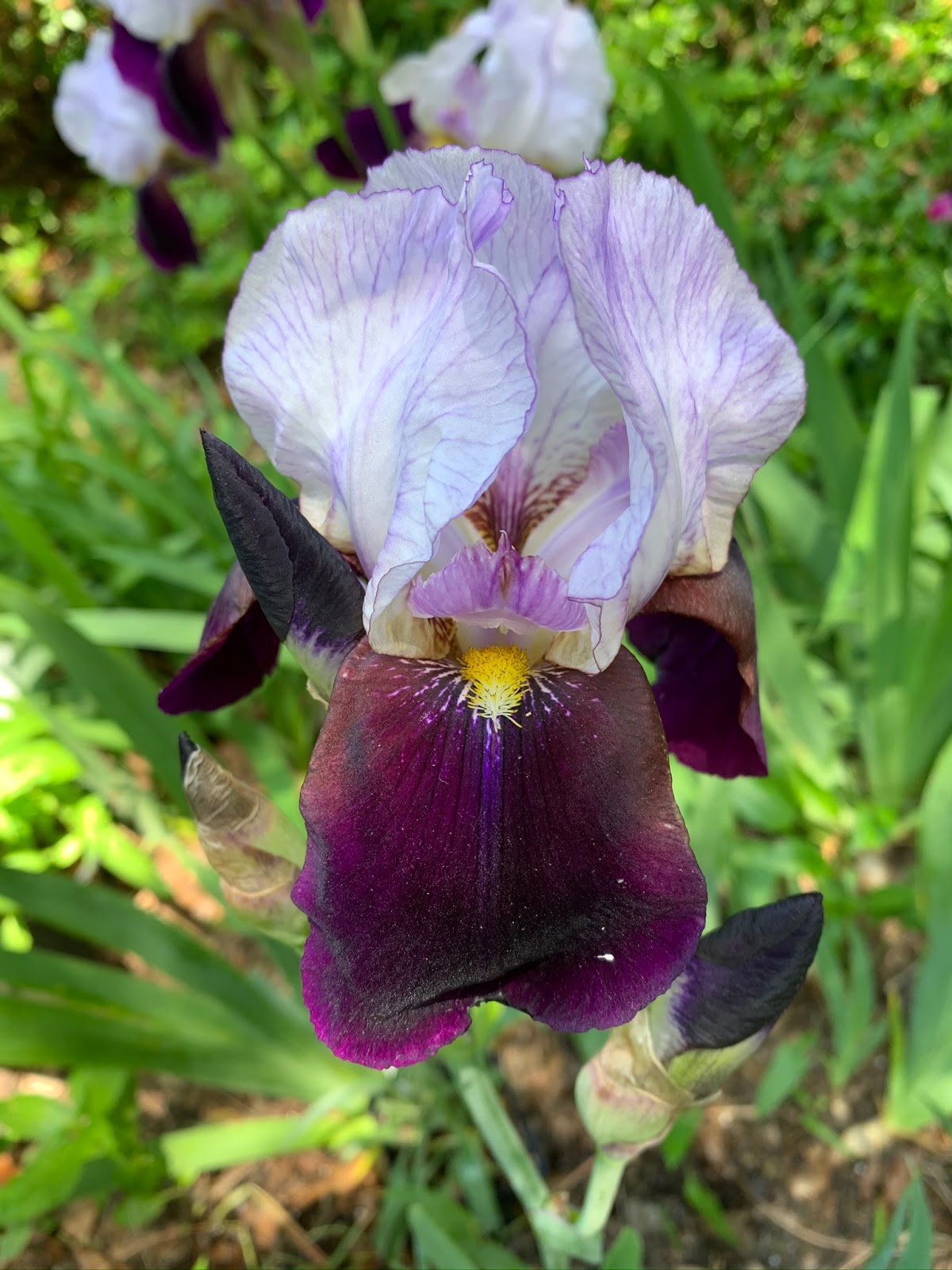
| bearded iris |
Pictured here is a bearded iris that I got from another gardener years ago. It came with no name, so I have no idea on the variety. In my head, I call it "grape bubble yum" as that is what it smells like to me.
Over at my Instagram account, I have posted many more blooms in the last few days that you can check including:
- Clematis 'Silver Moon'
- Clematis 'Taiga'
- Hardy Geranium (Geranium sanguineum) 'Pink Summer'
- Allium ‘Globemaster’
- several different weigela shrubs
and I will be sharing many more bloom photos in the coming weeks.
What is blooming in YOUR garden today?
Wednesday, May 13, 2020
Plant Profile: Lily of the Valley
When I picked up some Lily of the Valley (Convallaria majalis) pips from a garden club plant exchange years ago, I wanted a spot for them that was well away from other planting beds because I had been warned about how this plant can take over and be very aggressive. Just to get them in the ground quickly, I stuck them in an empty, dry shade area next to my home’s foundation. To my surprise, not only did they survive, but they actually thrived!
Their spreading tendencies are kept in check by being in that dry, full-shade spot. Give them better growing conditions at your own peril.
They are the definition of low-maintenance. At the beginning of spring, I rake out the old, tattered foliage from their beds and sprinkle in some leaf compost. This isn’t necessary, but it keeps the bed looking neat. Other than that, the only care they need is to pluck out the occasional weed in their midst.
The scent of their blooms in spring is lemony fresh. To pick some Lily of the Valley flowers to enjoy indoors, grasp the stem down at the base and then pull firmly upward in one smooth motion.
Note that they are poisonous and should be kept away from small children and pets.
Over the years, I have collected the pink version of Lily of the Valley as well as one with variegated foliage.
There is a native version, Convallaria majuscule ‘Greene’, that is almost impossible to differentiate from the Eurasian import unless they are side by side. The American one is a bit taller and can be found in the Appalachian woodlands in discrete clumps of just a few plants, rather than in a large patch.
I highly recommend this sweet little flower to beginning gardeners who want an early success to give them confidence to tackle more labor-intensive plantings.
Lily of the Valley -
You Can Grow That!
The video was produced by Washington Gardener Magazine.
➤ If you enjoy this video, please give it a thumbs up and subscribe to our Youtube channel (thank you!)
➤Remember to TURN ON notifications to know when our new videos are out
➤ FIND Washington Gardener Magazine ONLINE
~ WashingtonGardener.blogspot.com
~ http://twitter.com/WDCGardener
~ https://www.instagram.com/wdcgardener/
~ facebook.com/WashingtonGardenerMagazine
~ Podcast: GardenDC on Spotify, Apple, etc.
If you liked this video, you may enjoy these other plant profiles:
~ Virginia Bluebells Plant Profile
https://washingtongardener.blogspot.com/2018/04/plant-profile-virginia-bluebells.html
~ Baptisia Plant Profile
https://washingtongardener.blogspot.com/2023/07/baptisia-plant-profile.html
~ Spring Beauty Plant Profile
https://washingtongardener.blogspot.com/2020/04/plant-profile-spring-beauty-claytonia.html
Saturday, May 09, 2020
GardenDC Podcast Episode 10: Peppers, Fothergilla, and Rachel Carson's Home
This episode, we chat with Peter Pepper about growing Peppers and I describe my visit to Rachel Carson's home a few years ago. Also, I share what is blooming in my garden and the plant profile is on fothergilla.
We welcome your questions and comments!
You can leave a voice mail message for us at: https://anchor.fm/kathy-jentz/message Note that we may use these messages on a future episode.
BTW, YOU can become a listener supporter for as little as $0.99 per month!See how at: https://anchor.fm/kathy-jentz/support.
The episode is posted at: https://anchor.fm/kathy-jentz/episodes/May-9--2020-edq60b
It is also available on -
- RadioPublic: https://radiopublic.com/
gardendc-G2ql5V
- Breaker: https://www.breaker.audio/
gardendc
- PocketCasts: https://pca.st/9phvd8bk
- Google Podcasts at this link, either now or soon (note that currently, this link will only work on Android devices)
We welcome your questions and comments!
You can leave a voice mail message for us at: https://anchor.fm/kathy-jentz/message Note that we may use these messages on a future episode.
Friday, May 08, 2020
Fenton Friday: Frozen in Time
Tonight and tomorrow night we have another late freeze warning. This is unusually late and I was just sent a few tomato plants among other edibles to trial. They are all under a blanket in a corner of my home garden and I hope they make it through okay.
The lettuces are doing nicely in the plot and I am ready to make my first harvest from the Renee's Garden Baby Leaf Lettuce Heirloom Cutting Mix and I dug up a bunch of radishes to share with family members today.
What are you harvesting this month in your edible garden?
About Fenton Friday: Every Friday during the growing season, I'll be giving you an update on my community garden plot at the Fenton Street Community Garden just across the street from my house in zone 7 Mid-Atlantic MD/DC border. I'm plot #16. It is a 10 ft x 20 ft space and this is our 8th year in the garden. (It opened in May 2011.) See past posts about our edible garden by putting "Fenton" into the Search box above.
Wednesday, May 06, 2020
Plant Profile: Lilac (Syringa vulgaris)
The Lilac is a large, ornamental shrub whose flowers emit one of the most beautiful scents found in nature. On a sunny, breezy day, I can smell the lilacs in my side yard all the way down the block.
The Mid-Atlantic area is pretty much the southern most region that lilacs can flourish in, because they need to experience a winter freeze and like a temperate climate. They prefer a sunny, well-ventilated location and can take almost all soil types.
The only real problem for them in our region is that they are prone to powdery mildew. In our humid climate, most show signs of it by late summer. It will not kill the plant; it is just unsightly.
Remember to prune them after they finish flowering. Trim the bush to shape it and remove suckers at the same time. You can give them some leaf mulch or aged manure as compost, but don’t over-fertilize them.
The ‘Bloomerang’ Lilac was introduced to the market in recent years. It re-blooms throughout the growing season. This plant is a bit controversial among old-school gardeners who like their blooms to stay “in season.” In my opinion, flowering too often or not at the “correct” time is hardly a reason to dislike a plant! I am partial to the old standard lilacs, though, and find them to be hardier, more-robust plants.
Other new introductions include dwarf varieties. Lilacs are also available in shades other than the classic blue-purple. Look for white, pink, and yellow kinds.
Try planting a Lilac in your garden today – you can grow
that!
The video was produced by Washington Gardener Magazine.
➤ If you enjoy this video, please give it a thumbs up and subscribe to our Youtube channel (thank you!)
➤Remember
to TURN ON notifications to know when our new videos are out
➤
FIND Washington Gardener Magazine ONLINE
~ WashingtonGardener.blogspot.com
~ http://twitter.com/WDCGardener
~ https://www.instagram.com/wdcgardener/
~ facebook.com/WashingtonGardenerMagazine
~ WashingtonGardener.blogspot.com
~ http://twitter.com/WDCGardener
~ https://www.instagram.com/wdcgardener/
~ facebook.com/WashingtonGardenerMagazine
~ Podcast: GardenDC on Spotify, Apple, etc.
Subscribe to:
Posts (Atom)
Featured Post
Holiday Gifts for Gardeners ~ Top Gardening Gifts ~ 21+ Cool Gardening Gift Ideas
The holiday season is here and I bet you have a gardener on your gift list, so we've updated our annual Holiday Gifts for Gardeners ...
Most Popular Posts
-
In this episode of GardenDC: The Podcast about Mid-Atlantic Gardening, we talk with entomologist Max Ferlauto about his research on the b...
-
The November 2026 issue of Washington Gardener Magazine is out now and posted online (see link above). Inside this issue: Goldenro...
-
Another week of gorgeous balmy fall weather. We finally got some decent rain last night. I have been watering the seedlings and other fall c...