Saturday, April 10, 2021

GardenDC Podcast Episode 54: Flower Farming with Lisa Mason Ziegler

This episode we talk with Lisa Mason Ziegler of The Gardener's Workshop about her flower farm business. The plant profile is on Wild Violets and we share our upcoming events and local gardening news!

Lisa's own podcast is called Field & Garden and you can listen to it here.

We welcome your questions and comments! You can leave a voice mail message for us at: https://anchor.fm/kathy-jentz/message Note that we may use these messages on a future episode.

Note: this post contains Amazon affiliate links.

PIN THIS FOR LATER!

Friday, April 09, 2021

Fenton Friday: Feeling Spring-like


Fava seedlings


Lettuce mix
This week finally feels like spring - cool and rainy - but still lots of great sun and mild weather in-between. The plants are practically jumping out of the ground.

The peas and fava beans are putting on nice growth. I picked a few more stalks of the asparagus. 

The lettuce is doing well. I cut some lettuce leaves for my lunch today. I also saw some baby slugs when I moved a board aside, so will be back with Sluggo soon.

The strawberries are starting to flower and the garlic has doubled in size since last week!

The arugula and radishes left in from last fall have bolted and I will leave them be to collect their seeds later on. 

The recently planted broccoli are doing fine, but the ones that wintered over are also trying to bolt, I cut the flowerheads off those and we are keeping them under a cover cloth. I am hoping that gives me a few more weeks on them before the heat sets in.

We sowed seeds for 'Ultimate Hybrid' carrots, 'Garden Party' radishes, and 'White Egg' turnips today. I plan to go back this weekend to add more lettuces and a row of parsnips -- and that Sluggo!

How is your edible garden growing?

About Fenton Friday: Every Friday during the growing season, I'll be giving you an update on my community garden plot at the Fenton Street Community Garden just across the street from my house in zone 7 Mid-Atlantic MD/DC border. I'm plot #16. It is a 10 ft x 20 ft space and this is our 8th year in the garden. (It opened in May 2011.) See past posts about our edible garden by putting "Fenton" into the Search box above.


Thursday, April 08, 2021

Seed Giveaway 2021

UPDATE: Reminder of our Seed Giveaway deadline! Please read all the details below.

For local groups, I am happy to arrange for you to come by for contactless pick-up Contact me through our social media or in the comments section below. We want to give out large batches.

If you are interested in only a few packs, come by the Beltsville Garden Club sale this Saturday - I will have a basket of free seed packs out on my table for folks to sort and pick from - from 8am until they run out! The list of available seed packs is at the link above.
Note we do not have any herb or flower seeds left. These are all veggies.

-------------------------------------

We have a surplus of seed packets left over from the annual Washington Gardener Magazine Seed Exchanges. 

Here is the list of currently available seeds:

- Early White Patty Pan Summer Squash
- Cocozelle Green Stripe Summer Squash 
- Early Prolific Straightneck Summer Squash 
- Boston Marrow Winter Squash
- Waltham Butternut Winter Squash
- Moon and Stars Red Flesh Watermelon
- Oxheart Red Tomato
- Red Pear Tomato
- Brandywine Pink Tomato

All the seed packs are from heirloom seed company Landreth Seed and have a sell-by date of 2019, but should still be viable.

If you are a community garden, farm, school garden, garden club, little free library, etc. and want 20 or more seed packs, send a pre-paid Priority Mail flat-rate envelope. Include a note listing which seeds you want and a few alternatives, in case we run out of certain kinds. We will fill the orders on a first-come, first-served basis.

Send your pre-paid Priority Mail flat-rate envelope by April 30 to:

Washington Gardener Magazine Seed Giveaway
826 Philadelphia Ave.
Silver Spring MD 20910

A donation* of $5 to Seed Swap Day for any seeds received is a wonderful way to support our annual Washington Gardener Magazine Seed Exchanges, but is not required. Here is how to donate via Paypal: go to https://seedswapday.blogspot.com/ and click on the "Donate" icon on the upper right corner of the page.

*Note that the donation is not tax-deductible, but is much appreciated to keep our seed-sharing mission alive!

LOCAL ALERT: If you are in or near the DC area, we are placing seeds in Little Free Library (LFL) locations throughout the neighborhoods. If you have an LFL in the area and would like to be a seed distribution point. Contact us by placing a comment below. We will then arrange to drop off seed packs to you.

A HUGE THANK YOU to American Meadows/Landreth Seeds for donating these seeds to our annual Seed Exchanges!

Wednesday, April 07, 2021

Plant Profile: Wild Violet

Wild Violets (Viola sp.) are a sweet little wildflower with heart-shaped foliage and tiny purple flowers. There is also the closely related Confederate Violet, which has white flowers with purple streaks.

A lawn of Wild Violets can be a lovely sight in early spring, though some consider this dainty flower to be more of a weed than a welcome garden plant. However, they are a native wildflower that is the host plant for several kinds of fritillary butterflies and can have a place in your home landscape.  They make a nice groundcover in a woodland garden and can also be grown easily in a container.

They need virtually no care, except to cut the ground-level brown flowers back to prevent seeding, if you do not want them to reproduce by self-sowing. They also expand in clumps through underground rhizomes.

Wild Violets are edible and are a favorite of foragers. You can eat both the flowers and foliage. A purple syrup can be made from the flowers to flavor a cocktail and add a fun coloring to baked goods.

Wild Violets - You Can Grow That!

 If you enjoy this video, please give it a thumbs up and subscribe to our Youtube channel (thank you!)

Remember to TURN ON notifications to know when our new videos are out 

The video was produced by Washington Gardener Magazine.

Visuals by Khloe Quill
Audio by Kathy Jentz


 FIND Washington Gardener Magazine ONLINE

WashingtonGardener.blogspot.com

http://twitter.com/WDCGardener

https://www.instagram.com/wdcgardener/

~ Facebook.com/WashingtonGardenerMagazine

~ Podcast: GardenDC

 Pin this for later!


Monday, April 05, 2021

Monday Thoughts

"Plants do not grow merely to satisfy ambitions or to fulfill good intentions. They thrive because someone expended effort on them."
~
Liberty Hyde Bailey 

Saturday, April 03, 2021

GardenDC Podcast Episode 53: Superior Perennials with Karen Rexrode

This episode we talk with Karen Rexrode  about her favorite low-maintenance perennials. The plant profile is on Dutch Hyacinths and we share our upcoming events and local gardening news!

BTW, YOU can become a listener supporter for as little as $0.99 per month! See how at: https://anchor.fm/gardendc/support.


The episode is posted at: https://anchor.fm/gardendc/episodes/Episode-53-Superior-Perennials-with-Karen-Rexrode-eu3vas

The GardenDC podcast is also available on -

We welcome your questions and comments! You can leave a voice mail message for us at: https://anchor.fm/kathy-jentz/message Note that we may use these messages on a future episode.

Note: this post contains Amazon affiliate links.

PIN THIS FOR LATER!


Friday, April 02, 2021

Fenton Friday: First Fava Sighting

fava seedlings in two rows in the ground


fava seedlings in a container
 

This week was cold and rainy with brutal high winds. That kept me out of the plot except for a bit of weeding.

The great news is that both the peas and fava beans have emerged. The fava are in two rows in the ground and we planted some in a container as well, just to see how that would work.

The other thing to emerge, right on time for Easter, are a few stalks of the
 asparagus. I will be looking out for many more in the coming days. 

The lettuce, broccoli, garlic, and arugula are all doing well - despite last night's near-freezing temps -- as are the strawberries, blackberry, rosemary, yarrow, and chives. No sign yet of the newly planted potatoes, but I was not expecting that for a few weeks still.

I did not get a chance yet to do the plot clean-up nor to sow the seeds for carrots, radish, parsnip, turnips, and more lettuces.

How is your edible garden growing?

About Fenton Friday: Every Friday during the growing season, I'll be giving you an update on my community garden plot at the Fenton Street Community Garden just across the street from my house in zone 7 Mid-Atlantic MD/DC border. I'm plot #16. It is a 10 ft x 20 ft space and this is our 8th year in the garden. (It opened in May 2011.) See past posts about our edible garden by putting "Fenton" into the Search box above.

Thursday, April 01, 2021

DIY: Violet Syrup

Early spring is the perfect time to get out and forage for edible flowers. Wild Violets are easy to identify and collect. (See more about growing Wild Violets here.)  You can eat both their flowers and foliage. For the purposes of this recipe, collect just the flowers.

The taste of these Wild Violet syrup is like a light grape juice. It can be used as a flavor syrup in a SodaStream or as a flavoring for a cocktail or mocktail. You can also use it in baking recipes that call for light simple syrups.

It can take a few hours to collect enough of these tiny violets to make a whole cup, so if you can get a 1/4 up or 1/2 cup just adjust the recipe proportions accordingly. Basically, it is one part violets to one part water to one part sugar.


Level: easy   Cost: inexpensive   Use: edible/gift


Materials:
- 1 cup Wild Violet flowers

- 1 cup+ water

- 1 cup sugar

- a few drops of lemon juice

- food coloring (optional)

- a glass jar with lid


Step 1: 
Collect the wild violets. Look for them off the beaten path and not in areas where dogs do their business and chemicals are sprayed.
Step 2: Select a large glass jar with a lid. (I cleaned out an old pickle jar.) Place the violets inside and pour in 1 cup of boiling water. Let sit out on a counter overnight to steep.
Step 3: The next day, shake it up and scoop or strain out the violets. Press the violets against the lid or strainer to extract further juice and flavor from them. Discard the used violets in your compost.
Step 4: Add a cup of sugar and then more hot water up to just below the top of the jar. Close the lid tightly and shake it vigorously to blend in the sugar.
Step 5: The syrup is done, but will not look purple. To get the nice lavender color, add a few drops of lemon juice.
Step 6: I wanted a deeper purple color, so I added a few drops of red and blue food coloring and stirred it up.
Step 7: Allow to cool and then label it. Use it in drink and baking recipes as desired. Store in the refrigerator.


Tips and Care:
  • This same recipe can be followed to make a flavor syrup from other edible flowers such as roses or lilacs.
  • It can store for up to two weeks in the refrigerator.
  • This syrup has health benefits such as being high in vitamin C and A.
  • You can pour some into little bottles and tie a ribbon on each to give them out as a pretty gift.
  • If you use an alternative sweetener, like honey or brown sugar this will effect the color and it may not look as clear or deep purple.

This post contains affiliate links, which means that if you click on one of the product links, I’ll receive a few pennies from Amazon.
This is a monthly blog series on DIY projects for the beginning home gardener. Look for the other installments in this DIY blog series by putting "DIY" in the search box here at washingtongardener.blogspot.com

Pin This For Later!


Introducing "Color Me Bloom"

Bloom Soil, DC Water's Class A exceptional quality biosolids soil amendment, has expanded their product line now to include Color Me Bloom, a Bloom infused eyeshadow palette. 

We here at Washington Gardener Magazine are big believers in natural products and that includes our beauty regime. This has chemical-free, carbon footprint-reducing ingredients: Biosolids fresh off the Blue Plains belts for a fresh face. It is literally fertilize for our face! 

Best of all, they say, "Bloom’s slow-release nutrients mean your makeup will stay pristine from morning till night. Leave it on overnight to soak up some extra organic matter and humic acid for the skin. Vegan friendly, tested on plants only!"

Watch the educational make-up tutorial at: 

https://bloomsoil.com/wp-content/uploads/2021/03/final_606333a5c961a0002997aa29_904566.mp4


Happy April Fool's Day!


Wednesday, March 31, 2021

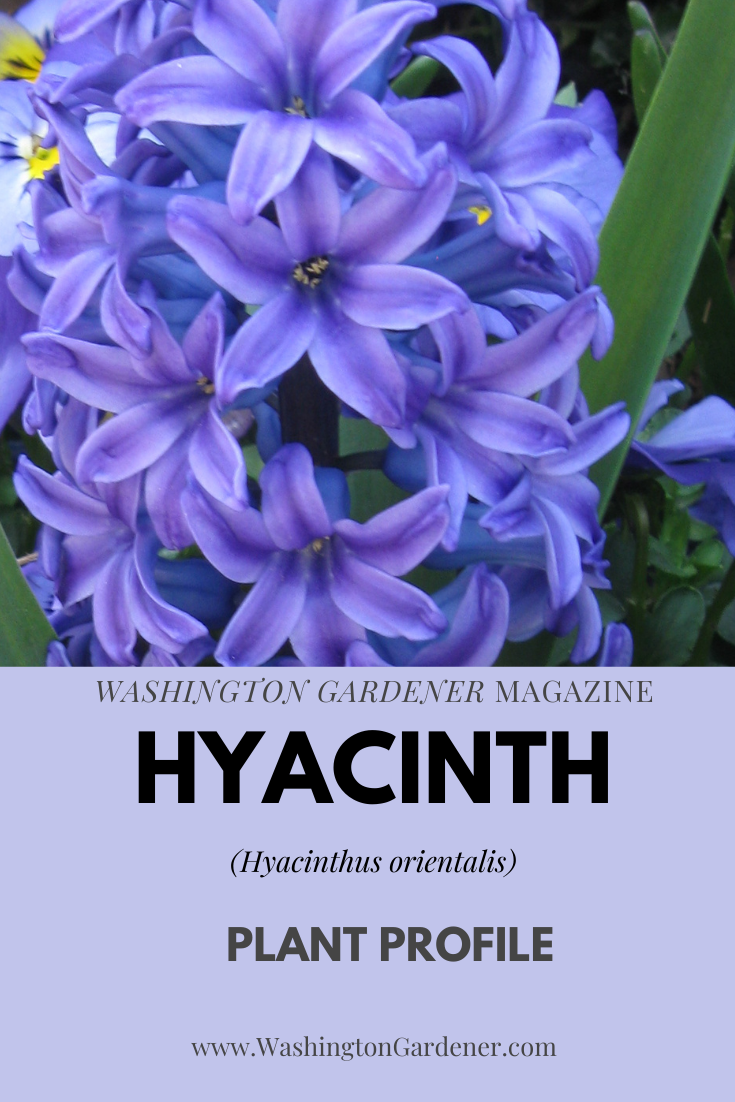
Plant Profile: Hyacinth

Hyacinth (Hyacinthus orientalis) are a spring-flowering bulb that have been in cultivation for more than 400 years. They originated in the eastern Mediterranean and are sometimes referred to as Dutch Hyacinths to differentiate them from the small Grape Hyacinth (Muscari armeniacum) or the aquatic plant Water Hyacinth (Eichhornia crassipes).

Hyacinths have a strong, sweet fragrance and are a long-lasting cut flower in a vase. They are also easy to force into early indoor bloom in the winter time.

The National Garden Bureau has declared 2021 as the #YearoftheHyacinth. At one time there were more than 2,000 named cultivars. Today, there are less than 50 cultivars available. They come in shades of blue, pink, yellow, peach, and white. Popular cultivars include ‘Delft Blue’, ‘Gypsy Queen’, and ‘City of Haarlem’.

For best selection, order your bulbs in spring. Plant the bulbs in mid-autumn, the same as you do with Tulips and Daffodils. They need a sunny location with well-draining soils, to prevent the bulbs from rotting.

Cut off the flower spikes as soon as the flowers fade to encourage the hyacinths to store more energy in their bulbs and return next year. For this same reason, do not cut back the foliage until it also starts to fade.

After several years, the bulbs can revert to the original single-flowering species, so you may wish to replenish your plantings with fresh bulbs annually.

And on bonus aspect to Hyacinths is that they are deer-resistant. The bulbs themselves are poisonous, so squirrels don't snack on them either.

Hyacinth - You Can Grow That!

The video was produced by Washington Gardener Magazine.

Visuals by Khloe Quill
Audio by Kathy Jentz


 If you enjoy this video, please give it a thumbs up and subscribe to our Youtube channel (thank you!)

Remember to TURN ON notifications to know when our new videos are out

 FIND Washington Gardener Magazine ONLINE

WashingtonGardener.blogspot.com

http://twitter.com/WDCGardener

https://www.instagram.com/wdcgardener/

~ Facebook.com/WashingtonGardenerMagazine

~ Podcast: GardenDC

Pin this for later!


Monday, March 29, 2021

Monday Motivation

"If you've never experienced the joy of accomplishing more than you can imagine, plant a garden."  - Robert Brault

Featured Post

Holiday Gifts for Gardeners ~ Top Gardening Gifts ~ 21+ Cool Gardening Gift Ideas

The holiday season is here and I bet you have a gardener on your gift list, so we've   updated   our annual a Holiday Gifts for Gardener...

Most Popular Posts