Monday, April 13, 2020

21 Gifts for Gardeners ~ Gardening Gifts ~ Cool Gardening Gift Ideas

Spring has sprung, so I thought I'd  share again the garden products I use almost every day. I added a few more on this year that I have personally trialed. These are the tried-and-true work tools that make my garden grow, save my back from breaking, and generally make life a little easier. Treat yourself!


BTW, the gift ideas are linked to Amazon, so if you click on them and order any, Washington Gardener Magazine gets a few pennies added to the account for the referral. Our full Amazon storefront is at:


Need even more ideas?My friend Keri at Miss Smarty Plants blog has put together her list of great garden gift suggestions here.

Disclosure: Clicking on these links and then ordering anything from Amazon may put a few pennies in the Washington Gardener Magazine bank account. Thank you for anything you can direct our way. We are participants in the Amazon Services LLC Associates Program, an affiliate advertising program designed to provide a means for sites to earn advertising fees by advertising and linking to amazon.com.

Saturday, April 11, 2020

GardenDC Podcast Episode 6: Spring-Flowering Trees and Shrubs

Listen to the most recent episode of our podcast posted on April 11, 2020.

David Ellis (photo by Allen Rokach)
This episode, we chat with David Ellis, editor of The American Gardener, the magazine of the American Horticultural Society, about favorite spring flowering trees and shrubs. The plant profile is on pansies/violas and we reflect on the late, great Henry Mitchell.


BTW, YOU can become  a listener supporter for as little as $0.99 per month!See how at: https://anchor.fm/kathy-jentz/support. 

It is also available on -
  • Google Podcasts at this link, either now or soon (note that currently, this link will only work on Android devices)

We welcome your questions and comments!

You can leave a voice mail message for us at: https://anchor.fm/kathy-jentz/message Note that we may use these messages on a future episode.


Friday, April 10, 2020

Fenton Friday: You Look Radishing!

The last few days have been incredibly windy (with 50mph gusts), so I haven't gotten by the plot much this past week. Today, I weeded a bit and saw some nice progress in the lettuce, spinach, beet, and pea seedlings. All are on track to harvest in a few weeks.

Can you believe it? The kale and spinach are actually bolting after one day this week got above 80 degrees! I cut off their flower stalks and tucked the plants as best I could back under their cover cloth as there is a freeze warning for tonight. Yes, that is a typical spring in the Mid-Atlantic -- seesawing from one temperature extreme to another.

The radishes are developing nicely and I pulled a few to eat with Easter brunch on Sunday.

I didn't get a chance to start any new seeds outside, but I hope this week to get over and clear out another weedy section of the plot and to start some cutting garden flower seeds.


'Snak Hero' Peas
'Early Scarlet Globe' Radish
Viroplay Spinach Seedlings
What are you planting this month in your edible garden? 

About Fenton Friday: Every Friday during the growing season, I'll be giving you an update on my community garden plot at the Fenton Street Community Garden just across the street from my house in zone 7 Mid-Atlantic MD/DC border. I'm plot #16. It is a 10 ft x 20 ft space and this is our 8th year in the garden. (It opened in May 2011.) See past posts about our edible garden by putting "Fenton" into the Search box above.

Wednesday, April 08, 2020

Plant Profile: Fragrant Witch Alder (Fothergilla spp.)


In early spring, the flower puffs on Fothergilla appear at the end of the branches. They look like soft, little bottlebrushes. The flowers have a honey-like fragrance and attract native bees and moths.

Following the flowers, the shrubs leaf out and the rest of the appeal of this plant soon becomes clear. The foliage is fuzzy and often has a blue-ish cast in spring. In the autumn, the foliage practically glows with seasonal colors.

The tag may say “full sun,” but partial shade will do. Also, in our region’s hot summers, some shelter from the afternoon sun is best.

During the first year, it will need consistent watering, while its roots establish themselves. After that, it should be fairly drought-tolerant.

Fothergilla prefers acidic, moist, but not wet, soils. If yellow leaves appear, that may possibly indicate alkaline conditions, which are not favored by Fothergilla species. Soil amendments appropriate for Azalea and Rhododendron, work for Fothergilla as well. Apply them in early spring.

There is no need for pruning! Let it grow and assume its natural form. Remove only broken, dead, or crossing branches. It is fairly slow-growing, but will sucker and colonize over time. If you have the space, let it.

This small shrub looks best in groupings of three or five and paired with other woodland native plants like Dogwood, Itea, and Sweet Pepperbush (Clethra alnifolia).

You will find that the Fothergilla ‘Mt. Airy’, Dwarf/Coastal Fothergilla (Fothegilla gardenia), and Fothergilla ‘Blue Shadow’ do the best in our region and are fairly commonly available at your local, independent garden center.

See the Washington Gardener Magazine April2017 cover story for much more about this fascinating plant.

Try planting a Fothergilla in your garden today – you can grow that!

The video was produced by Washington Gardener Magazine and edited by intern Emily Coakley.
If you enjoy this video, please give it a thumbs up and subscribe to our Youtube channel (thank you!)
Remember to TURN ON notifications to know when our new videos are out
FIND Washington Gardener Magazine ONLINE
WashingtonGardener.blogspot.com
http://twitter.com/WDCGardener
https://www.instagram.com/wdcgardener/
~ facebook.com/WashingtonGardenerMagazine
~ Podcast: GardenDC on Spotify, Apple, etc.


Sunday, April 05, 2020

Gardens Victorious: What to Grow in Your Victory Garden

by Cindy Brown 

In 1939, the New York Times published an article addressing the chaos facing the world: “We will need the mental and physical tonic work with nature and close touch with the soil never fail to bring.” Gardening promotes sanity in an insane world. Create your own garden and became victorious over your adversaries, both mental and physical.
   During WWII, commercial produce growers were instructed to produce only high-protein foods: corn, potatoes, beans, and wheat. This encouraged home gardeners to grow the “luxuries” like lettuce, celery, cucumbers, peppers, cauliflower, eggplant, and watermelon. When growing your own Victory Garden consider growing vegetables that are at the best when harvested fresh, are hard to find in the market, family heirlooms, or would encourage non-gardening family members to pick up the trowel. When space is non-existent, or at a premium, grow vegetables in containers. Anything, yes anything, can be grown in a container — as long as it is big enough, watered frequently, and fertilized regularly.
   To maximize your production, harvest often and be ready to replant when vegetables are harvested. Vegetable gardens aren’t planted once a year and forgotten; efficient gardeners plant five times a year — early spring, late spring, early summer, late summer, and fall. This ambitious schedule is for type “A” personalities, your garden should be a reflection of your personality, lifestyle, and available time. Every home garden should include tomatoes, herbs of choice, and a fruit that draws teenagers off the computer.
   Top choices for DC-area gardens: fava beans, snap peas, kale, lettuce, radishes, spring onions, cilantro, tomatoes, peppers, pole beans, okra, cucumbers, summer squash, basil, oregano, sage, mint, lavender, parsley, spinach, garlic, blueberries, scuppernong grapes, and strawberries. All are relatively easy to grow, best when fresh, and 99.44% and guaranteed to make the pickiest eater smile.

[Excerpted from the July/August 2006 issue of Washington Gardener Magazine. Cindy Brown was our EdibleHarvest columnist at that time, while she was the Assistant Director at Green Spring Gardens. She is now with Smithsonian Gardens.]

Saturday, April 04, 2020

GardenDC Podcast Episode 5: Horticultural Storyteller


Listen to the most recent episode of our podcast posted on April 4, 2020.


This episode we talk with Abra Lee of Conquer the Soil, a horticultural storyteller and Longwood Fellow. The plant profile focuses on the Pussy Willow and we add a new segment about what is growing in our community garden plot and home garden this week.

BTW, YOU can become  a listener supporter for as little as $0.99 per month!See how at: https://anchor.fm/kathy-jentz/support. 

It is also available on -
  • Google Podcasts at this link, either now or soon (note that currently, this link will only work on Android devices)

We welcome your questions and comments!

You can leave a voice mail message for us at: https://anchor.fm/kathy-jentz/message Note that we may use these messages on a future episode.


Friday, April 03, 2020

Fenton Friday: All Hail Kale


This week at the garden plot things are humming right along.

The carrots, radish, turnips, spinach, peas, and garlic all doubled in size since last week.

The kale is bursting out from under the cover cloth and the broccoli is also pushing to get out of it, so I harvested from both and plan to combine them both with pasta tonight.

The strawberry plants even have a few early blooms on them!

The only disappointment is the asparagus. I really thought I would arrive to final several spears up today that I could try out in an omelette recipe. Alas, I found only a few measly spears and I fear that the plant is petered out and I need to start over again. Which means another 3-year wait for a decent harvest again, sigh. Well, better to do so now, then waiting and losing another year of future harvest.

What are you planting this month in your edible garden? 

About Fenton Friday: Every Friday during the growing season, I'll be giving you an update on my community garden plot at the Fenton Street Community Garden just across the street from my house in zone 7 Mid-Atlantic MD/DC border. I'm plot #16. It is a 10 ft x 20 ft space and this is our 8th year in the garden. (It opened in May 2011.) See past posts about our edible garden by putting "Fenton" into the Search box above.


Wednesday, April 01, 2020

Plant Profile: Spring Beauty (Claytonia virginica)


Spring Beauty is a spring ephemeral that is only a few inches tall. The lovely flowers are white or light-pink with a dark-pink stripe inside their petals. There is also a yellow flower form that is less common.

Spring Beauty prefers moist soil and part-shade. The tiny flowers last for a week or so and then the grass-like leaves are not very noticeable. A few weeks later the foliage also disappears for the rest of the season.

It is native to the Eastern U.S. and from Canada down to Texas. Several kinds of bees and flies visit the flowers.

To add them to your lawn or garden, you can purchase the corms (tiny bulbs) from native plant nurseries. If you are lucky, the plants will seed themselves about and you will have a nice colony of plants.

You can sometimes miss this wildflower if you go on a walk on an overcast day as the blooms close up at night and in dim light to conserve energy.

Try planting Spring Beauty in your garden today – you can grow that!

The video was produced by Washington Gardener Magazine and edited by intern Emily Coakley.

If you enjoy this video, please give it a thumbs up and subscribe to our Youtube channel (thank you!)
Remember to TURN ON notifications to know when our new videos are out
FIND Washington Gardener Magazine ONLINE
WashingtonGardener.blogspot.com
http://twitter.com/WDCGardener
https://www.instagram.com/wdcgardener/
~ facebook.com/WashingtonGardenerMagazine
~ Podcast: GardenDC on Spotify, Apple, etc.


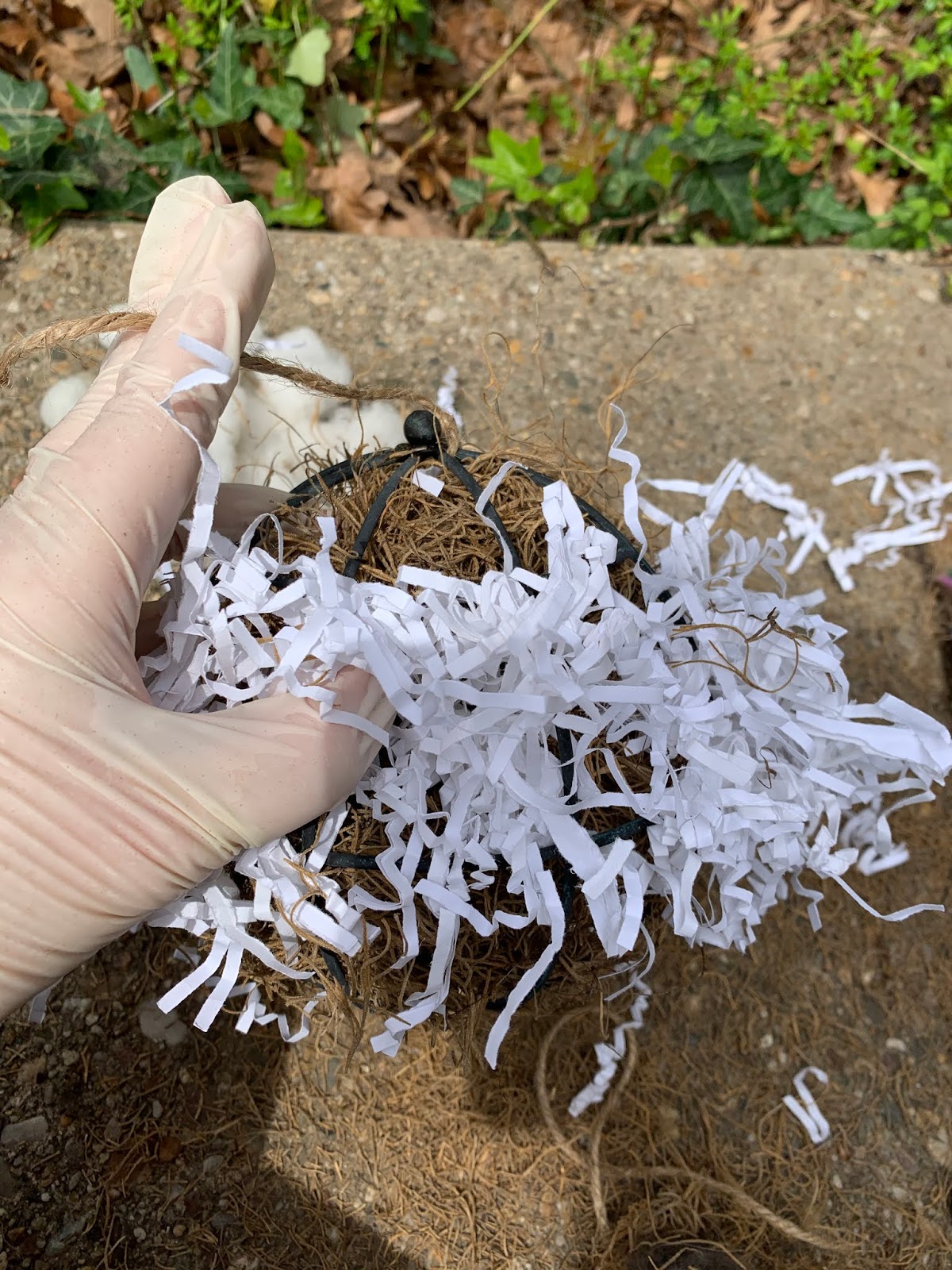
DIY: Bird Nesting Material Ball or Cage

This early spring craft can be a fun rainy day activity with kids and then once hung in your garden outside a window, you can watch as bird's gather from your offerings. (You can make several and put them in various spots to see which ones the birds prefer.) Later on, after the fledglings have hatched, you can see what nests used your materials.
Level: easy   Cost: minimal   Use: garden decor/wildlife/gift
Materials:
- dried grasses
- small twigs
pet hair
- dry leaves
- cattail or milkweed fluff
- cotton (I grew my own)

Step 1: Collect materials from your garden and/or purchase them.

Step 2: Tie a 10-inch piece of twine to the top of the cage or sphere and knot it securely. You will use this later for hanging it.

Step 3: Stuff coconut fiber or Spanish moss into the center of the wire cage or wire form.

Step 4: Add your other bird nesting materials loosely into the cage/frame so the birds can pull them out, but secure enough that the wind won't blow it away. Here is where you can get creative -- form patterns or layers with them materials as you wish.

Step 5: Hang in garden.
Note: it is not recommend to use yarn and ribbon as bird's feet can get tangled in them and also avoid dryer lint as it can contain harmful chemicals from laundry products.
This post contains affiliate links, which means that if you click on one of the product links, I’ll receive a few pennies from Amazon.
This is a monthly blog series on DIY projects for the beginning home gardener. Look for the other installments in this DIY blog series by putting "DIY" in the search box here at washingtongardener.blogspot.com


Featured Post

Holiday Gifts for Gardeners ~ Top Gardening Gifts ~ 21+ Cool Gardening Gift Ideas

The holiday season is here and I bet you have a gardener on your gift list, so we've   updated   our annual a Holiday Gifts for Gardener...

Most Popular Posts