Monday, December 11, 2017

Win a Pass to the Garden of Lights at Brookside Gardens

For our December 2017 Washington Gardener Reader Contest, Washington Gardener Magazine is giving away several passes to the Garden of Lights at Brookside Gardens in Wheaton, MD. Each pass admits a car-load full and then you walk around the garden light displays. (Prize value is $30.)
    Step into a magical winter wonderland illuminated with more than one million dazzling colorful lights shaped into hand-crafted, original art forms of flowers, animals and other natural elements. Stroll from garden to garden enjoying twinkling tree forms, sparkling fountains, and whimsical winter scenes. The Garden of Lights celebrates its 19th season as a Baltimore/Washington, DC area family holiday tradition.
   The night wouldn’t be complete without a visit inside the Conservatory to enjoy watching G-Scale model trains wind through a seasonal landscape. Afterward, warm up inside the Visitors Center while you sip hot cocoa and listen to one of the nightly musical performances.
   The Garden of Lights runs through January 1, 2018 (except December 24 & 25). Find out more at http://www.montgomeryparks.org/brookside/garden_lights.shtm
   To enter to win a pass that admits one car-load of guests to the Garden of Lights, send an email to WashingtonGardener@rcn.com by 5pm on Friday, December 22, with “Lights Show” in the subject line and in the body of the email tell us your new year's resolution for your garden. Please also include your full name and mailing address. The pass winners will be announced and notified by December 24.

UPDATE
Our contest winners chosen at random from the submitted entries are:
  • Caity Valley, Washington, DC
  • Judy Daniel, Washington, DC
  • Karen Sutter, Arlington, VA
  • Kathy Pongor, Savage, MD
  • Anne Hardman, Silver Spring, MD
Congratulations to all and enjoy the light display!


Wednesday, December 06, 2017

Video Wednesday: Camellia Plant Profile


Camellia (Camellia sasanqua) is a gorgeous shrub covered in long-lasting blooms that will help get you through the worst of the winter doldrums. This Camellia's white, pink, or red blossoms stand out in high contrast against glossy, dark green foliage. 

Sometimes referred to as "Christmas Camellias," the sasanqua varieties of Camellia are native to the coastal forests of southern Japan. The Japanese use the leaves of sasanqua to make tea, and the seeds are pressed into tea seed oil for use as a lubricant and in cooking and cosmetics. It was introduced by Dutch traders into Europe in 1869. 
 
This Camellia is hardy to zones 7-10, so may not thrive in the colder parts of our Mid-Atlantic region or may require some extra protection to get it through in very cold winters. Try it as a container plant, as a hedge, or esapliered against a brick wall.


Camellias should be lightly fertilized and pruned sparingly, only as needed. Once established, they are fairly low-maintenance. They typically only need to be watered during dry spells.

My personal favorite Camellia sasanqua is 'Yuletide'. There is a notable one planted on the grounds of the US Botanic Garden in Washington, DC, that looks terrific each year around Christmas. 


'Winter's Charm' is another Camellia sasanqua favorite. It was bred by the late Dr. William L. Ackerman, author of Growing Camellias in Cold Climates.

For more information about growing Camellia's locally, visit the Camellia Society of the Potomac Valley’s web site at http://cspv.org/.

Enter "plant profile" into the search box at the top of this page to view our many other videos.

Monday, December 04, 2017

Lessons Learned: Turnips

By Nicole Reisinger
One of the required projects for interns at Washington Gardener Magazine was to choose our own vegetables to grow throughout the fall semester. During our meetings each week, we would stroll over to the Fenton Community Garden and check on the progress of our plants. This season, I chose to grow ‘Seven Top’ turnips, ‘Purple Top White Globe’ turnips, and turnip greens.
I have never grown turnips before, let alone eaten them, so I was excited to try something new. They are very similar to growing radishes — a plant I’ve only ever needed to grow for a science project in middle school — so I was not too intimidated.
I was so excited to finally see something sprout out of the ground after almost two weeks of waiting (granted my patience could use a little practice). The ‘Seven Top’ and ‘Purple Top White Globe’ turnips sprouted at the same time while the greens trailed about a week behind.
My biggest faux pas when growing my turnips was not thinning them enough. I dug the holes 3-inches apart and put about three seeds in each hole. Thinking natural selection would allow the seeds to duke it out underground, I did not follow the thinning process as well as I should have. It is recommended to thin the seedlings 4 to 6 inches apart when they are 4 inches high. If I had followed this instruction, I would have probably yielded turnips larger and wider than my pinky toe. Thankfully, I was able to salvage a few plants and managed to end up with a few that actually resembled turnips.
The first frost back in October nipped at my turnip greens, but I was able to harvest a few leaves to bring home and cook. Uyen, another intern, had added her radish greens in a soup, so I decided to follow suit and try the same. I found a vegetable soup recipe by Southern Living specifically for turnip greens, and it ended up being very simple to make. It called for the addition of ham and onions, and the turnip greens were extremely similar to kale in regard to its preparation, stalky texture, and hearty taste.
I picked some ‘Purple Top White Globes’ turnips from the plot so I could give my family a little tasting for our Thanksgiving dinner. The few I gathered were not big enough to serve by themselves, so I cut them into small chunks along with some beets and carrots. I tossed the veggies in olive oil, sea salt, pepper, fresh thyme, and a tad of brown sugar and spread them on a sheet pan to roast in the oven for about 40 minutes at 400 degrees. In the end, these three root vegetables looked pretty displaying their fall colors on the table.  
About the Author:
Nicole Reisinger is a senior multiplatform journalism major at the University of Maryland. This autumn, she is an editorial intern at Washington Gardener Magazine.

Sunday, December 03, 2017

Lessons Learned: Radishes

By Uyen Nguyen

Throughout my time with Washington Gardener magazine, two other interns and I got the opportunities to plant, water, weed, and harvest our very own vegetables with editor and publisher Kathy Jentz. We each grew them separately in Kathy’s plot in the Fenton Community Garden in Silver Spring, MD.
Growing up, I loved eating daikon radishes — usually pickled or in soups, but I never tried any other kinds of radishes, even though there are way too many to name. So, this semester I chose to grow four different types of radishes: ‘White Icicle’, ‘French Breakfast’, ‘Cherry Belle’, and ‘Roxanne F1’ (a 2015 All-America Selections winner)
Before we planted them, Kathy Jentz told me radishes are easy to grow in the fall because they are cool-season vegetables and mature very fast, but I never imagined how right she’d be — the 'French Breakfast' and 'Roxanne' radishes were ready to be harvested in just a month. (Planted Sept. 10, harvested Oct. 11)
Disclaimer: We pulled the ‘Roxanne’ radishes and replaced them with the ‘Cherry Belle’ radishes one week after the first harvest (Oct. 18) and a frost hit, so the 'Cherry Belle' didn’t grow as fast as the others.

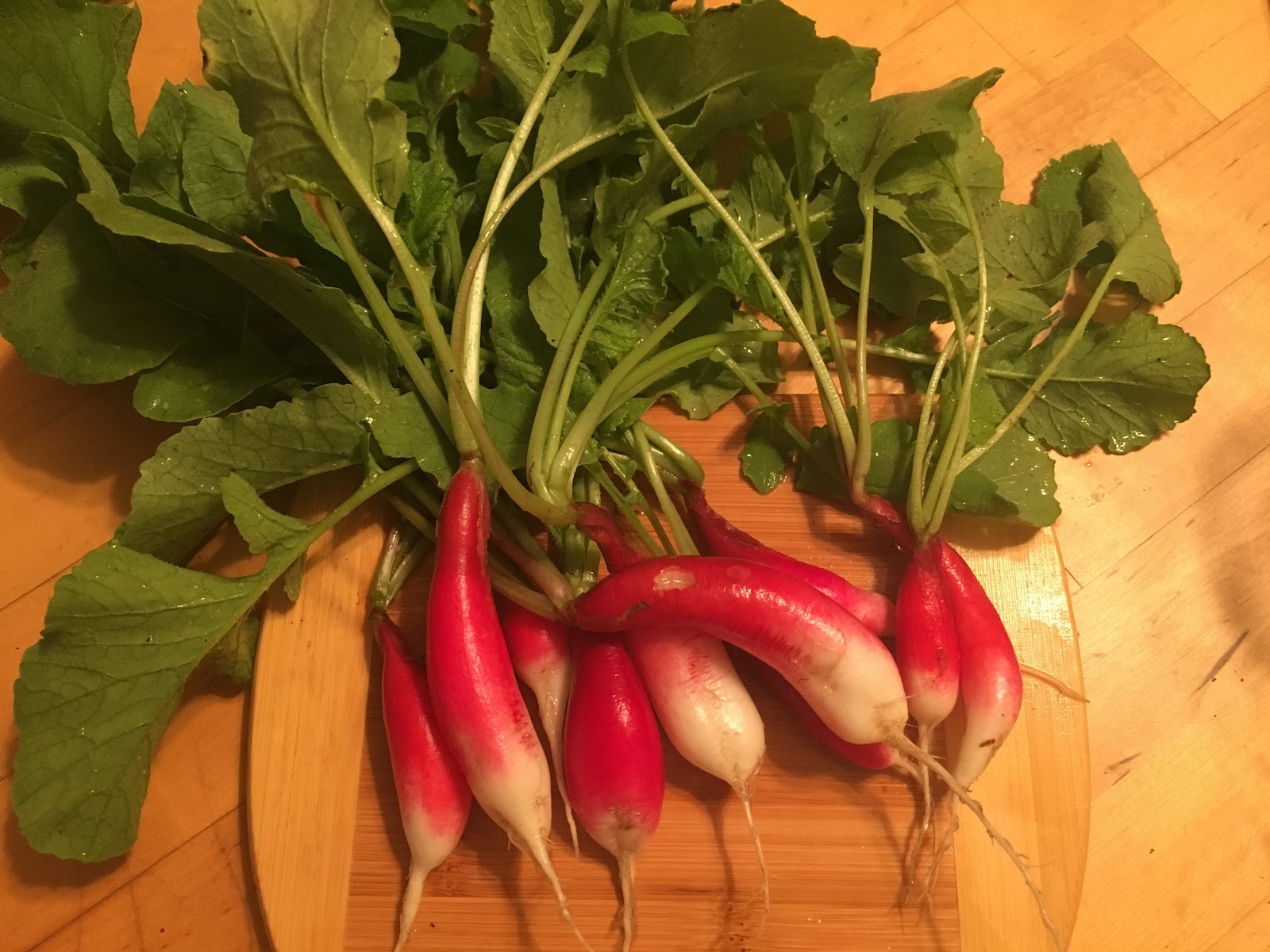
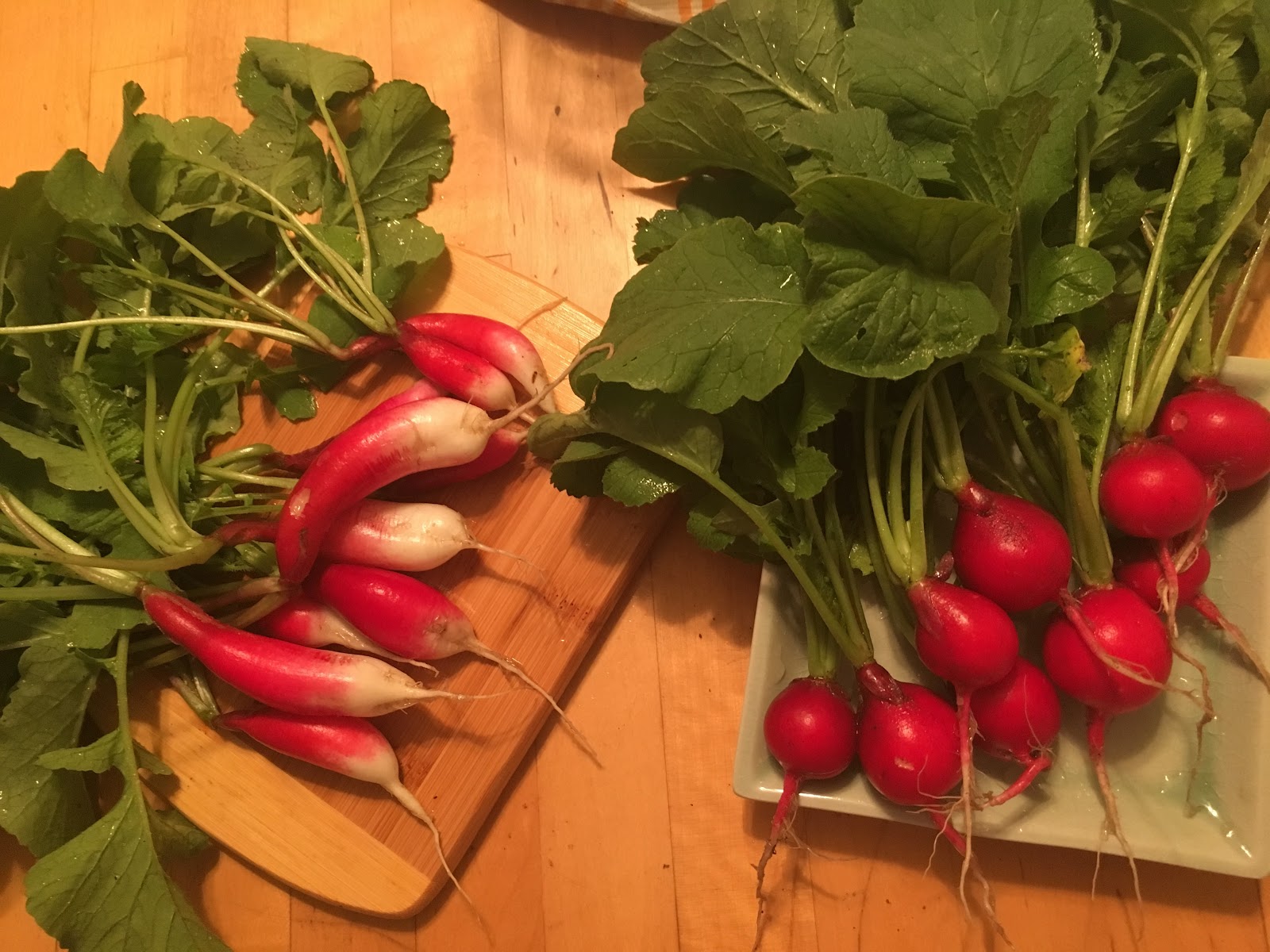
The ‘French Breakfast’ radishes are the oblong ones shown below and they grew to be about 1.5 inches long and 0.75 inches wide. These radishes are tall and skinny. Since they stuck a bit above ground, they were vulnerable to pests, but you can just cut the bitten parts off.

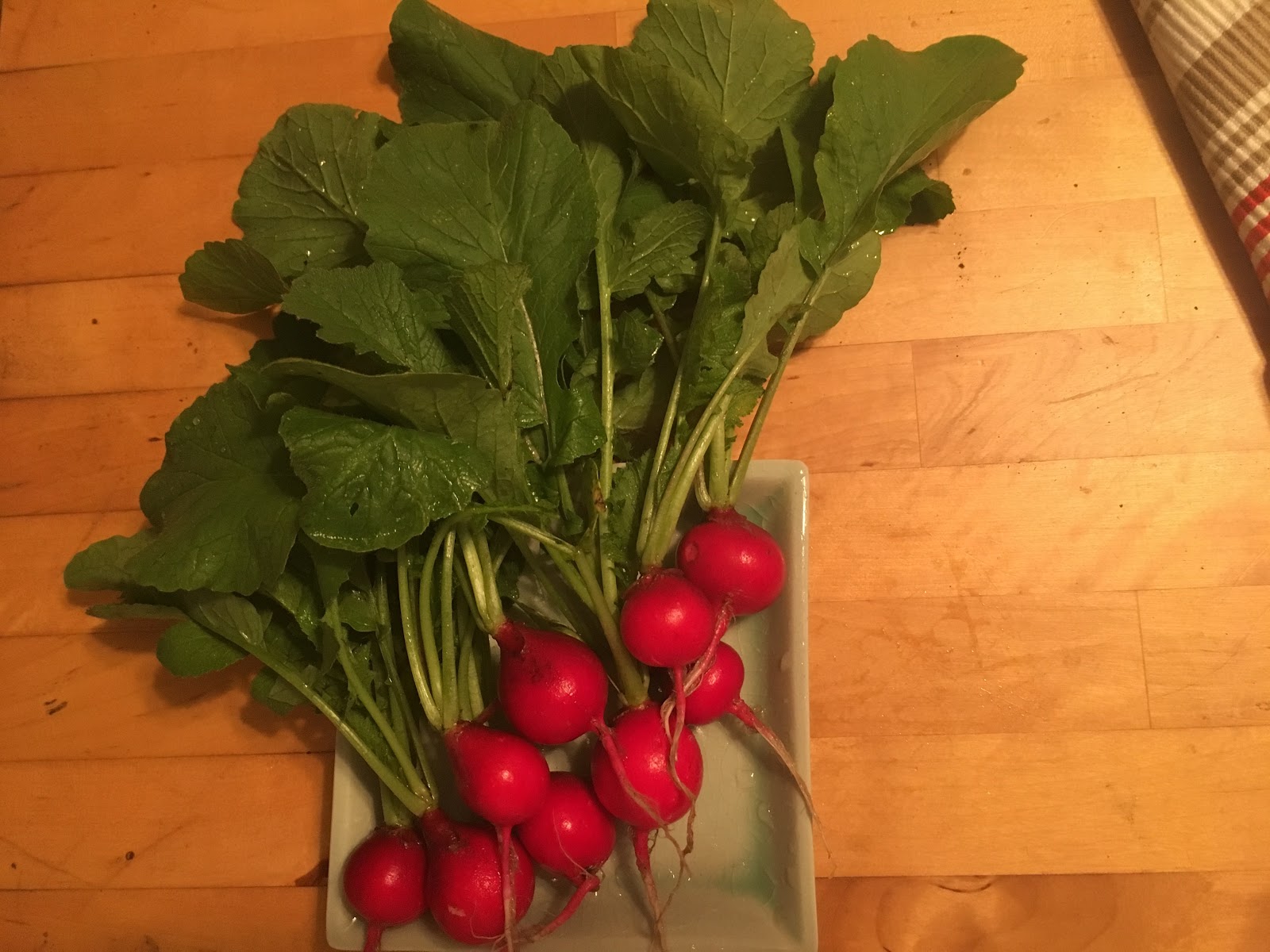
The ‘Roxanne’ radishes are the small, round ones below. These grew to be about 1-1.5 inches in diameter and were the most spicy or "sharp" out of the bunch, but were very easy to cut into tiny slices because of the crispiness. I ate these and the 'French Breakfast' radishes raw with hummus.


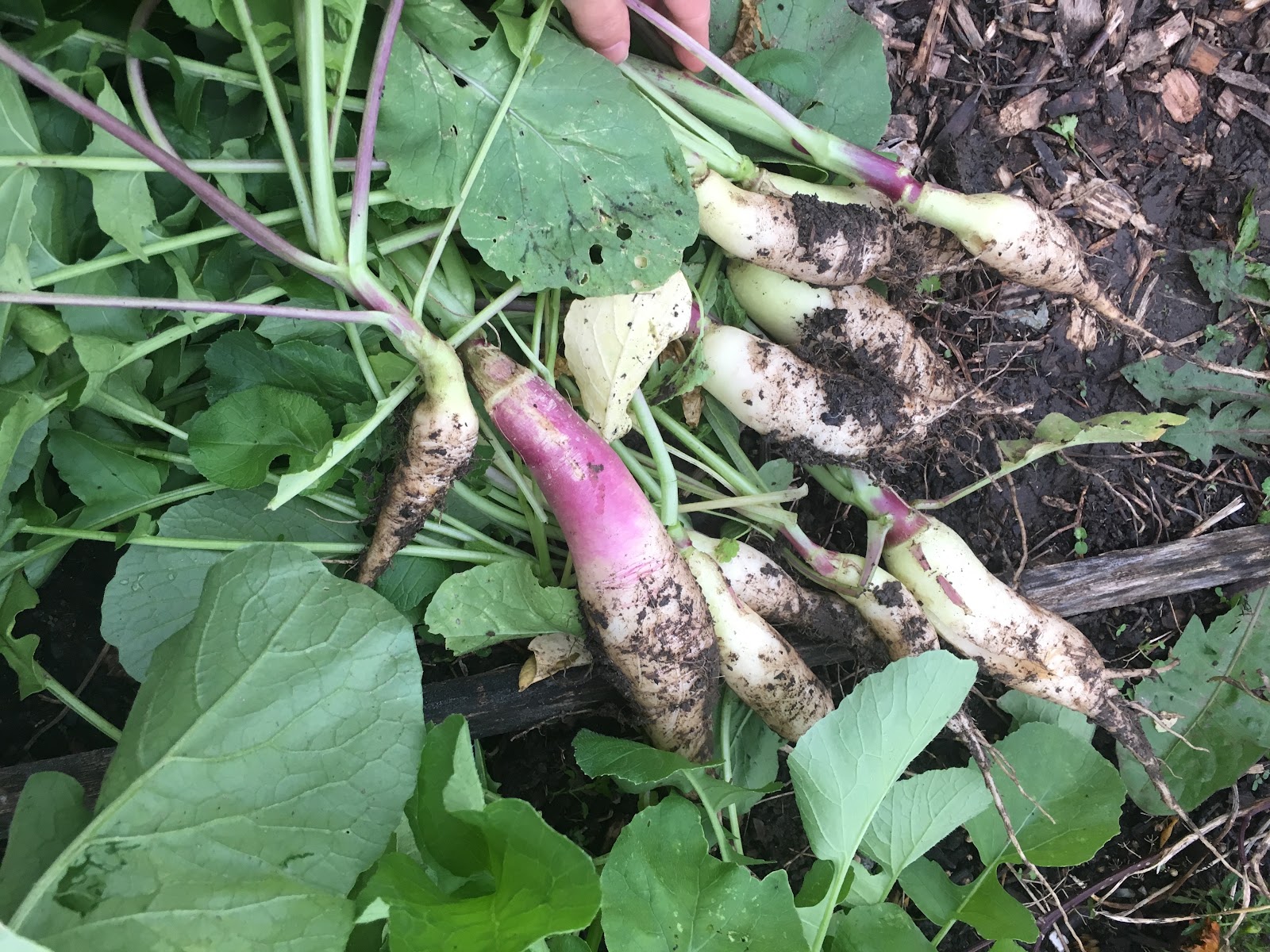
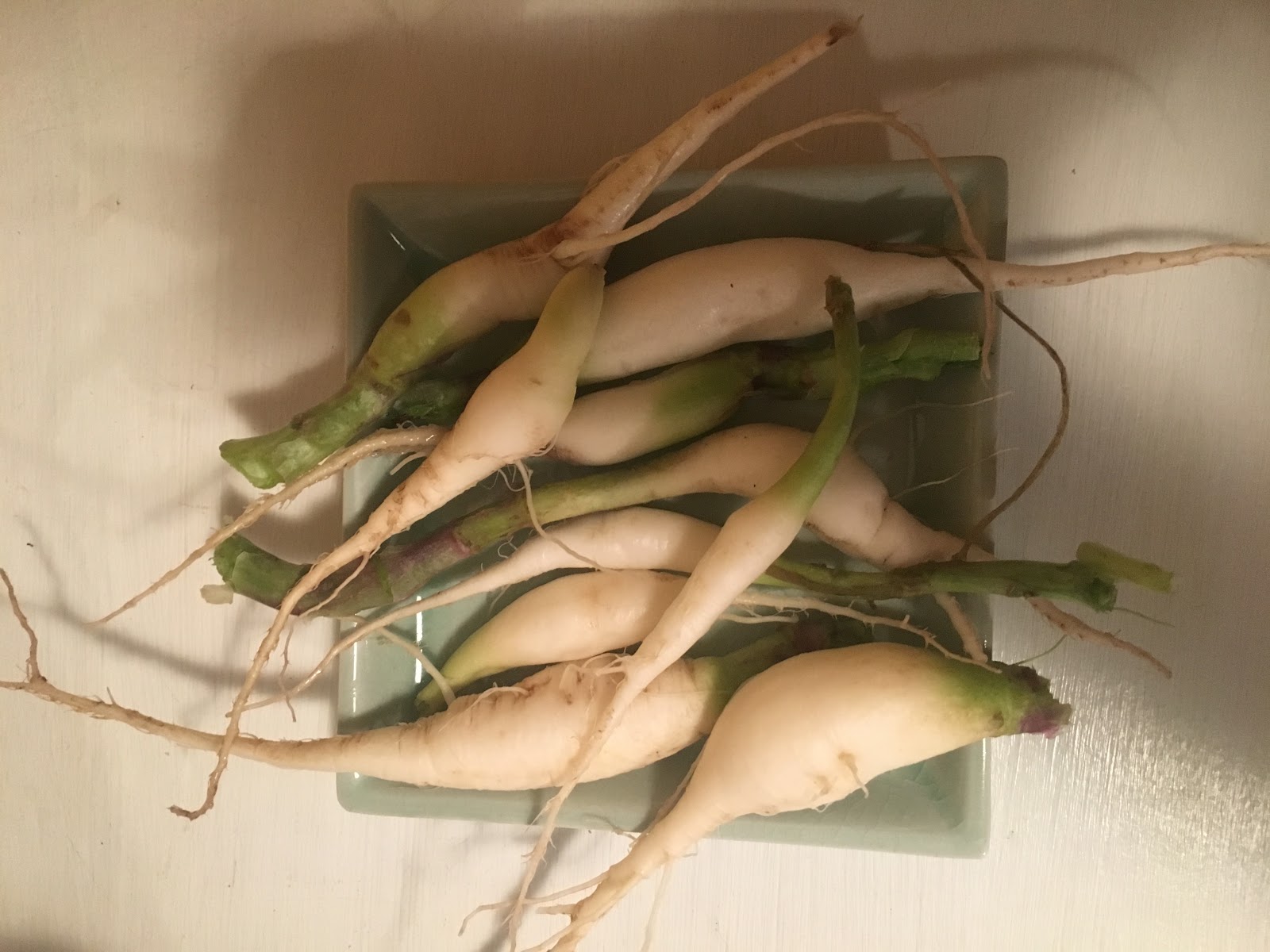
The ‘White Icicle’ were last to be harvested, but they grew the longest. I think these were my favorite to eat because they were less spicy. They were definitely my favorite to pull because of the gratification I got from seeing the almost 5-inch beauties. I put these radishes in my soup and they added tons of flavor to my dish — it was like a spicy carrot.


Things I learned from my experience:
·      Radishes aren’t spicy the way jalapeno peppers are spicy, but they give you the same "nose-tickle" that follows when biting into something spicy.
·      Radish greens are edible! When handling them, be careful of their tiny prickles. The greens have a delicious spinach-like flavor when cooked.
·      Gardens are like an outdoor classroom — it’s fun to plant vegetables, even if you are not a typical gardener because the care you put into your plot makes you appreciate the food you eat even more.

About the Author:
Uyen Nguyen is a senior multiplatform journalism major at the University of Maryland. This autumn, she is an editorial intern at Washington Gardener Magazine.

Saturday, December 02, 2017

Lessons Learned: Spinach and Broccoli

By Maeve Dunigan

Throughout my fall internship with Washington Gardener Magazine I was able to experiment with growing two different vegetables. Though neither attempt yielded particularly successful results, the experience still proved a fulfilling one that I learned a lot from.


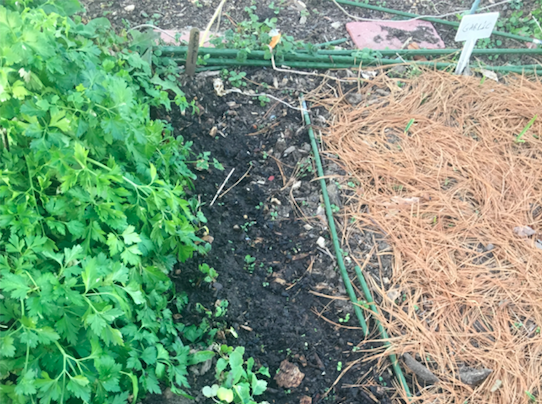
My first attempt was back in September when I planted a ‘Gangbusters’ variety of Spinach. I planted two rows of seeds and followed the directions on the packet by ensuring the seeds were well spaced apart and about an inch deep in the soil. Unfortunately, after about two weeks, the spinach still had not shown any growth. There were small green sprigs, but they were very hard to differentiate from the surrounding weeds.


Luckily, Washington Gardener Magazine's editor Kathy Jentz suggested that I turn over the small plot and re-plant with some already grown Broccoli ‘Artwork’ seedling plants.


Planting the broccoli was fairly easy. Though the soil was a bit hard to dig through do to cold and lack of rain, I was able to dig out six holes, one for each of my broccoli plants. In order to ensure that these plants were protected from pests, we covered them with a protective row-cover blanket.


Unfortunately, the pests still managed to sneak in. About a week after planting the broccoli, we realized that slugs had been chewing on some of the leaves. After checking to make sure it wasn’t harmful to use around edible plants, Kathy applied Sluggo, a slug and snail killing bait, around the plants.


The Sluggo proved a success. When I returned a week later, the plants were growing again and showed larger and fuller leaves.

Overall, this experience taught me a lot about the trials involved in growing edibles during the fall season. I am hopeful that the broccoli I planted eventually produces some sort of yield, or, at the very least, does not become another meal for the slugs.  

About the Author: Maeve Dunigan is a senior multiplatform journalism major at the University of Maryland, College Park. This autumn, she is an editorial intern at Washington Gardener Magazine.

Friday, December 01, 2017

DIY: Okra Santa Ornament

Santa face close-up
By Kathy Jentz

Disclosure: Some of the links below are affiliate links. This means that, at zero cost to you, I will earn an affiliate commission if you click through the link and finalize a purchase.

These cute Santa ornaments are a fun holiday decor item or gift. Your Santa design and style may vary from ours pictured here. The shape of the okra can really add character to the finished face, so play around with that. You could add metallic accents and glitter as you wish. You can also paint the dried okra as various other figures like angels, snowmen, ghosts, etc. for other occasions.

Materials:

Dried okra pods
Acrylic paints in assorted colors
Foam paint brushes
Black marker
Small nail
Floral wire

unpainted okra pods and red-painted ones
Steps:

  • Grow okra. Harvest and let it dry for several months. 
  • Paint all of it red. Set aside to dry.
  • Paint a face area. (I had to mix white, light pink, and yellow together to created a satisfying flesh-colored paint.)
  • Paint white eyebrows, mustache, beard, and tip of his hat.
  • Use a black marker to dot the eyes.
  • Dot on a maroon mouth and pink cheeks.
  • Push a nail into the "hat" then remove it and thread a thin piece of floral wire through the holes and twist the ends together to form the hanger.  
  • how to create the hanger
  • Hang on your Christmas tree or use for a decorative gift tag.

This is a monthly blog series on DIY projects for the beginning home gardener. Look for the other installments in this DIY blog series by putting "DIY" in the search box here at washingtongardener.blogspot.com


PIN THIS FOR LATER!


Wednesday, November 29, 2017

Video Wednesday: Amsonia Plant Profile


Amsonia hubrichtii grows well outside of its limited native range (the mountains of western Arkansas) and is proven to be hardy in USDA Zones 4–9. This herbaceous perennial takes about three growing seasons to reach maturity and is long-lived. A mature plant will have about 50 stems and grows three feet high and wide. This species is also commonly called thread-leaf blue star or Arkansas blue star — or, simply, Amsonia.
   It dies down in the winter and starts to re-sprout in April. It is deer-resistant and well-noted for providing three seasons of interest. In spring, there are clusters of pale-blue flowers. Then, in summer, it has copious amounts of feathery, apple-green foliage. Finally. it has brilliant, clear-yellow foliage for at least a month in autumn. It is most often planted because of this colorful display it provides from October into November.
   You can prune the plant to about 12 inches high immediately after the bloom cycle has ended to encourage a fuller growth habit for the summer. The sap is sticky; so wear gloves when pruning. 
   It produces its best color when grown in full sun. However, it will tolerate morning sun and afternoon shade. Amsonia prefers moist, well-drained soil, but it can adapt to somewhat drier conditions once it has become established. 
   The best method for propagating Amsonia hubrichtii is by dividing the crown in spring. Softwood cuttings are also possible. Starting this species by seed has mixed results, because the seeds sprout erratically.
   Amsonia hubrichtii is known for its effectiveness in mass plantings, informal borders, and naturalistic landscapes. I love seeing it planted along roadsides throughout the Mid-Atlantic states. One famous landscape setting is by the Capitol Columns at the U.S. National Arboretum in Washington, DC. It is a show-stopping display in mid-autumn with the purple aster blooms setting off the golden amsonia foliage.
  Amsonia hubrichtii: You Can Grow That!

 You can read more about Amsonia in the Summer 2011 issue of Washington Gardener Magazine 


Wednesday, November 22, 2017

Video Wednesday: Beautyberry Plant Profile


Beautyberry (Callicarpa americana) is a shrub that is native to our Mid-Atlantic area and throughout the southeastern United States, Beautyberry adapts well to various growing conditions from part shade to full sun, from moist soil to dry. It reaches 4-6 feet in height and width.

It is a show-stopper in late summer/early fall when the brilliant purple berries adorn the branches. Birds and other wildlife are also fond of the berries as a food source so you may find your berry display stripped sooner than you would like.

See more about Beautyberry at:
http://washingtongardener.blogspot.com/2016/09/beautyberry-you-can-grow-that.html

To see other videos in our Plant Profile series., go to:
~ Japanese Anemones - click here
~ Asters - click here
~ Toad Lily - click here

~ Pink Muhly Grass - click here
~ Phalaenopsis or Moth Orchids - click here
Chrysanthemums - click here 

Monday, November 20, 2017

Win a copy of Container Gardening Complete in November 2017 Washington Gardener Reader Contest

For our November 2017 Washington Gardener Reader Contest, we are giving away a copy of Container Gardening Complete.
   The new book by Jessica Walliser will be the most-comprehensive container gardening book on the market. It hands readers everything they’ll need to create a gorgeous and productive container garden, including potting soil recipes and lists of the best container-friendly vegetable and fruit varieties, herbs, and ornamentals. Container Gardening Complete also features 20 cool DIY container projects that illustrate step-by-step instructions for building creative containers and filling them with the best plants.
   You’ll get to know the ins and outs of gardening in a small space, from the importance of drainage, irrigation, and other watering concerns to ornamental combinations of plants, and the very best vegetables, fruits, and nonedibles for container gardening.
   It is coming out December 12 from Cool Springs Press/Quarto Publishing.
  To enter to win a copy of Container Gardening Complete, send an email to WashingtonGardener@rcn.com by 5:00pm on November 30 with “Container Book” in the subject line. In the body of the email, tell us what your favorite article was in the November 2017 issue of Washington Gardener Magazine and why. Be sure to include your full name and mailing address. The winner will be announced and notified on December 1.

UPDATE:
Thank you to all who entered our November 2017 Washington Gardener Reader Contest.Our winner chosen at random is: Michael Kelley of Berwyn Heights, MD.

Friday, November 17, 2017

November 2017 issue of Washington Gardener Magazine features Brussels Sprouts, Urban Forestry, Spotted Lanternfly Warning, and much more


The November 2017 issue of Washington Gardener Magazine is now out.

Inside this issue:
- Brushing Up on Brussels Sprouts
- Scary Tales about the Spotted Lanternfly
- Latest Research Findings in Urban Forestry
- How to Prepare a New Bed Using the No-till Method
- Plant Swap Finds Can Bring Home Noxious Weeds
- Your Garden Task List
- Tips for Growing Amaryllis
- DC-MD-VA Gardening Events Calendar
- Meet Filmmaker Karyl Evans
and much more…

Note that any submissions, event listings, and advertisements for the December 2017 issue are due by December 10.


Subscribe to Washington Gardener Magazine today to have the monthly publication sent to your inbox as a PDF several days before it is available online. You can use the PayPal (credit card) online order form here: http://www.washingtongardener.com/index_files/subscribe.htm

Thursday, November 16, 2017

Garden Books Gifted to Brookside Horticultural Reference Library

By Uyen Nguyen

Holly Stover accepts the book donation on behalf of Brookside.
Washington Gardener staff stopped by Brookside Gardens in Wheaton, MD, last Saturday to drop off a donation of books that will be added to the Horticultural Reference Library.
Editor and publisher Kathy Jentz has featured reviews of several of the books in previous editions of the magazine. The books cover a wide range of horticultural topics, such as propagation techniques, miniature bonsai trees, and landscape design.
The value of this batch of donated books is about $300, which added to a previous donation made earlier this year for a total of about $1,000. Last year’s book donations came to $683.01, and in 2015, Washington Gardener gave $535 in donated books. The magazine’s largest yearly donation was in 2013, with $3,070.94 worth of books donated.

The mission of the Horticultural Reference Library at Brookside Gardens is to be a resource for Brookside Gardens and Montgomery County Parks staff, the citizens of Montgomery County, MD, and any other individual interested in learning about the science and art of Horticulture. Volunteer librarians are there and ready to help you find answers to your plant questions; they are available Monday through Friday at 10 a.m. to 3 p.m., or by appointment.
About the Author:
Uyen Nguyen is a senior multiplatform journalism major at the University of Maryland. This autumn, she is an editorial intern at Washington Gardener Magazine.

Featured Post

Holiday Gifts for Gardeners ~ Top Gardening Gifts ~ 21+ Cool Gardening Gift Ideas

The holiday season is here and I bet you have a gardener on your gift list, so we've   updated   our annual Holiday Gifts for Gardeners ...

Most Popular Posts