Showing posts sorted by relevance for query after dark. Sort by date Show all posts

Friday, August 29, 2025

Fenton Friday: Colin’s Cucumbers and Zucchini

Colin Davan and cucumbers. Photo by Ian Ferris.

Guest Blog by Colin Davan

With a pile of seeds spread across the table, I was left with some tough decisions. After my fellow summer interns Miguel and Ian had picked their tomatoes and peppers, I was tasked with four seed packs: two kinds of cucumbers and two types of zucchini plants. 

However, these were not just any vegetable plants. Each brought their own unique challenges and tasks. Starting with the cucumbers, I had one pack of Slicing Cucumber and another of Japanese Climbing Cucumber, which required a tomato cage surrounding it, hence the name.

Moving to the zucchini, I was in charge of the Nimba Squash Zucchini and Dark Star Zucchini. 

The summer plot got off to a hot start with Miguel and Ian planting their tomato and pepper seedlings. In my first week, I spent my time thoroughly weeding and clearing out the section of the plot I was given. Since these vegetable plants required so much space, I delayed my seed sowing until the second week. 


The second week, I returned and formed the four small mounds spaced out a couple of feet from one another. After I planted the seeds in each mound, topped them with compost, and surrounded them with straw, I protected them with small wire pieces (hardware cloth), so the urban pests would not come to take my special seeds or baby seedlings. I stood back and took a picture of the dirt mounds. I began to wonder: what will come of these seeds? Will I find any success in the garden this summer?

After returning the following week, a glimpse of success began to push out from the mounds. Small green seedlings had begun to arise with a few pesky weeds around them. I tended to my four small mounds and returned the following week. 

When I returned, I saw an increase in seedlings that were beginning to flourish. Both of the cucumber plant mounds exploded as each had several small seedlings that I would eventually thin down to two each. However, I was not seeing close to the same progress with my zucchini plants. 


Photos from top down: Thriving 'Nimba' Squash Zucchini, Climbing Cucumbers, and failed 'Dark Star' Zucchini.

I would come to find later on that my zucchini plants would ultimately give me problems all summer. The Dark Star never produced a seedling and the Nimba Squash grew much more slowly than my cucumbers. However, that did not deter my garden grind. We planted a different zucchini squash variety (' Zucchini 'Black Beauty') in Dark Star's former spot and gave extra care to my zucchini each week.

As the blazing hot weeks in the garden went on, my Nimba Squash and both cucumbers would grow at exponential rates. Powerful rainstorms all throughout July, hot sunny days, and a little bit of fish fertilizer created the perfect mix for results. 

By late July and early August, I had begun to see flowers and small cucumbers, but no actual zucchini yet. A bit of concern began to creep in as the deadline for submissions in the Montgomery County Fair was quickly approaching, and I did not have enough similar-looking cucumbers or zucchini ready to submit an entry. 

I was able to harvest many cucumbers from my Japanese Climbing plant and ended up submitting them to the DC State Fair (results below*). While the zucchini plants struggled, I was able to get a nice zucchini, which I used in a chocolate zucchini cake. (Thanks Kathy for the recipe!)

At the end of my Fenton journey, I realized this experience was not only about producing cucumbers and zucchini, but also of overcoming obstacles and strengthening my patience. I am so incredibly grateful for the opportunity with the Washington Gardener Magazine this summer, as I got to enhance my journalistic skills while also being on the Fenton plot working in a nice community garden.

*UPDATE:

The cucumber won first place! See the results at https://www.dcstatefair.org/2025-contest-results.

About the Author:


Colin Davan is an intern this summer session with Washington Gardener. He is a rising senior at the American University in Washington, DC, studying journalism with a minor in history. He grew up just outside of Boston in two towns (Hopkinton and Framingham), both with backyards always filled with a wide variety of flowers, herbs, vegetables, and fruits.

Wednesday, November 21, 2007

Gardening After Dark

Today was a rare glorious 60+ degree autumn day. No chill wind. No gloomy fog. Just a perfect dawn of jacket-free weather. I ditched my pile of paperwork and the big email backlog to spend the afternoon planting bulbs, moving azaleas, potting up begonias for indoor window sills, and general mucking up the garden. I only came in when I did as it got too dark to see the ground. You know you are garden-crazy when you start to consider investing in a miner's helmet light!

I posted about the practice of post-dusk gardening back in July here and observed how an innocent gardener can easily be mistaken for a nefarious grave digger. I know if one of my neighbors was out there hacking away at the earth past their bedtime, I'd have to seriously consider a call to the cops. It is just as well the darkness forces me indoors, when else would I have time to write these blog posts or browse through my seed catalogs?

Pictured here is one of the new displays at Brookside's Garden of Lights. Strolling through holiday light displays is one nighttime activity in the garden that we can all enjoy without raising undue suspicions.

Friday, August 18, 2023

Fenton Friday: Zucchini Trials

Zucchini hiding in Asparagus foliage.

By Taylor Edwards 


At the beginning of the internship, Kathy Jentz let me choose what I wanted to grow in the community garden plot over the summer. I knew nothing about gardening but I knew that whatever I grew, I didn’t want it to go to waste. I chose two types of Zucchini ('Incredible Escalator', a climbing zucchini and 'Dark Star' zucchini) and Zinnia 'Mazurkia' (Zinnia elegans). 


We planted the vegetables on June 7 and the flowers in the community garden a few weeks later. Throughout the summer, we would check the growth of each plant and tend to the rest of the plot. Because it was so hot, we did a lot of watering and pulling out weeds. I planted the seeds by creating a mound, inserting the seeds into it with my finger, and then watering it before and after. Within a few weeks, the Climbing Zucchini started to grow and you could see the tiny leaves come out of the ground. Unfortunately, the 'Dark Star' Zucchini didn’t sprout at all. After giving it a chance, we tried out a different squash in its place. That one didn’t grow as well so we decided to give the Climbing Zucchini room to grow by itself. There were trellises put up to guide the zucchini to grow on to them. What we found while growing the Zucchini was that the area had to be weeded out a lot. By the end of the summer, the Zucchini took over the bed and the leaves were spreading out into pathways. I haven’t done anything yet with the Zucchinis that I took home, but I plan on using the recipes that Kathy sent me to saute them and put them in pasta. 


The Zinnias were grown with the other flowers in a separate cutting garden bed. The seeds were placed in rows along with Cosmos, Cornflower, Dahlia, and Scabiosa. We planted them by direct-sowing the seeds onto the ground and covering them lightly with soil. After we planted them, we worked together to cover the bed with a garden netting to support the flowers when they grew taller. Next to the bedding were these never-ending chives that kept on growing back and shading our flower seedlings, so those were constantly being cut down. Throughout the weeks, we thinned the flower seedlings so they would have room to grow. By the end of July and early August, several Zinnias were in bloom and they were gorgeous! I really liked how vibrant the pink was in each petal. I got to take some home in a vase and admire how pretty they were. 


This process taught me how much trial and error you go through as you garden. I knew there was a lot of maintenance, but doing all the work showed how it can benefit your plantings. I felt proud to see the seeds growing into actual plants as the weeks went on. Even if you’re not an outdoors person, I definitely recommend finding a vegetable that you enjoy and start growing it yourself. It takes dedication, but you’ll be satisfied with the results.


About the author: Taylor Edwards is a rising senior majoring in journalism with a minor in Black Women’s Studies at the University of Maryland. She is a native of Waldorf, MD, and an intern this summer with Washington Gardener.


How is your garden plot growing this week?
 

About Fenton Friday: Every Friday during the growing season, I'll be giving you an update on my community garden plot at the Fenton Street Community Garden just across the street from my house in zone 7 Mid-Atlantic MD/DC border. I'm plot #16. It is a 10 ft x 20 ft space and this is our 12th year in the garden. (It opened in May 2011.)  See past posts about our edible garden by putting "Fenton" into the Search box above (at the top, left on this blog).

Friday, December 20, 2024

The Lilac in Nosferatu: Symbolism of Lilacs and Death

Do you swoon at the scent of lilacs? It is a favorite floral scent for many and a flowering shrub that others cherish for their childhood memories of smelling it in an older relatives' garden.

Lily-Rose Depp stars as Ellen Hutter in director Robert Eggers’ NOSFERATU, a Focus Features release.
Credit: Courtesy of Focus Features / © 2024 FOCUS FEATURES LLC

The lilac takes on a symbolic life of its own in a new horror film being released in theaters on Christmas Day 2024.

I attended a preview screening of  "Nosferatu" on Friday, December 13. It is a remake of the 1922 classic horror film, which was based on ( *ahem*, completely ripped off) the "Dracula" novel by Bram Stoker. (Warning: The newer film is gruesome and hard to watch in many sections. It is definitely not for all.)

In an early scene in the film, the young newly married Thomas Hutter runs home in the driving rain with his hat covering a huge bouquet of cut lilacs for his new bride, Ellen. He is not a rich man, so this is quite an extravagant gesture and meant to make up for the fact that he will soon be taking a long work trip away from her. When she receives them, she screams in anguish and claims that the flowers are a waste and that they will all die. I have always found people who make this statement to be churlish and ignorant. It really is a silly assertion, given that the lilac flowers' vase life indoors is virtually the same as it is on the plant itself (one to two weeks), so why not go ahead and cut some to enjoy while they last!

The lilac is native to Eastern Europe, so it is no wonder Count Orlok is drawn to them, since they would have reminded them of the springtimes of his human youth. And that is where I have one serious issue with the movie, which takes place in 1838 during the weeks leading up to Christmas. How anyone of this time period would source a big bouquet of these springtime flowers is a mystery. It is not a plant that can be forced into bloom prior to February/March nor does it grow in southern locations where it could be imported from, because lilacs need a cold winter to set their flower buds.

Lilac, the color itself, which was named after the flower, is associated with youth and purity. In the film, Ellen wears a lilac dress and cloak and some (faux) lilacs in her hair. She also cuts the end ogf her hair and puts it into a locket for Thomas on his travels. (SPOILER ALERT: This locket is grabbed by Count Orlok and he smells the hair in it -- mentioning the scent of lilacs.)

According to LovFlowers.co, "lilacs symbolize renewal and the promise of new beginnings, as they are among the first flowers to bloom in spring. This makes them a wonderful representation of rebirth and growth. In Victorian England, lilacs were also a symbol of love and remembrance, often given to loved ones as a sign of devotion."

The lilacs use in funerals is described by the Schilling Funeral Home as a "common choice for the funeral or memorial tribute of a young person or someone who had a childlike nature or good heart. With its signature floral scent and youthful appearance, lilies signify purity and innocence. They are often brought to funerals and memorials to represent the idea that the deceased’s soul has become peaceful and innocent in death or that the deceased will be reborn in a new life."

SPOILER ALERT: This funereal use of lilacs is apropos for strewing around Ellen's body after her sacrifice at the end of the film and being robbed of her innocent youth. Moreover, it likely helped to combat the putrid smell of the Count's schriveled corpse lying on her.

Lilacs have many other layers of meanings. American folklore recommends them for warding off evil sprits and the Victorians associated them with "old love" and remembrance as the shrubs are long-lived (often lasting a century or more in the garden).

According to this article, they were not associated with death until the springtime assassination and funeral of Abraham Lincoln, which is a few decades after the events in this film. Smell is the most evocative of scents and can bring a person right back to a signficant time and place where they smelled a certain fragrance before. In the case of lilacs, Walt Whitman writes of Lincoln's passing, "I find myself always reminded of great tragedy of that day by the sight and odor of these blossoms. It never fails."

The article's author, Melissa Gouty, continues, "the scent of lilacs is what he associated with his grief, and he immortalized that in his eulogical poem about the death of President Abraham Lincoln, "When Lilacs Last In Dooryard Bloom’d."

Interestingly, the smell of lilacs releases the organic chemical compound Indole (present in both feces and flowers). As a Johns Hopkins University blog post explains, "lilacs can smell fresh at first and then, quickly thereafter, decayed and rotten...tempering the promise of spring with an indolic hint of decay and desolation." The film "Nosferatu" aims to do the same with its haunting story and stunning imagery that linger in one's mind far after the film has been viewed. Indolic, indeed. 


The print shown above
 is by Open Sea Design and is inspired by "Ellen Hutter, a haunted young woman pursued by a terrifying vampire infatuated with her." They also offer this card with just a simple lilac flower on it. 
For information on actually growing lilacs yourself, go to our Lilac Plant Profile here.
Note that there is also a limited edition NOSFERATU perfume for $125.00. (It is currently sold out!) It is described as having a "chilling scent of wilting lilacs, velvety vegan ambergris and strikes of lightning that fill the air with petrichor and electricity—It's both delicate and hedonistic."

On a side note, if you are interested in adding more "Nosferatu" flowers to your goth garden, check out this dark-purple daylily with a chartreuse-green throat. I have found no other flowers or plants with "Nosferatu" in their names. Plant breeders, get on your marks - get set - go! Find out more about goth gardening here and here.

If YOU want to grow lilacs in your garden, here are some basics about lilac growing.

We also have a GardenDC Podcast episode all about lilacs that you can listen to here.

And I highly recommend this book, if you decide you want to get serious about collecting lilacs.


Lilacs: Beautiful Varieties for Home and Garden
Author: Naomi Slade
Photography: Georgianna Lane
Publisher: Gibbs Smith
List Price: $22.99
Order Links: https://amzn.to/3xLGGMX and https://bookshop.org/a/79479/9781423661306
Washington Gardener Magazine reviewer Tori Vandergriff wrote, "Lilacs is a jaw-dropping piece of literature due to Slade’s elegant and informative language, as well as Lane’s incredible photography. This book would be perfect for anyone seeking to learn more about the history of lilacs, the differences in each variety, and how to care for them in the garden. I would highly recommend this book to any gardener (beginner or otherwise) and anyone who loves gorgeous flowers!"

PIN THIS FOR LATER!

Friday, July 13, 2007

Gardening By Moonlight

Here is a link to a short piece on squeezing in gardening with a busy work-life in today's Washington Post Business section. Vickie had interviewed me for this earlier this week and I wasn't expecting to see it in print so quickly. Hey, they may not give me a feature story in the Home section, but I'm slowly nibbling at the edges ;-).

I just heard from a reader who bought a camper's or miner's light -- the type that is built into a headband - so they can garden after dark. (I think I've seen them in the LLBean catalog.)

Now I myself have been known to curse the shortened days of fall. I'm out there looking like a kook, flailing my arms about practically every 30 seconds to get my motion-sensitive outdoor lights to stay as I weed past 7:00pm in October. I haven't quite made the leap to buying equipment to enable staying out later. Hmm, that might have to go to my Christmas wish list.

I lifted the above picture from thefoodproject.org.uk web site. It clearly shows how very similar gardening at night can appear to be DIY grave digging. "Who? Me? No officer, I'm just planting some seed garlic -- no dead bodies here -- nope, just us wild and crazy urban gardeners."

Wednesday, November 02, 2022

Celosia Plant Profile

Celosia Plant Profile

Celosia (Celosia argentea) is an annual flowering plant in the Amaranth family that is also known as Woolflower or Feather Cockscomb. Depending on the variety, the flowers can be bright yellow, orange, deep red, purple, or pink. They have a long season of bloom from June until heavy frost.

They originate from East Africa and are hardy to USDA zones 10 and 11, so in most areas they are started by direct-sowing seeds or transplanting seedlings after the threat of frost is gone in spring. Celosia will self-sow and return year after year in the same spot, if you let them.

There are three major forms of Celosia blooms. The spicata are very narrow and candle-like, the plumosa are flame-like, and the cristata are broader and can form into interesting shapes like coral or fans.

Celosia make sturdy and long-lasting cut flowers and can be dried easily – though they lose their bright coloring and fade after time.

The foliage of Celosia can be bright-green or dark-red. The leaves are edible and should be gathered when young and tender (before the flowers emerge). They are traditionally boiled or steamed as a side dish that tastes similar to spinach.

Celosia grows best in full sun and well-draining soils. It can be grown in containers or in beds. They may require staking if they grow too tall or top-heavy.

Celosia: You Can Grow That!

BTW, 2023 will be the Year of the Celosia -- find out more here.

The video was produced by Washington Gardener Magazine as part of our Plant Profile series for Mid-Atlantic USA gardeners.

Audio and text by Kathy Jentz

Video and editing by Brandie Bland

 If you enjoy this video, please give it a thumbs up and subscribe to our Youtube channel (thank you!)

Remember to TURN ON notifications to know when our new videos are out

 FIND Washington Gardener Magazine ONLINE

WashingtonGardener.blogspot.com

http://twitter.com/WDCGardener

https://www.instagram.com/wdcgardener/

~ Facebook.com/WashingtonGardenerMagazine

~ Podcast: GardenDC

PIN THIS FOR LATER!


Friday, September 01, 2017

Fenton Friday: Pepper Report

Today I pulled out several of the pepper plants at the community garden plot to make room for the fall plantings. These plants were care for by our summer interns and had really nice yields. Today, I was even able to pull another 5 pounds fruits off of them before I composted the foliage and stalks.

Here is the report from Mika Park:


This summer, I grew six different types of peppers at the Fenton Community Garden in Silver Spring. I planted the six types on May 31 as seedlings we were sent to trial, and most were expected to be harvested within 80 days. The varieties I planted are hot 'Fish' peppers, hot 'Dragon Roll' peppers, ornamental 'Black Pearl' peppers, sweet 'Mad Hatter' peppers, sweet 'Candy Cane' peppers, sweet 'Lemon Dream' peppers, and sweet 'Gold Standard' peppers.

The hot, heirloom 'Fish' peppers were a bit small, more like 2 inches than the 3 that they are supposed to reach. They were supposed to take 80 days, and at day 82 they were still small. The plant itself did not grow to the 18-24 inches it was supposed to, but rather stopped at about 10 inches. Despite the size, they were relatively spicy, even more so the hot 'Dragon Roll,' which has a scoville rating of 200. They retained their striped cream and green color.

The hot 'Dragon Roll' peppers from Burpee were not as hot as they should have been. However, they grew to the expected size of 3-4 inches. They had some spice at the top near the seeds, but not anywhere near 200 scovilles. The foliage developed beautifully and the plant grew to its intended size. Some peppers turned red and mushy after the 67 day harvest point, but the majority remained green after that point or began to turn red.

The 'Black Pearl' peppers grew beautifully. The peppers developed early on, emerging as a very dark purple color that looked almost black. Some bunches have turned bright red in color as they were ready for harvest at day 85. These are ornamental peppers, because they are ridiculously spicy. They have a scoville rating from 10,000 to 30,000.  I sampled a tiny piece of one and can understand why this is ornamental and not used for cooking.


The sweet 'Mad Hatter' peppers from PanAmericanSeed remained green, with some developing yellow at the top, although they can turn red. They are probably still green because they are ready at 85-90 days and I ended my trial at day 82. Some have started yellowing, but they are all the right size at 2-3 inches. While they are a sweet pepper, this harvest was definitely lacking in flavor.

The sweet 'Candy Cane' peppers from PanAmericanSeed were mainly green and white stripes, and some developed a red tint -- 2 or 3 became a bright red. It was strange that not all of them became red, since the harvest time was relatively shorter, at 60-65 days. They grew to the expected size at 3.5-4 inches, and had a sweet and light flavor.

The 'Lemon Dream' peppers from Burpee mostly remained green, although some turned yellow and orange. This was surprising because they were supposed to be ready for harvest at 70 days, and despite growing to the expected size of three inches. They were very sweet!

Lastly, the 'Golden Standard' peppers from Burpee did not fully turn yellow by the end of my trial. They look reminiscent of yellow and green tie-dye. They do taste sweet. They also did not get to be the expected 5 inches by 5 inches size, and were closer to 4 inches by 4 inches.

How is your edible garden growing this week?


About the auhor: 
Mika Park is a sophomore multi-platform journalism major at the University of Maryland. This past summer, she was an editorial intern at Washington Gardener Magazine. She was born in Holland and raised in Brooklyn, NY.


About Fenton Friday: 
Every Friday during the growing season, I'll be giving you an update on my community garden plot at the Fenton Street Community Garden just across the street from my house. I'm plot #16. It is a 10 ft x 20 ft space and this is our 6th year in the garden. (It opened in May 2011.)

Friday, August 07, 2020

Fenton Friday: Basil Report

For this week's community garden report, we are turning it over to one of our summer interns to let us know how their growing project went.

By Anastazja Kolodziej

This summer, I grew basil in the community garden plot. My family grows basil in a pot on our balcony, but growing it in the ground was a different experience — while the potted basil remains only a few inches tall, the basil in the plot grew large and bushy.

At the start of June, I planted six types of basil in the plot: lime, Thai, Tulsi, and three 'Prospera' Genovese basils from starter plants, as well as ‘Profumo di Genova’ Genovese and Mrs. Burns’ lemon basil from seed. Unfortunately, neither of the basil types I planted from seed grew, leading us to believe the seeds were bad.

I planted the starter plants about 4-5 inches deep in the ground and around a foot apart from one another. The seeds I planted by scattering them close to each other in an approximately three-foot-long line, which I covered about a quarter-inch deep. 

I visited the garden weekly to weed and — once the basil had grown larger — pick off the plants’ flowers. My potted basil has never grown large enough to flower, so this was a surprise for me, but I quickly learned that removing the flowers is vital to ensuring that the basil plants spend all their energy on growing leaves.

basil seedling plants
Shortly after planting the basil seedling plants.

By mid-July, the 'Prospera' Genovese basil plants had grown to about 1-1.5 feet tall, while the lime, Thai, and Tulsi basils had grown bushier rather than significantly taller. Now, in early August, two months after they were planted, the 'Prospera' plants are 2 feet tall, with the three others at around a foot tall. 

The 'Prospera' basil is a type of basil specially bred to resist downy mildew. There was no issue with mildew this summer on any of the plants, though it was a very hot and humid summer. The 'Prospera' Genovese basil had the classic basil taste and leaf shape, as well as fairly small flowers.

The suitably-named lime basil had a sweet and citrusy flavor, which made it my favorite type. It grew very bushy — so much so that it hung out onto the walkway — and its flowers grew large pretty quickly. 

The Thai basil was somewhat tangy and spicy. It had dark purple stems and flowers, which helped with removing the flowers, as they were easier to distinguish from the leaves.

The Tulsi basil was both sweet and bitter, a bit reminiscent of the Thai basil. In appearance, it was similar to the lime basil, with large, light purple flowers and fuzzy stems. 

I used basil from all these plants to make a pesto-like basil sauce for a Savory Sunday basil mushroom pizza recipe. The various types of basil have notably different flavors, and mixed together, they gave the sauce additional levels than if I had just used the standard Genovese basil alone. 

All four types of basil that I grew from starter plants were easy to maintain, although removing flowers became a lengthier process as the plants became bushier.

About the Author: Anastazja Kolodziej is a rising senior at the University of Maryland, double majoring in multiplatform journalism and the classics (Ancient Greek and Latin). On campus, she serves as an assistant managing editor at The Diamondback. 
About Fenton Friday: Every Friday during the growing season, I'll be giving you an update on my community garden plot at the Fenton Street Community Garden just across the street from my house in zone 7 Mid-Atlantic MD/DC border. I'm plot #16. It is a 10 ft x 20 ft space and this is our 8th year in the garden. (It opened in May 2011.) See past posts about our edible garden by putting "Fenton" into the Search box above.

Sunday, June 24, 2007

Rain Out

The Summer Solstice Open Garden last Thursday went really well - a good number of visitors and had some great conversations. Then the dark clouds moved in and an unpredicted rainstorm began. So that cut attendance dramatically, though a few folks stayed or arrived later. Here is one of the two pictures I took at the event. Both taken of the inside of my gazebo where it was nice and dry. This is of my dad and a young visitor who was more interested in empty juice bottles than garden flowers. I'm lucky I even got a chance to take those photos. Because of the weather bringing it to a premature ending, I'll definitely look at some date this fall to maybe hold a similar, but shorter event.

This weekend was one event after another from my nieces' first dance recital to helping out at the local yoga studio to a brunch with the new DC Urban Gardeners groups. On my nieces' stage debut, you haven't lived until you've seen 3+ hours of toddlers shaking their tushies and gangly teens hip-hop dancing. It was about an hour too long for me -- though there were some highlights (aside from my nieces' onstage brilliance!) like a "windowbox ballet" featuring beginner ballerinas dancing artfully with window frames and posing behind them. The finale was "Thriller" -- which was actually pretty entertaining -- who knew third-graders make great zombies!

After that busy weekend I have the GWA-DC regional meeting I'm co-hosting tomorrow and the APGA meeting this Thursday-Friday. I was also supposed to do a radio interview on Wednesday - though that looks to be rescheduled judging by a message I just received. Could use the time in-office if it is!

Wednesday, May 18, 2022

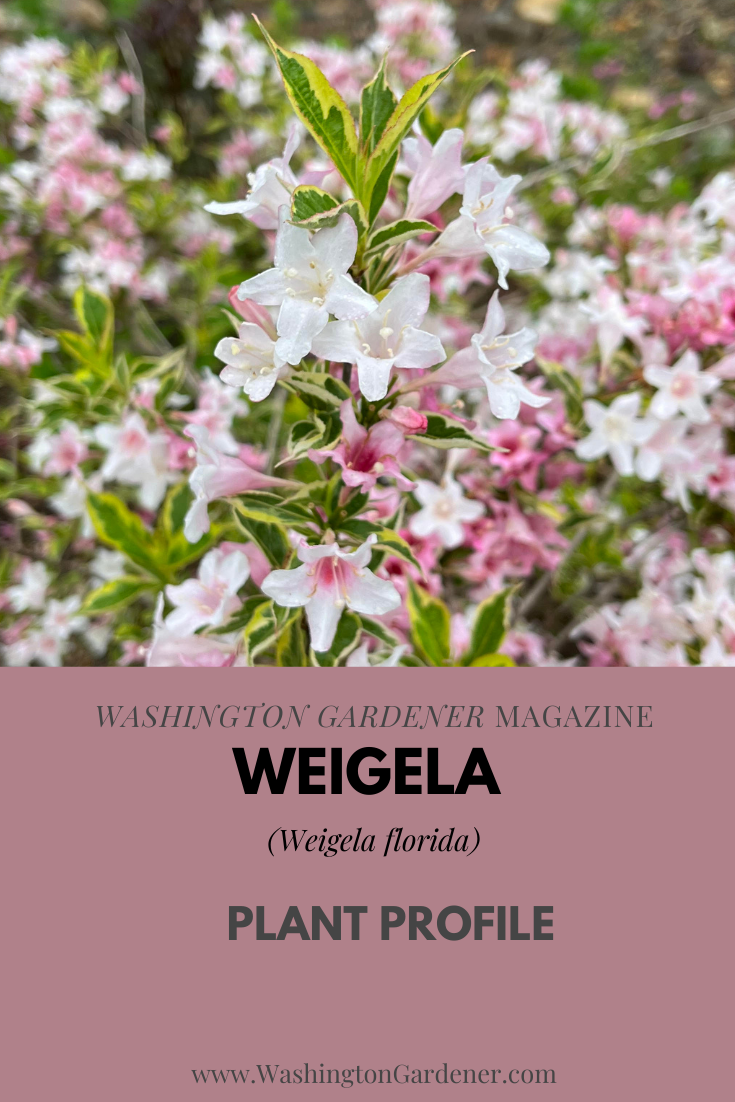
Weigela (Weigela florida) Plant Profile

Weigela (Weigela florida) Plant Profile

Some pronounce it WAY-gul-luh, others say wy-GEE-la. No matter how you say it, Weigela (Weigela florida) is a gorgeous, deciduous shrub and a stunning bloomer that attracts hummingbirds and butterflies to your garden.

   It is in the honeysuckle family and is native to Asia. It is hardy to USDA Zones 4 to 8. It can grow 6 to 10 feet wide and high. Dwarf and miniature versions are also available.

   Its tiny, tubular-shaped blooms line up along the plant’s long, bending branches in abundance in mid-spring. It also re-blooms sporadically in late summer.

   Flowers come in various shades of white, pink, and red, while the contrasting foliage can range from bright-green to dark-bronze, depending in the cultivar.

   For best blooming, plant it in full sun, although it can take a bit of shade. Water it consistently for the first few years. After that, it is quite drought-tolerant. It flowers on old wood, so do any pruning right after this year’s blooms finish.

   Some recent cultivars to try include ‘Night Tuxedo’, ‘Czechmark Trilogy™’, ‘Sonic Bloom Red’, and ‘Minuet’.

Weigela: You Can Grow That!

The video was produced by Washington Gardener Magazine as part of our Plant Profile series for Mid-Atlantic USA gardeners.

Audio, video, and text by Kathy Jentz

 If you enjoy this video, please give it a thumbs up and subscribe to our Youtube channel (thank you!)

Remember to TURN ON notifications to know when our new videos are out

 FIND Washington Gardener Magazine ONLINE

WashingtonGardener.blogspot.com

http://twitter.com/WDCGardener

https://www.instagram.com/wdcgardener/

~ Facebook.com/WashingtonGardenerMagazine

~ Podcast: GardenDC

PIN THIS FOR LATER!

Wednesday, July 22, 2020

Plant Profile: Crape Myrtle (Lagerstroemia)


Crape Myrtles are native to Asia and were introduced to the United States in 1790. Crape Myrtles are known for their colorful, long-lasting flowers that bloom in the summer. The flowers are born on long branches in panicles of crinkled blossoms with crape-like texture. Flower colors vary from deep-purple to red and white, with almost every shade in between.

After flowering, it produces seed capsules that start off green then turn dark brown. It is not necessary to cut these seeds off, unless you find them unattractive.

In the wild, most crape myrtle are multi-stemmed large shrubs, but today it is possible to find a crape myrtle filling every landscaping need from small trees to dense barrier hedges to container-sized varieties that grow only 2 foot tall.

The practice of topping-off crape myrtles to keep their growth in check is not advisable. Instead, pick a variety that is bred to reach full maturity at a smaller size.

One of the joys of crape myrtle tree is its brilliant fall color and in the winter is its beautiful, exfoliating bark. It takes a few years to develop that bark texture, so give it time.
Many of the newer crape myrtle varieties were developed at the U.S. National Arboretum in Washington, DC. These were bred to be disease-resistant and hardier for northern climates. They are generally hardy to Zone 7. If planted in colder zones, they die back to the ground each winter, but with care and lots of mulching will regenerate new growth from their roots.

‘Natchez’ (white flowers), ‘Sioux’ (dark pink), and ‘Muskogee’ (light lavender) are three of the most popular National Arboretum introductions with many more being developed by other people. Some of the newer varieties have burgundy leaves with blooms from purple to brilliant pink and others are dwarf in form.

Crape myrtles bloom on new growth, so you can prune them in the early spring, if you so desire, and they will still flower that summer.

Crape myrtle flowers most heavily in full sun. Other things that may cause Crape Myrtles to bloom less are too much water, lack of heat, and over-fertilization. Note also that crape myrtles are one of the last plants to leaf out in the spring, so if you think yours might be dead in April give it until the end of May to prove its case.

Crape Myrtle - You Can Grow That!

The video was produced by Washington Gardener Magazine.
Visuals by Taylor Calavetinos
Audio by Kathy Jentz

 If you enjoy this video, please give it a thumbs up and subscribe to our Youtube channel (thank you!)
Remember to TURN ON notifications to know when our new videos are out
 FIND Washington Gardener Magazine ONLINE
~ Facebook.com/WashingtonGardenerMagazine
~ Podcast: GardenDC on Spotify, Apple, etc.

PIN THIS FOR LATER!


Featured Post

Holiday Gifts for Gardeners ~ Top Gardening Gifts ~ 21+ Cool Gardening Gift Ideas

The holiday season is here and I bet you have a gardener on your gift list, so we've   updated   our annual a Holiday Gifts for Gardener...

Most Popular Posts