
Washington Gardener Magazine is the award-winning publication for Mid-Atlantic USA gardeners by local gardeners.
Wednesday, April 30, 2014
Video Wednesday: Historic Garden Week in Virginia 2014
House and Garden Tours across the commonwealth of Virginia are offered April 26-May 3, 2014. Tour proceeds fund the restoration and preservation of Virginia's historic gardens. Each spring visitors are welcomed to more than 250 of Virginia's most beautiful gardens, homes, and historic landmarks during "America's Largest Open House."


Monday, April 28, 2014
Latest Magazine Issue Features Fabulous Ferns for the Mid-Atlantic Gardens

You’ll also find in this issue:
• Beet Growing Tips
• Daytrip to Chanticleer Gardens
• Profile of Patterson Clark, Washington Post’s Urban Jungle columnist
• New Plant Introductions for 2014
• Garden Book Reviews
• Easy to Make Terrariums
• Native Plant Profile of Rock Polypody
• Curbing Boxwood Blight
• Battling Iris Borer
• 9 Tips for Chemical-Free Weed Control
• And much, much more...
To subscribe and start with this issue, send a check for $20.00 payable to Washington Gardener Magazine today to:
Washington Gardener
826 Philadelphia Ave.
Silver Spring, MD 20910
OR go to www.washingtongardener.com/index_files/subscribe.htm and use our PayPal credit card link.
Friday, April 25, 2014
Fenton Friday: Seedlings UP
 |
| Radish seedlings |
The peas, radish, spinach, and turnip seedlings are all popping up in good numbers. Soon I will need to thin them. The carrots, lettuce, and arugula are not really showing yet, but I'll give them in extra week or so before I panic and re-plant them.
My aspargus is pretty well done and the broccoli is starting to slowly form heads. A nice surprise today was seeing that the strawberry plants have already started to bloom.
How is your edible garden growing?
 |
| Strawberry plants already flowering |
Wednesday, April 23, 2014
Video Wednesday: Container Gardening Tips from the US Botanic Garden
Here is a timely share of a Washington Gardener Magazine video from our Youtube channel. As you pot up your containers this season, keep these tips in mind from the U S Botanic Garden on the National Mall in Washington, DC. In the summer, you have seen their wonderful container plantings -- big, bold, and healthy in the hot sun. In this video, USBG gardeners, Margaret Atwell and Beth Ahern, share some of their container gardening tips.
A few extra tips I learned from them that are not in the video footage:
~ Margaret likes to use 6 different plants per container.
~ They use their own soil mix -- basically a light potting mix.
~ After potting up, they sprinkle in Osmocote slow release fertilizer.
~ They do not use any rocks, gravel, or other fillers in the bottom of their pots for drainage.
Tuesday, April 22, 2014
Win a Leesburg Flower & Garden Festival T-shirt

The Leesburg Flower and Garden Festival is held annually on the third weekend of April. Standard event hours are 10am-6pm on Saturday and 10am-5pm on Sunday. There is a $3 suggested donation for visitors 10 years or older. This annual event heralds the coming of spring and features more than 120 vendors on the streets of historic downtown Leesburg, VA. Amazing landscape displays, plant material, annuals, perennials, tools, furniture, garden décor, and much more is on hand at this event.
To enter to win the Leesburg Flower & Garden Festival T-shirts, send an email to WashingtonGardener@rcn.com by 5:00pm on April 25 with “Leesburg T-shirts” in the subject line and in the body of the email, please also include your full name and mailing address. Tell us: “My favorite local plant sale or garden festival is.. ” The T-shirt winner will be announced and notified by April 30.
Friday, April 18, 2014
Transform an Invasive Bradford Pear Tree into a Fruiting Pear ~ Washington Gardener Enews ~ April 2014
The Washington Gardener Enews ~ April 2014 issue is now out. It is also posted and archived online at:
INSIDE THIS ISSUE:
• Back Issue Sale• April-May To-Do List
• Hardy Ferns Magazine Excerpt
• Latest Blog Links
• Local Garden Events Listings
• Transform an Invasive Bradford Pear Tree into a Fruiting Pear
• New ‘Wild Boar’ Tomato
• Reader Contest to Win Leesburg Flower and Garden Festival T-shirts
Subscribe to Washington Gardener Magazine today to have the monthly enewsletter sent to your inbox as a PDF several days before it is available online.
Fenton Friday: Frozen Foods
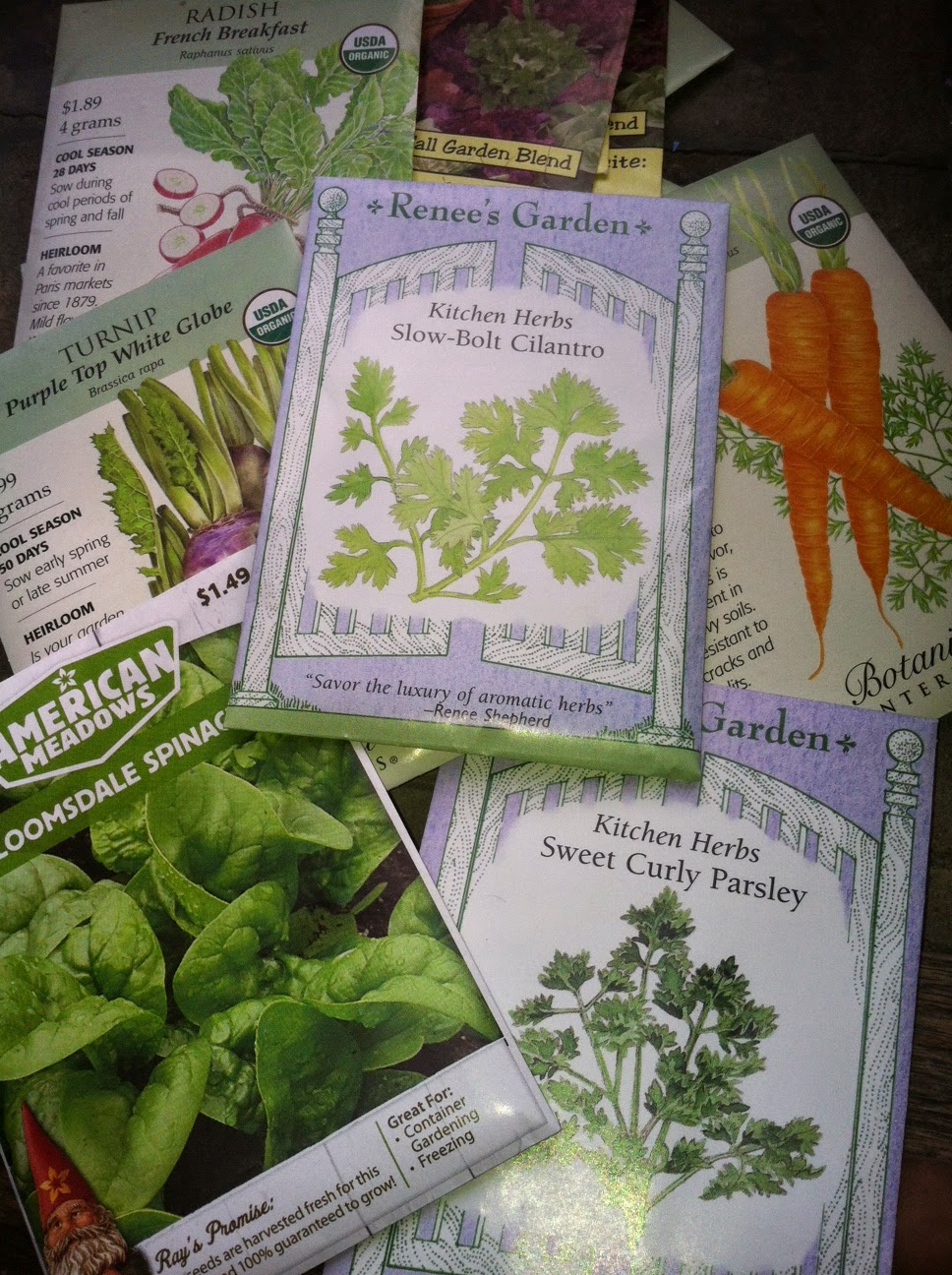
Between arctic wind blasts, I did manage to plant several rows of cool-season vegetable seeds. Those include:
~ Radish 'French Breakfast' from Botanical Interests
~ Slow-Bolt Cilantro from Renee's Gardens
~ 'Bloomsdale' Spinach from American Meadows
~ Lettuce Garden Blend from a mix given out by the Maryland Master Gardener
~ Sweet Curly Parsley from Renee's Gardens
~ Carrots 'Danvers 126' from Botanical Interests
~ Rocket aka Arugula from Love and Carrots
~ 'Purple Top White Globe' Turnips from Botanical Interests
~ and some unnamed seed potatoes shared by another gardener at the Fenton Community Garden
Given the frosty temps, I will give all of these an extra week to come up and see if any need re-seeding.
So what is growing in your edible plot today?
Wednesday, April 16, 2014
Video Wednesday: PlantBot Genetics
If you are in the DC area, I highly recommend spending a few minutes at a clever, interactive art exhibit "PlantBot Genetics" at the Montgomery College TP/SS campus on the Maryland-DC border. The artworks are a satire of modern industrial agricultural practices, but really, even if you don't care a fig about GMO or Big Ag, I think you'll still get a kick out a dahlia plant that sing's Warrant's Cherry Pie at full blast.
Here is a video of the Attackaratus. I promise the other "plants" in the exhibit are a lot more friendly.
Tuesday, April 15, 2014
A Monsoon for Garden Bloggers' Bloom Day
 |
| New Gnome Friend |
Below is the Spring Snowflake (Leucojum), which resembles the early Snowdrop (Galanthus) bulb as well as the later Lily of the Valley (Convallaria majalis). I first saw the Spring Snowflake with its elegant nodding bells scattered along a woodland pathway at Hillwood's Gardens in DC and had to have it. A gardening friend said she had lots of extras at her place and dug three small clumps for me. Aren't fellow gardeners the most generous people on this planet?
The rest of the garden is bursting with blooms and I hope they survive tonight's freeze. They include: Lilacs, Daffodils, Veronica, Snapdragons, Hellebore, Sweet Violets, Lobelia, Pansy, Hyacinth, Muscari, Tulips, Forsythia, PJM Rhododendron, Flowering Plum and Crabapple trees, Weeping Higan Cherry Tree, and Violas. Those are all that I could quickly jot down running around in the rain. I'm sure there is more, but it is growing late and I'll end with those.
What is blooming in your garden today?
 |
| Spring Snowflake (Leucojum vernum) |
Monday, April 14, 2014
Best Spots for Viewing Virginia Bluebells
Favorite Bluebell Peeping Spots (updated from a previous blog post)
 Native Virginia Bluebells are unfurling all over the Mid-Atlantic this week. (Yes, it is not just all about the Cherry Blossom here in the DC area!) Get out to view masses of these special local wildflowers while they are at their peak over these next
few weeks.
Native Virginia Bluebells are unfurling all over the Mid-Atlantic this week. (Yes, it is not just all about the Cherry Blossom here in the DC area!) Get out to view masses of these special local wildflowers while they are at their peak over these next
few weeks.
I asked the folks on the Native Plants East discussion list for their bluebell peeping suggestions. Here are their combined responses:
~ I was just out at Carderock and in some areas the bluebells are almost fully out. In others they are still in bud... I also go to places on the Virginia side such as Riverbend, Scott's Run, and Turkey Run. These will all be better Easter weekend especially since the orientation of the Virginia side of the Potomac is more northerly, so gets a bit less warming than the Maryland side. But many native wildflowers are out now and 'peeping' is great just about any time.
- Marney Bruce, Montgomery County Master Gardener
~ There are two local Bluebell festivals (Merrimac Farm and Bull Run) that took place last weekend and both parks welcome visitors. - KJ
~ Lovely stands of bluebells occur at BlockHouse Point Park which is also along the Potomac, but further out River Road. If possible park at the second (small) parking area and take the BlockHouse Trail into the woods. - Cheryl Beagle, Conservatory Gardener, Brookside Gardens
~ I've seen them on the C-and-O canal (years ago) near the locks above Swains (like Pennyfield Lock). Not sure how many are still there, and it wasn't a huge field or anything, just patches alongside the towpath. If you can get a bike out there to ride the canal, you can cover more miles to discover more patches. - Cindy Walzcak, Takoma Hort Club member
~
Turkey Run Park (the trail down to the Potomac River from the first
parking lot) has wonderful bluebell displays in mid-April. This site mentions Balls Bluff east of Leesburg and also here is a link to bluebells at River Bend. - Mary Ann Lawler, VNPS
 ~
Last weekend, I saw a lot of bluebell "buds" at Great Falls, on the
Maryland side, near the Billy Goat trail. I imagine this weekend they
would be in full and glorious bloom! - Paula Jean Harvey
~
Last weekend, I saw a lot of bluebell "buds" at Great Falls, on the
Maryland side, near the Billy Goat trail. I imagine this weekend they
would be in full and glorious bloom! - Paula Jean Harvey
~ I saw Bluebells blooming along the steam in the hosta garden at Meadowlark Botanical Gardens last
week. I know they also have them in their Potomac Wildflower
collections, but I didn't get to walk through that part of the garden. -
Mona Miller, Volunteer, Meadowlark Botanical Gardens, Vienna, VA
~ Turkey Run has bluebells along the Potomac: from parking lot C-1, take zig-zag trail down to the Potomac Heritage Trail ;
wander either up or down river from there. Also some nice smaller
patches along Woods Trail heading east (north? In the same direction as
the river flows) from the Parkway Headquarters Building. - Margaret
Chatham, Falls Church, VA, Potomac Gorge Weed Warrior at Turkey Run
Do you have any favorite spots for viewing Virginia Bluebell in the Mid-Atlantic? Please share them in the comments section below.

Be sure to read the companion blog post today on how to grow Virginia Bluebells in your own garden!
And see still MORE about growing Virginia Bluebells here.
How to Grow Virginia Bluebells
Guest Blog by Carol Allen
 When I first moved into my then-rural neighborhood, deer sightings
were a chance occurrence and I loved to ramble the TROT maintained horse
paths through the adjacent Seneca State Park. I had known of Virginia
Bluebells (Mertensia virginiana) through pictures and maybe seeing one
or two plants. Nothing quite prepared me for that first spring! I had
noticed the huge numbers of the emerging cluster of leaves where the
horse path forded a stream and the banks were wide and gently sloped. I
wondered what could possibly be so numerous. Some sort of alien
invasive? Back then the biggest concern was Japanese Honeysuckle and
abandoned home sites with their masses of Vinca minor. By the last part
of March and the first week of April, the plants were uncurling and
showing color. There were hundreds and hundreds of Virginia
Bluebells covering areas bigger than city lots! Yes, I succumbed to the
temptation and dug up a couple of the younger plants. I found that
mature plants had deep, heavy parsnip-like roots that resisted
transplanting. That was 40 years ago.
When I first moved into my then-rural neighborhood, deer sightings
were a chance occurrence and I loved to ramble the TROT maintained horse
paths through the adjacent Seneca State Park. I had known of Virginia
Bluebells (Mertensia virginiana) through pictures and maybe seeing one
or two plants. Nothing quite prepared me for that first spring! I had
noticed the huge numbers of the emerging cluster of leaves where the
horse path forded a stream and the banks were wide and gently sloped. I
wondered what could possibly be so numerous. Some sort of alien
invasive? Back then the biggest concern was Japanese Honeysuckle and
abandoned home sites with their masses of Vinca minor. By the last part
of March and the first week of April, the plants were uncurling and
showing color. There were hundreds and hundreds of Virginia
Bluebells covering areas bigger than city lots! Yes, I succumbed to the
temptation and dug up a couple of the younger plants. I found that
mature plants had deep, heavy parsnip-like roots that resisted
transplanting. That was 40 years ago.
The spot down by the ford is long gone, a victim of deer overpopulation and an upstream housing development causing massive erosion of the stream bank. My "little" patch? ....is now a couple of hundred feet square!
Virginia Bluebells are true spring ephemerals and complete their life cycle before the tree's leaves are fully mature. The clustered buds are pink and the flowers open and mature to a beautiful lavender-blue. The leaves are oval and grey-green with the plants reaching a height of 1 - 2'. They are summer dormant and are gone by late June in our area. Bluebells can be found in floodplains and areas of moist soil. Mine have flourished in good garden soil with the occasional summer drought-relieving watering.
Seed can be collected in early June as the stems collapse. They can be sown in the fall for spring germination or stored, cold stratified and sown out in the early spring. Crowns can be divided as well. Virginia Bluebells are easy to propagate and can be found in most good nurseries.
 Native Americans used the roots of Virginia Bluebells to treat
tuberculosis, whooping cough, and other ailments. Today it is listed as
either vulnerable or threatened in both New York and Michigan. Virginia
Bluebells are reported to be rabbit-resistant, but sadly they are not
deer-resistant.
Native Americans used the roots of Virginia Bluebells to treat
tuberculosis, whooping cough, and other ailments. Today it is listed as
either vulnerable or threatened in both New York and Michigan. Virginia
Bluebells are reported to be rabbit-resistant, but sadly they are not
deer-resistant.
About the Author
Carol Allen describes herself as a committable plant-a-holic. She has more than 25 years’ experience in the horticulture industry with special interest in plant pests and diseases and is a Licensed Pesticide Applicator in the states of Maryland and Virginia. Carol can be contacted at carolallen@erols.com. Carol is also the "InsectIndex" columnist for Washington Gardener Magazine.
Be sure to also visit the companion blog post on great spots in the DC-region to view masses of Virginia Bluebells in bloom.
The spot down by the ford is long gone, a victim of deer overpopulation and an upstream housing development causing massive erosion of the stream bank. My "little" patch? ....is now a couple of hundred feet square!
Virginia Bluebells are true spring ephemerals and complete their life cycle before the tree's leaves are fully mature. The clustered buds are pink and the flowers open and mature to a beautiful lavender-blue. The leaves are oval and grey-green with the plants reaching a height of 1 - 2'. They are summer dormant and are gone by late June in our area. Bluebells can be found in floodplains and areas of moist soil. Mine have flourished in good garden soil with the occasional summer drought-relieving watering.
Seed can be collected in early June as the stems collapse. They can be sown in the fall for spring germination or stored, cold stratified and sown out in the early spring. Crowns can be divided as well. Virginia Bluebells are easy to propagate and can be found in most good nurseries.
About the Author
Carol Allen describes herself as a committable plant-a-holic. She has more than 25 years’ experience in the horticulture industry with special interest in plant pests and diseases and is a Licensed Pesticide Applicator in the states of Maryland and Virginia. Carol can be contacted at carolallen@erols.com. Carol is also the "InsectIndex" columnist for Washington Gardener Magazine.
Be sure to also visit the companion blog post on great spots in the DC-region to view masses of Virginia Bluebells in bloom.
Subscribe to:
Posts (Atom)
Featured Post
Holiday Gifts for Gardeners ~ Top Gardening Gifts ~ 21+ Cool Gardening Gift Ideas
The holiday season is here and I bet you have a gardener on your gift list, so we've updated our annual Holiday Gifts for Gardeners ...

Most Popular Posts
-
 The rain held off and we had more than 200 people come to yesterday's Washington Gardener Magazine 16th Annual Tomato Taste at the Fre...
 -
 In this episode of GardenDC: The Podcast about Mid-Atlantic Gardening, we talk with Helen Yoest , author of Cultivating Native Plants for P...
 -
 “In this broken world where nature is increasingly being made homeless, and where many wild species’ populations are trending downwards, we ...