Here in the Mid-Atlantic USA (USDA zone 7) on the DC-MD border, the past month has been a fairly mild mid-autumn. My garden is slowing down, but we haven't had a hard freeze yet. That means I have lots of annuals still. Some of them are even thriving and reviving in this cooler period. In particular, the fuchsia in my hanging pots on my gazebo (pictured here) is coming back strong and is looking stunning in the autumn light.
Other annuals still looking good include bacopa, impatiens, torenia, violas, snapdragons, and salvia.
What is blooming in your garden today? It is the 15th of the month, which means Garden Bloggers' Bloom Day again. To view links to other garden bloggers' blooms around the world to see what it blooming in their gardens today and to read their collective comments, go to: https://www.maydreamsgardens.com/2020/11/garden-bloggers-bloom-day-november-2020.html
This episode we talk with April Thompson, a food writer and director of sales and marketing for Bloom, about foraging for wild edibles. The plant profile is on Smokebush and I share some foliage highlights in my garden.
BTW, YOU can become a listener supporter for as little as $0.99 per month! See how at: https://anchor.fm/kathy-jentz/support.
Google Podcasts at this link, either now or soon (note that currently, this link will only work on Android devices)
We welcome your questions and comments! You can leave a voice mail message for us at: https://anchor.fm/kathy-jentz/message Note that we may use these messages on a future episode.
This fall I planted Watermelon Radish seeds and those are a few weeks away still from harvest. However, I was still able to harvest some radishes as I had the 'White Icicle' and the 'Cherry Belle' ones from the springtime self-sow. This one pictured here grew mostly above ground so it is a bit more green than "white" - but it will be just as tasty after I peel off that outer layer.
Elsewhere in the plot, the interns harvested more Lettuce and the Arugula is getting up to a decent size. The Broccoli is looking a bit worse as some insect is chewing up the leaves and no flowerheads have formed yet.
I also picked 4 more small Eggplants off the one container plant. With a freeze warning for tonight and tomorrow, I think this may finally be it for that plant and the last of the Cherry Tomatoes.
I am letting the Okra go woody as I want to collect the seed pods to use in holiday decorating and I have also left the Holy Basil (Tulsi) in place as it just keeps on blooming. I am happy to have it re-seed in place where it is.
What plants do you leave for seed in your garden plot?
About Fenton Friday: Every Friday during the growing season, I'll be giving you an update on my community garden plot at the Fenton Street Community Garden just across the street from my house in zone 7 Mid-Atlantic MD/DC border. I'm plot #16. It is a 10 ft x 20 ft space and this is our 8th year in the garden. (It opened in May 2011.) See past posts about our edible garden by putting "Fenton" into the Search box above.
Gomphocarpus
physocarpusa member
of the Milkweed family that has many common names including Hairy Balls, Giant
Swan Plant, Goose Plant, Family Jewels, Oscar, Monkey Balls, and Balloon Plant.
(Asclepias physocarpa is the former
botanical name.)
It is native to South America and grown as an annual in our
region.It is hardy to zones 9-11.
It prefers full sun and moderate moisture.It can grow 4-6 feet high. The flowers are
not that showy, but the seed pods are a show-stopper.
Like other Milkweeds, it supports Monarch caterpillars and
butterflies – as well as other pollinators. It is also deer-resistant.
You can start seeds indoors a few weeks before the last
expected frost date in spring and then transplant them outdoors.
This plant is a favorite for flower arrangements. The
seedpods dry nicely and it makes a terrific conversation starter in the
landscape or on a table.
Gomphocarpus
physocarpus- You Can
Grow That!
The video was produced
by Washington Gardener Magazine.
Visuals by Nicole Noechel
Audio by Kathy Jentz
Filmed at the U.S. Botanic
Garden in Washington, DC.
➤ If you enjoy this video, please give it a thumbs up
and subscribe to our Youtube
channel (thank you!)
➤Remember to TURN ON notifications to know when our new
videos are out
A Truly Green Holiday:
A Talk on Seasonal Plants and a Bulb Forcing Demo
Have you ever given or
gotten a beautiful blooming poinsettia or amaryllis and then slowly watched it
decline? What a New Year's bummer! This talk will teach you how to care
for classic seasonal plants. She'll also cover some unique holiday plant
choices as well that make great gifts and additions to your home decor.
Finally, she'll teach you bulb forcing basics--tricking spring-blooming bulbs
like tulips into flower earlier to enjoy during those seemingly endless gray
days of late winter when we crave green the most. Speaker: Kathy
Jentz, Washington Gardener Magazine.
Groundcovers are low-growing plants that serve many
different purposes in the landscape from limiting weed growth to stabilizing
slopes to adding texture to your garden. Find out more about these beautiful,
hard-working plants and the best kinds to use for the Mid-Atlantic region.
Speaker: Kathy Jentz, Washington Gardener Magazine.
*All of the webinars are held via Zoom. Once you register, you will get a confirmation and a link to the Zoom connection details. Note that if you cannot attend the live class, you can still register and get a link to view the class recording for two weeks after the actual class date.
This episode we talk with David Mizejewski, naturalist with the National Wildlife Federation about creating backyard habitats. The plant profile is on Russian Sage and I look for ways to light the dark.
BTW, YOU can become a listener supporter for as little as $0.99 per month! See how at: https://anchor.fm/kathy-jentz/support.
Google Podcasts at this link, either now or soon (note that currently, this link will only work on Android devices)
We welcome your questions and comments! You can leave a voice mail message for us at: https://anchor.fm/kathy-jentz/message Note that we may use these messages on a future episode.
Somehow we got spared the worst of the frost, though the bitter nighttime temperatures and arctic-like winds were not kind to many things in my home garden. Notably, the Coleus and Impatiens are looking pretty ragged.
In the garden plot, I planted Carrot and Spinach seeds plus more Garlic. I also top-dressed with straw and compost the areas I'd cleared out from summer crops.
The growing season is winding up, so there may be a few more Fenton Friday posts from our fall semester interns on what they grew. Other than those, this may be my last in the series for this growing season. Looking back, it was a fairly successful one -- though an unusual one -- with COVID precautions, freezing temps on Mother's Day weekend, and a wet August/September.
My biggest lesson from this year will be to start the cool season edibles earlier -- both in February for a spring harvest and in July for the autumn harvest.
How was the 2020 growing year for you? What lessons will you carry over for 2021?
About Fenton Friday: Every Friday during the growing season, I'll be giving you an update on my community garden plot at the Fenton Street Community Garden just across the street from my house in zone 7 Mid-Atlantic MD/DC border. I'm plot #16. It is a 10 ft x 20 ft space and this is our 8th year in the garden. (It opened in May 2011.) See past posts about our edible garden by putting "Fenton" into the Search box above.
Smokebush is a shrub with many ornamental qualities. It has beautiful
foliage and the airy seed-heads look like puffs of smoke surrounding the bush.
Smokebush (Cotinus coggygria)
is also known as Rhus cotinus,
the European smoketree, and Venetian sumach. It is a member of the cashew family.
There is an American native version as well (C. obovatus).
It needs full sun to put on a real “smoke show,” but it can
tolerate shade conditions. It is a tough
plant and needs little care. It is hardy from zones 5 to 8. It can reach up to
6 feet high and wide.
Use caution when mowing or working around a Smokebush, as
the bark is thin and easily damaged by weed whackers or other garden equipment.
It is deer- and rabbit-resistant.
Popular cultivars available include ‘Winecraft Gold’,
with bright golden foliage, and ‘Winecraft Black’, which has dramatic dark foliage
and a dwarf habit. Look in garden centers starting in 2021 for a new introduction
called ‘The Velvet Fog’ from the Proven Winners brand. It has bright pink
plumes with blue-green foliage.
Smokebush makes a good accent plant in the landscape or it can
be grown in a grouping to form a hedge. It is deciduous and drops its leaves in
late fall.
It can be trained and pruned to grow as a tree or a shrub. To
prune a Smoketree, wait until late winter or early spring and selectively
remove entire branches to attain the shape you like.
Smokebush - You Can Grow That!
The video was produced
by Washington Gardener Magazine.
Visuals by Nicole Noechel
Audio by Kathy Jentz
Additional footage provided
by Spring Meadow Nursery
➤ If you enjoy this video, please give it a thumbs up
and subscribe to our Youtube
channel (thank you!)
➤Remember to TURN ON notifications to know when our new
videos are out
This craft is an ideal convergence of two of my favorite pastimes -- gardening and reading. It came out so well, that I am thinking of making more for holiday gifts. I have many friends who share my plant and book obsessions -- it will be fun to match a vintage title with their interests.
For this project, I sorted through a box of old volumes in my attic recently and chose a book that I thought would be a good candidate for this craft. It was a hardback sci-fi tale with a few torn pages and a missing book jacket.
For some people, using a book may seem like heresy, but as someone who has volunteered at a library book store for years and has seen how many books go in the incinerator or are "remaindered" in a dumpster because they are not in sellable shape, I can attest that being re-made as art or decor is a much better fate for a slightly damaged book. If you have a book in less-than-perfect shape, you might consider this, rather than trying to donate it knowing it will likely get destroyed if it is not in close to perfect condition.
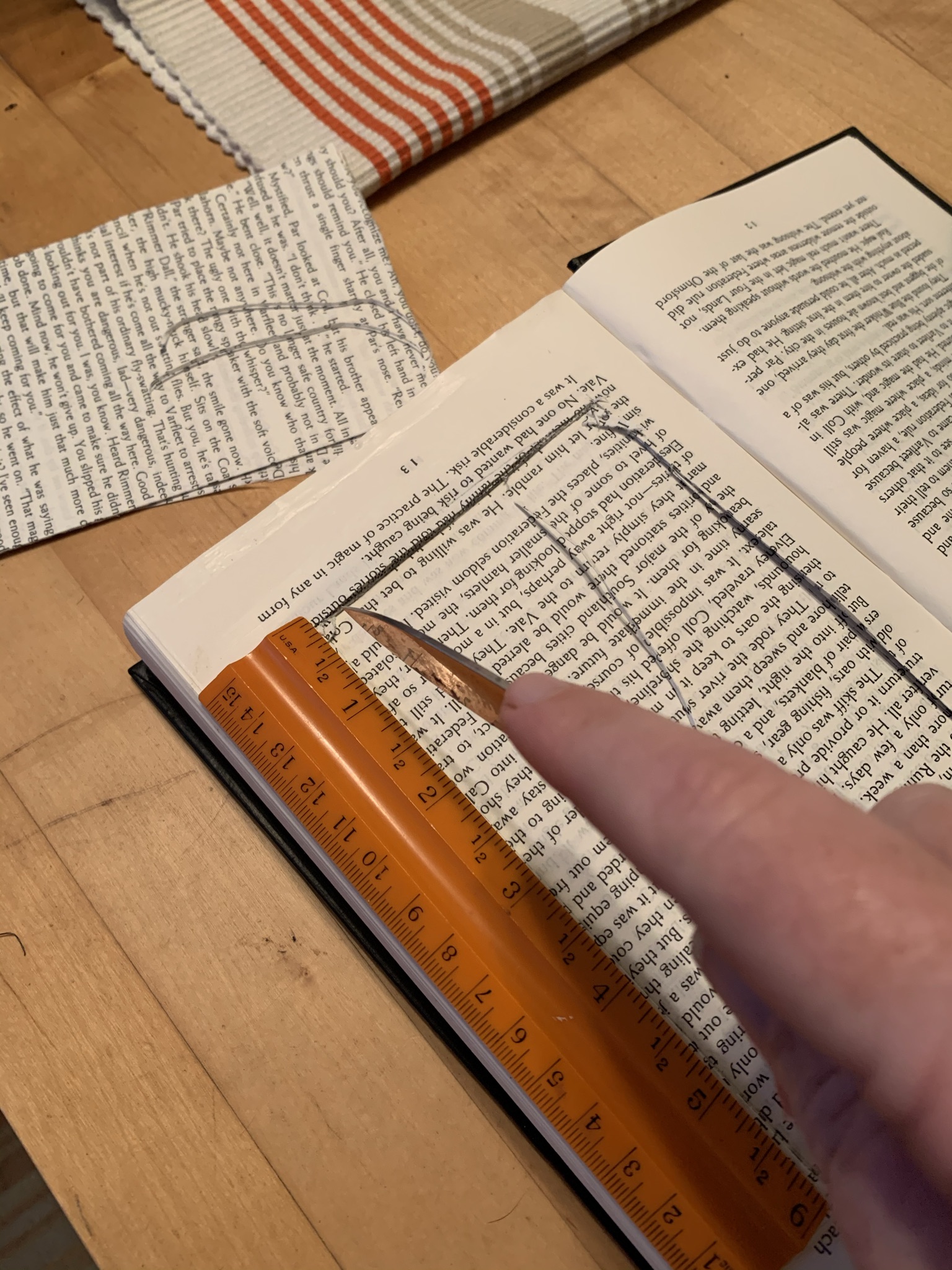
Step 1: Open up the book to about 10 pages in and crease it open. Put a heavy weight on the open book to keep it open. (I used a large ceramic pot.) Then spread Mod Podge using a foam brush liberally around the ends of the pages that you will be cutting a hole into later. Let it drive overnight. (I did a second layer of Mod Podge to be super-secure.)
Step 2: Measure in an inch from the page edges with a ruler and then begin cutting out the inner part of the page to create your planting hole. This is the longest and most tedious part of the process. To get through 150+ pages it took me a few hours total. I rested my hands and wrists when they started to get tired. I did it over a few days --working for about a half-hour at a time. Switch out the blade on your knife for a new one when the old one gets dull. The page cuts don't have to be perfect as you are lining and they will be hidden. Be careful not to rush or get distracted, so you don't cut yourself!
Step 3: Once you have excavated your planting hole. Line it with a plastic bag.
Step 4: Scoop some potting mix into the plastic lining and then plant your succulents inside it. Arranges as you like.
Step 5: Trim off any plastic sticking out around the planting hole's edges.
Step 6: Place decorative pebbles around the succulents and covering any bare potting mix. You can also use Spanish moss or aquarium gravel for this.
Tips and Care:
Choose succulent plants that are small and shallow rooted. Once they grow larger, you may want to pull them out and replace them with new, smaller selections.
About once a week, sprinkle the succulents with a bit of water. Try not to water the surrounding book pages.
Display the finished book planter on a stack of books on a side table in a sunny space.
Some people cut out the hardback cover and plant through that. This results in plantings coming out of the front of a closed book, but I personally like the look of an open book myself.
This post contains affiliate links, which means that if you click on one of the product links, I’ll receive a few pennies from Amazon.
This is a monthly blog series on DIY projects for the beginning home gardener. Look for the other installments in this DIY blog series by putting "DIY" in the search box here at washingtongardener.blogspot.com.
This episode we talk with Marie Mims Butler about her experiences gardening for wildlife at the Virginia Zoological Park in Norfolk, VA. The plant profile is on Tall Sedum and I share a bit about the late-blooming Roses in my garden.
BTW, YOU can become a listener supporter for as little as $0.99 per month! See how at: https://anchor.fm/kathy-jentz/support.
Google Podcasts at this link, either now or soon (note that currently, this link will only work on Android devices)
We welcome your questions and comments! You can leave a voice mail message for us at: https://anchor.fm/kathy-jentz/message Note that we may use these messages on a future episode.
Eric Bond of Takoma Radio stopped by again and we recorded another segment* in the garden. He watched as I demonstrated how to plant Garlic and added straw mulch to the beds. I showed off the great looking Lettuce and a 'White Icicle' Radish I pulled out that had self-sown from the spring.
Elsewhere in the plot, the Arugula and two rows Watermelon Radish 'Mantanghong' are growing well. I harvested Okra and what will be the last of the mini Eggplants as we are predicted to get a frost/freeze this evening.
I think I have officially given up on the White Bunching Onions, Cilantro, and Moss Curly Parsley seeds. They were old packets and I don't think any germinated. I may try again with new seeds -- depending on how the weather is next week.
The Snap Peas 'Sugar Magnolia' continue to climb up their trellis -- still no flowers or pea pods!
The Broccoli seedlings are getting nibbled on a bit by bugs -- no florets forming yet.
I pulled all the Basil and I hope to get time tomorrow to make a big batch of pesto made for freezing.
What are you harvesting in your garden this week?
*The radio segment will air on Sunday, November 1
at 2pm ET. You can listen online at: https://takomaradio.org/.
About Fenton Friday: Every Friday during the growing season, I'll be giving you an update on my community garden plot at the Fenton Street Community Garden just across the street from my house in zone 7 Mid-Atlantic MD/DC border. I'm plot #16. It is a 10 ft x 20 ft space and this is our 8th year in the garden. (It opened in May 2011.) See past posts about our edible garden by putting "Fenton" into the Search box above.