Showing posts with label pollinator. Show all posts

Wednesday, October 08, 2025

Gentian Plant Profile

Gentian Plant Profile

Closed Bottle Gentian (Gentiana andrewsii) is native throughout the northeastern half of the United States.

It is a perennial wildflower with blue/purple blooms that are nearly closed at the tip. They are arranged in a tight clusters atop the stem and at full bloom when look like they are buds about to open fully—though they never do. There are also some naturally occurring white versions of the flower.

Closed Bottle Gentian is hardy to zones 3-7. These plants are slow-growing, but long-lived and are very low-maintenance. They bloom from late summer into mid-fall and are not bothered by an early frost.

It grows best in moist, rich soils either in full or partial sun.

Bottle Gentian is pollinated by bumblebees that pry open the flower to crawl inside and sip nectar plus deposit pollen.

Gentian: You Can Grow That!


The video was produced by Washington Gardener Magazine.

Audio, Video, and Text by Kathy Jentz

Editing by Ellen Isaacson


 If you enjoy this video, please give it a thumbs up and subscribe to our Youtube channel (thank you!)

Remember to TURN ON notifications to know when our new videos are out

 FIND Washington Gardener Magazine ONLINE

WashingtonGardener.blogspot.com

http://twitter.com/WDCGardener

https://www.instagram.com/wdcgardener/

~ Facebook.com/WashingtonGardenerMagazine

~ Podcast: GardenDC


If you liked this video, we think you will like these other Plant Profiles:

~ Trout Lily Plant Profile

https://washingtongardener.blogspot.com/2025/04/trout-lily-plant-profile.html

~ Virginia Bluebells Plant Profile

 https://washingtongardener.blogspot.com/2018/04/plant-profile-virginia-bluebells.html

~ Baptisia Plant Profile

https://washingtongardener.blogspot.com/2023/07/baptisia-plant-profile.html

PIN THIS FOR LATER!

Wednesday, August 13, 2025

Stokesia Plant Profile


Stokesia Plant Profile

Stokes’ Aster (Stokesia laevis) is a perennial plant with white, pink-ish, blue, or purple flowers that bloom from summer into early fall. The flowers resemble thistles, but are much fluffier. The dark green foliage is evergreen.

It is hardy to USDA Zone 5 to 9.

It is native to North Carolina to Louisiana. Its native habitat is in the coastal plains, bogs, pine savanna, and open woodlands. It attracts butterflies and bumblebees.

Stokes Aster does best in full to part sun in moist, acidic soils with good drainage.

It is somewhat deer- and rabbit-resistant.

Remove spent flowers to prolong the bloom season. Other than that, this plant is extremely low-maintenance.  

You can propagate it by dividing Stokesia clumps in spring or fall.

Available cultivars include ‘Blue Danube’, ‘Rosea’, and ‘Silver Moon’.

Stokesia: You Can Grow That!


The video was produced by Washington Gardener Magazine.

Audio, Photos, Video, and Text by Kathy Jentz

Editing by Miguel Zarate


 If you enjoy this video, please give it a thumbs up and subscribe to our Youtube channel (thank you!)

Remember to TURN ON notifications to know when our new videos are out

 FIND Washington Gardener Magazine ONLINE

WashingtonGardener.blogspot.com

http://twitter.com/WDCGardener

https://www.instagram.com/wdcgardener/

~ Facebook.com/WashingtonGardenerMagazine

~ Podcast: GardenDC


If you liked this video, we think you will like these other Plant Profiles:

~ Echinacea Plant Profile

https://washingtongardener.blogspot.com/2019/07/video-plant-profile-coneflowers.html

~ Gaura Plant Profile

https://washingtongardener.blogspot.com/2025/08/gaura-plant-profile.html

~Shasta Daisy Plant Profile

https://washingtongardener.blogspot.com/2023/08/shasta-daisy-plant-profile.html


Pin this for later!

Wednesday, August 06, 2025

Gaura Plant Profile


Gaura Plant Profile

Gaura (Oenothera lindheimeri previously Gaura lindheimeri)) is an herbaceous flowering plant with a floppy, weeping habit that looks good in a cottage garden or planted in containers. It has star-shaped blooms in shades of pale pink and white that flower from late summer into fall.

It is also known as Butterfly Gaura, Lindheimer's Beeblossom, Indian Feather, and Wand Flower. The flowers  attract bumblebees, long-tongue bees, and butterflies.

Though it is reportedly hardy to USDA Zones 5 to 9, it is an annual or tender perennial (also known as temperennial) in our region – depending on your zone and how harsh and wet the winter weather is each year and how heavy your clay soil is. As an extra measure to winter them over, you can add straw mulch around the base to insulate them.

Gaura grows best in full sun and well-draining soils. It is native to Louisiana and Texas.

Cut it back after it finishes flowering and divide the large clumps in mid-spring. You can take cuttings in the fall to propagate them indoors

A few Gaura cultivars to try include 'Siskiyou Pink' and ‘Whirling Butterflies’.

Gaura: You Can Grow That!


The video was produced by Washington Gardener Magazine.

Audio, Photos, Video, and Text by Kathy Jentz

Editing by Ian Ferris


 If you enjoy this video, please give it a thumbs up and subscribe to our Youtube channel (thank you!)

Remember to TURN ON notifications to know when our new videos are out

 FIND Washington Gardener Magazine ONLINE

WashingtonGardener.blogspot.com

http://twitter.com/WDCGardener

https://www.instagram.com/wdcgardener/

~ Facebook.com/WashingtonGardenerMagazine

~ Podcast: GardenDC


If you liked this video, we think you will like these other Plant Profiles:

~ Blazing Star Plant Profile

https://washingtongardener.blogspot.com/2022/07/blazing-star-plant-profile.html

~ Black Cohosh Plant Profile

https://washingtongardener.blogspot.com/2025/07/black-cohosh-plant-profile.html

~ Fleabane Plant Profile

https://washingtongardener.blogspot.com/2025/05/fleabane-plant-profile.html

 Pin this for later!

Wednesday, July 09, 2025

Black Cohosh Plant Profile

Black Cohosh Plant Profile

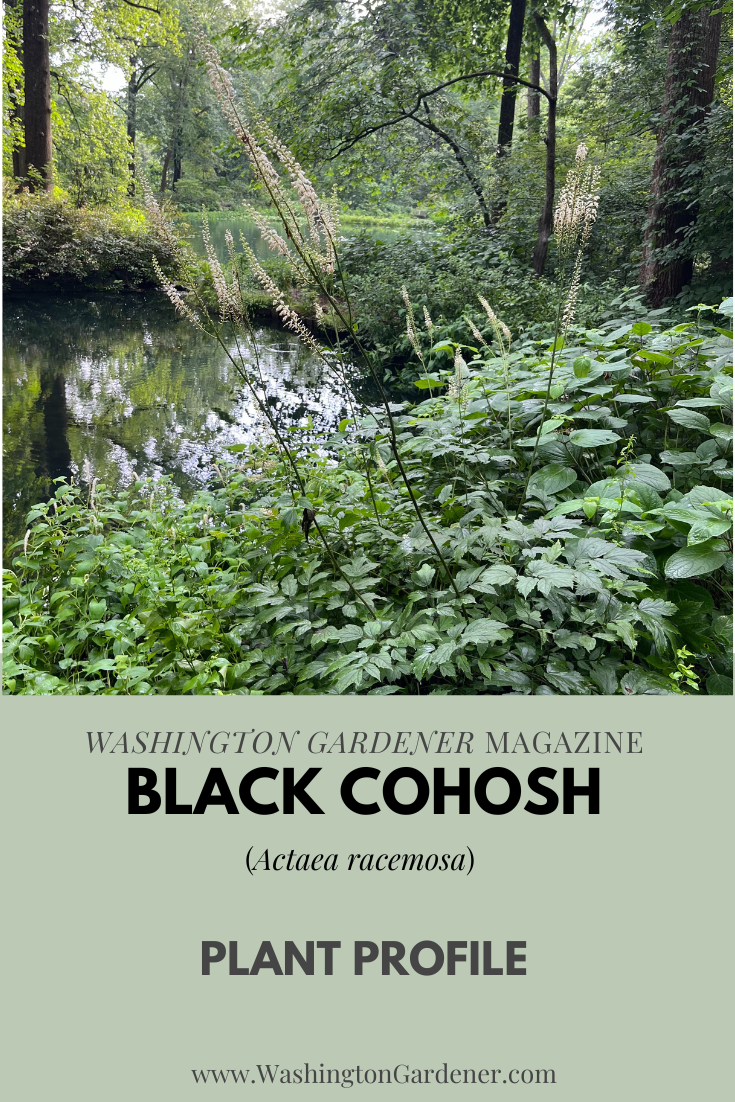
Black Cohosh  (Actaea racemosa formerly Cimicifuga racemosa) is a perennial plant with a base of dark green foliage that sends up tall white blooms in the early summer. It can grow from 3 to 8 feet tall and about 3 feet wide.

It is also known as Bugbane, Fairy Candle, and Black snakeroot. It is a member of the Buttercup family.

It is native to the eastern half of the U.S., where it grows naturally in moist deciduous woodlands. It is hardy to USDA Zones 3 to 8.

Black Cohosh prefers to grow in full to part shade in rich soils, yet is fairly drought tolerant once established.

Black Cohosh is a good choice for filling in the spaces when spring ephemerals have gone dormant.

Native Americans used Black Cohosh for a variety of medicinal purposes and it is used today in menopause treatments.

Pollinators love it. It is also the larval host for the Appalachian Azure butterfly. It is deer-and rabbit-resistant.

Black Cohosh can be started easily from seed. The seeds should be collected in the fall and planted immediately. It will take a couple years for the plants to flower. You can also divide the plants in the early spring or late fall.

Black Cohosh: You Can Grow That!

The video was produced by Washington Gardener Magazine as part of our Plant Profile series for Mid-Atlantic USA gardeners.

Audio, video, and text by Kathy Jentz

Editing by Ian Ferris

If you enjoy this video, please give it a thumbs up and subscribe to our Youtube channel (thank you!)

Remember to TURN ON notifications to know when our new videos are out

FIND Washington Gardener Magazine ONLINE

~ WashingtonGardener.blogspot.com

~ http://twitter.com/WDCGardener

~ https://www.instagram.com/wdcgardener/

~ Facebook.com/WashingtonGardenerMagazine

~ Podcast: GardenDC


If you liked this video, we think you will like these other Plant Profiles:

~ Lotus Plant Profile

https://washingtongardener.blogspot.com/2023/08/lotus-plant-profile.html

~ Carolina Allspice Plant Profile

 https://washingtongardener.blogspot.com/2022/05/carolina-allspice-plant-profile.html

~ Little Bluestem Grass Plant Profile

https://washingtongardener.blogspot.com/2022/08/little-bluestem-grass-plant-profile.html


PIN THIS FOR LATER!

Wednesday, July 19, 2023

Bronze Fennel Plant Profile

Bronze Fennel Plant Profile

Bronze Fennel (Foeniculum vulgare) is an ornamental perennial herb whose ferny, soft foliage and bright yellow flowers make it a favorite background plant for many gardeners.

Its wispy, tall stems look great in combination with other plants such as rose bushes. The cultivar ‘Purpureum’ is especially attractive with a darker, smoky plum coloring to its foliage.

Plant it in full sun and it will grow to up to 6 feet high. It does not need staking or fertilizing. It is hardy to USDA zones 5 to 9 and is native to the Mediterranean and southwest Asia.

It is not the kind of fennel that produces a large edible bulb at its base. Instead, it looks and grows more similarly to dill or anise.

Bronze Fennel is also a great addition to the pollinator garden. The flowers attract many kinds of bees and hoverflies. It is also a host plant that supports the Black Swallowtail butterfly’s caterpillars.

You can collect the fragrant fresh leaves to use in fish dishes and the dried seeds in a variety of savory or sweet recipes.

Bronze Fennel is deer-resistant and it has no serious diseases issues.

It will self-seed around, if you let it, but it is easy to pull and transplant it when it is at the seedling stage to another place in your garden.

Bronze Fennel: You Can Grow That!

The video was produced by Washington Gardener Magazine as part of our Plant Profile series for Mid-Atlantic USA gardeners.

Audio and text by Kathy Jentz

Video and editing by Taylor Edwards

If you enjoy this video, please give it a thumbs up and subscribe to our Youtube channel (thank you!)

Remember to TURN ON notifications to know when our new videos are out

FIND Washington Gardener Magazine ONLINE

~ WashingtonGardener.blogspot.com

~ http://twitter.com/WDCGardener

~ https://www.instagram.com/wdcgardener/

~ Facebook.com/WashingtonGardenerMagazine

~ Podcast: GardenDC

 PIN THIS FOR LATER!

Saturday, July 15, 2023

GardenDC Podcast Episode 156: Gardening for Wild Bees

In this episode of GardenDC: The Podcast about Mid-Atlantic Gardening, we chat with Sam Droege, a wildlife biologist at the USGS, all about gardening for native and specialist bees. The plant profile is on Bronze Fennel and we share what's going on in the garden as well as some upcoming local gardening events in the What's New segment. We close out with a tribute to the late, great garden writer Pam Harper* as our Last Word.


If you liked this episode, you may also enjoy listening to:

~ GardenDC Podcast Episode 47: Pollinator Victory Gardens

https://washingtongardener.blogspot.com/2021/02/gardendc-podcast-episode-47-pollinator.html

~ GardenDC Podcast Episode 141: Nature's Best Hope with Doug Tallamy 

https://washingtongardener.blogspot.com/2023/03/gardendc-podcast-episode-141-natures.html

~ GardenDC Podcast Episode 31: Beekeeping

https://washingtongardener.blogspot.com/2020/10/gardendc-podcast-episode-31-beekeeping.html

This episode is archived at: 
*Amazon affiliate link. Any purchases here made there may add a few pennies to the GardenDC account, but will not impact the prices you pay.

BTW, YOU can become a listener supporter for as little as $0.99 per month! 

SHOW NOTES: 01:07 Meet Sam Droege, a wildlife biologist at the United States Geological Survey (USGS). 04:40 Droege’s childhood environment in Hyattsville, Maryland 07:03 What does Droege grow and prioritize in his own personal and professional gardens? 09:44 How to switch invasive species to native plants. 12:45 What invasive plants get through despite using this method? 14:46 “In lots of our cases we just bury everything and then deal with what comes up,” with the perennials coming back up through the mulch in following years. 16:24 Most facts people have about bees are about honey bees, not native bees. Honey bees are not native to America, meaning they are much less involved in pollinating native plants. Wild bees, however, are incredibly important to the native ecosystem. 18:20 Clearing up native bee misconceptions. 19:35 The honey bee collapse (and how it wasn’t what people thought). 21:34 “About 40% of the native pollen-carrying bees are highly specialized.” 22:58 You can make a big difference in the bee population by planting diverse and native plants. 25:49 A quick guide on how to help from your own home: “If you want to save wild bees, you plant native plants of a variety of kinds.” 28:18 Which plants should you grow? Pick native plants that bloom throughout the year and have an unusually colored blossom (blue, white, yellow). 29:53 Pollen Specialist Bees of the Eastern United States: https://jarrodfowler.com/specialist_b... 30:58 Diversity matters. Different colors and shapes attract different bees, helping each different species. 32:44 How cutting your yard affects the ecosystem: “You cut anything during the year - during the growing season - you’ve eliminated almost all the fall flowers.” 34:44 Don’t think your space is too small. It can take as little as five flowers to provide enough pollen for a bee to create a nest and have a bee baby. 35:51 For small space gardeners, there are tons of options. You may only be able to choose a couple of plants, but many native plants are amenable to container gardening if they’re treated well. 40:00 Composites and bees. 42:08 Significant conservation is typically dependent on shrubs and perennials due to their specialized nature. 43:51 Native flower-abundant shrubs: Pinxter Azalea, New Jersey Tea, and Dogwood varieties. 44:10 Azaleas and bees. 45:26 You don’t need to know the details to help -- planting native plants makes a big difference. 47:28 “Forest Bathing” is great for the mental health of everyon. Bringing that into your own neighborhood can help your own mental state and the neighbors around you. 51:03 Droege’s favorite wild bees. 53:38 Find Droege on social media through Facebook, Twitter, and Tumblr: @usgsbiml 54:39 Access beautiful photos at USGS’s Flickr account: @usgsbiml 55:53 Contact Droege through email: sdroege@usgs.gov 57:30 Bronze Fennel: This week’s Plant Profile! 59:25 Garden Updates: The Cup Flower is starting to bloom, the Vitex is just forming buds. At the community garden the Zucchini, Tomatoes, Peppers, and cut-flower garden are all doing well. 59:56 Upcoming Events: The Washington Gardener Photo Show Opening Reception; Montgomery County Agricultural Fair; Ladew Topiary Gardens “Come Inside” Open House; Common Good City Farm Back-to-School Tomato Jam ; Urban Tree Summit with Casey Trees (https://caseytrees.org/urban-tree-sum.... 1:02:48 “The Urban Garden” by Kathy Jentz and Teri Speight. 1:03:48 “Groundcover Revolution” by Kathy Jentz. 1:05:10 The Last Word: A tribute to the late garden writer Pamela J. Harper.

We welcome your questions and comments! You can leave a voice mail message for us at: https://podcasters.spotify.com/pod/show/gardendc/message Note that we may use these messages on a future episode.

And be sure to leave us a 5-star review on your favorite podcast platform plus share us on social media with #GardenDC, so other gardeners can find us too!

Episode Credits:
Host and Producer: Kathy Jentz
Interview Editor and Show Notes: Marissa Yelenik

PIN THIS FOR LATER!

Featured Post

Holiday Gifts for Gardeners ~ Top Gardening Gifts ~ 21+ Cool Gardening Gift Ideas

The holiday season is here and I bet you have a gardener on your gift list, so we've   updated   our annual a Holiday Gifts for Gardener...

Most Popular Posts