Friday, March 18, 2022

Fenton Friday: Post-Snow Report

Last weekend we had a surprise freeze with snow and ice. Luckily, all came through that fine. The Arugula (under a cover cloth) and the Garlic (uncovered, but insulated by straw) actually seem to have more than doubled in size!

Today it is in the 70s and the forecast seems clear of another freeze scare for the next few weeks.

The  Radish 'Rudolf' seedlings are up [see pic at right], while the row of 'Tonda di Parigi' Carrots alongside them are not -- though I do not expect to seem them make an appearance for several weeks. The organic salad bowl mix seedlings are also up in both the container [top photo] and the row in the ground.

I did a bit of weeding and planted the peas after I soaked them in a cup of water overnight. They are purple Sugar Magnolia Snap Peas from Botanical Interests. I'm so looking forward to them!

Are you back in your edible garden yet? If so, what are you growing?

About Fenton Friday: Every Friday during the growing season, I'll be giving you an update on my community garden plot at the Fenton Street Community Garden just across the street from my house in zone 7 Mid-Atlantic MD/DC border. I'm plot #16. It is a 10 ft x 20 ft space and this is our 11th year in the garden. (It opened in May 2011.) See past posts about our edible garden by putting "Fenton" into the Search box above.

Thursday, March 17, 2022

17+ Cherry Blossom Viewing Alternatives in the DC Region

(One of our most popular and imitated annual blog posts -- updated for 2022.)

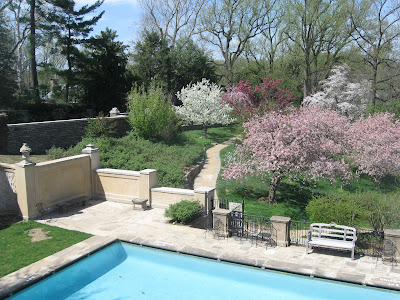
Dumbarton Oaks

It is Cherry Blossom Festival time again in Washington, DC. 

If the crowds are too much for you or you are just looking for a new angle to take a selfie - here are a several local alternatives to the Tidal Basin display:

#BlossomCam

The Trust for the National Mall and The National Cherry Blossom Festival hosts the #BloomCam. Go to the live feed here: https://nationalmall.org/bloomcam to view the trees along the Tidal Basin in real time as they bloom.

Petal Porch Parade

New this year is the Petal Porch Parade. These are homes decorated to bring the cherry blossom parade feel to your neighborhood. See more about them here and search the map of locations here.

Video Tours

There is now also a virtual tour videos posted: https://nationalcherryblossomfestivallive.org/

Public Gardens

~ The National Arboretum has a splendid and more varied display and LOTS or parking. Stroll around Fern Valley and the other gardens as well while you are there. Take the Self-Guided Tour: Beyond the Tidal Basin: Introducing Other Great Flowering Cherries  to explore the arboretum’s collection of over 2,000 cherry trees representing 600 different cultivars, hybrids, and species of various shapes, sizes, flower colors, and bloom times, including trees that have been created by arboretum scientists. Note: The free tour covers several miles of arboretum roads, and can be driven, biked, or walked. Pick up a brochure in the Administration Building.

Tudor Place is a lovely place to take a stroll on your own through the spectacular Yoshino Cherry Blossoms during the full bloom. Event and entry fees may apply.

Dumbarton Oaks in Georgetown, WDC, has a marvelous orchard of cherries. There is an admission fee that goes to support the gardens and you will want to make advance reservations. Parking is also a bear in that neighborhood -- I recommend you walk or take the bus. 

Hillwood Estate in NW DC is pleased to celebrate the National Cherry Blossom Festival with short guided tours of Mrs. Post’s Japanese-style garden. Docents will be available to answer questions between the tours. The suggested entry donation to Hillwood is $12 per adult.

Brookside Gardens in Wheaton, MD, also has beautiful cherry blossom trees and many other flowering trees like plum, apricot, magnolias, and quince in bloom right now, and you don’t have to fight the crowds to see them. The gardens are also full of flowering bulbs like hyacinths, tulips, and hillsides of daffodils.

Meadowlark Botanical Gardens in Vienna, VA, has over 100 cherry trees surrounding a lovely lake that you can stroll around. Admission to the gardens is a mere $5

Lewis Ginter Botanical Gardens in Richmond, VA, has a ring of Yoshino cherry trees around their lake and Okame cherry blooms throughout the gardens. There is an entry fee of $10 to visit the gardens.

~  River Farm in Alexandria, VA, is a historic 25-acre site on the banks of the Potomac River. River Farm was once part of George Washington’s original five farms, and currently the headquarters of the American Horticultural Society. The grounds offer spectacular river views, a wildlife garden, and delightful children’s areas. 

Green Spring Gardens near Annandale, VA, has several flowering cherry trees in its collection. There is also a wonderful witch hazel collection there.

Neighborhoods and Other Less-visited Spots

~ The Bethesda, MD, neighborhood of Kenwood for their stunning display. Park and walk in for an immersion in cherry tree lined streets.

~ Sarah Lawler suggests The Japanese American Memorial to Patriotism During World War II is a beautiful spot to see cherry blossoms. It is located near Union Station at the intersection of Louisiana Ave., New Jersey Ave. and D Street, NW, WDC. And across the street is a grove on the U.S. Capitol grounds.

~ Foxhall and Reservoir Rds, NW. Washington, DC. The Foxhall Village neighborhood near Georgetown has cherry blossom-lined streets that are known as the best-kept secret among locals.

~ Brenda Lynn shared she always bikes from Arlington, VA, in order to avoid having to park to take metro. It's a beautiful ride, and one could also bike along the GW parkway in VA to view all the blooms along the Potomac River

Oxon Run Park at 1200 Mississippi Ave SE, Washington, DC, has fairly new cherry tree plants and a lot of space to spread out and fly a kite.

~ National Harbor hosts a Sakura Sunday celebration. See: https://www.nationalharbor.com/events/annual-events/cherry-blossom-festival/

Anacostia Park at 900 Anacostia Drive, SE. Washington, DC. Cherry trees bloom along the Anacostia River at the 1,200-acre park that is one of Washington, DC's largest recreation areas.

~ An anonymous post to my blog, tipped me off that there are several blocks of cherry blossom trees creating an arch above the streets of Garrett Park Estates in Kensington, MD. "Take Strathmore Road near Holy Cross Church, turn onto Flanders and then I think it’s Waycross. The trees span several streets, are lovely, and totally free of crowds!"

~ Adam Bailey let me know that “Stanton Park and Lincoln Park on the Hill — and the Capitol Hill neighborhoods in general — have a good display of blossoms, too.”

~ "Scott Circle, at Massachusetts & 16th, also has some great cherry blossoms," reports John Boggan. 

~ Katie said, "There's a neighborhood off Query Mill in North Potomac, MD, that has streets lined with cherry trees. Not as fantastic as Kenwood, but if you're in the upper Montgomery County, it may be more accessible. Streets include Moran and Bonnie Dale. It blooms a few days later than Kenwood."

~ Casey Trees has an interactive map to find blooming street trees near your location. To try it out, go here: https://caseytrees.org/2019/03/heres-our-updated-d-c-cherry-blossom-map/

Grow Your Own!

 Ever since getting my weeping ‘Higan’ cherry, I feel no need to rush downtown. I keep a daily watch on my baby tree and celebrate loudly when the buds finally burst open. I highly recommend it. 
   Here is a video we created about growing ornamental cherry trees locally: 
   In addition, in the very first issue of Washington Gardener Magazine, we did a PlantProfile column on the selection and cultivation of cherry trees for our area. 

Got other DC-area Cherry Tree viewing locations? Please share them in the comments below.

>>> Visit our Amazon Store for all your Spring Gardening needs! <<<

Wednesday, March 16, 2022

Primrose Plant Profile

Primrose Plant Profile

Primroses (Primula hybrids) are a cold-hardy perennial to USDA zones 4-8. They come in an array of flower colors including reds, whites, yellows, oranges, purples or pinks with yellow centers and scalloped green foliage.

They are widely sold as a houseplant at local supermarkets and garden centers in late winter and early spring. At just $2-5 each, I buy several and use them to decorate my home with flowers during the gray days of January and February.

When they stop flowering, I plant them out in the garden in a moist, part-shade spot. They come back reliably each year with little to no care and bloom about the same time outdoors as they did inside.

One extra step I do for them is that I pinch out any spent blooms as I come across them during regular watering (side note: never let them dry out!). This encourages more and longer flowering from the plants. You can also give them a few drops of liquid fertilizer to prompt more flower formation when they start to slow down.

Rather than compost these sweet little plants, why not plant them out in your garden and be rewarded with blooms for years to come?

Primrose: You Can Grow That!

The video was produced by Washington Gardener Magazine.

Audio, Photos, and Text by Kathy Jentz

Video and Editing by Hojung Ryu


 If you enjoy this video, please give it a thumbs up and subscribe to our Youtube channel (thank you!)

Remember to TURN ON notifications to know when our new videos are out

 FIND Washington Gardener Magazine ONLINE

WashingtonGardener.blogspot.com

http://twitter.com/WDCGardener

https://www.instagram.com/wdcgardener/

~ Facebook.com/WashingtonGardenerMagazine

~ Podcast: GardenDC

 PIN THIS FOR LATER!

Tuesday, March 15, 2022

Marching into Bloom Day

It is Garden Blogger's Bloom Day again! On the 15th of each month, we gardeners around the world with blogs share a few flower photos from our gardens.

Here in the Mid-Atlantic USA (USDA zone 7) on the DC-MD border, we had had a very harsh winter. January was our coldest and snowiest in years. We had a tantalizing taste of a few warm days and we are back now to the typical March of cycles of cold temps and blustery winds followed by glimpses of  spring. Today is a lovely spring-like day.

Blooming in my garden today, I have Winter Jasmine, Witch Hazels, Heather, and Hellebores. The Forsythia flowers are opening and the buds on my Flowering Plum are just about ready to burst. Early bulbs flowering now include Snowdrops, Crocus, Winter Aconite, and early-season Daffodils like 'Tete-a-Tete'  and 'February Gold'. In outside containers, I have Primroses, Alyssum, and Pansies.

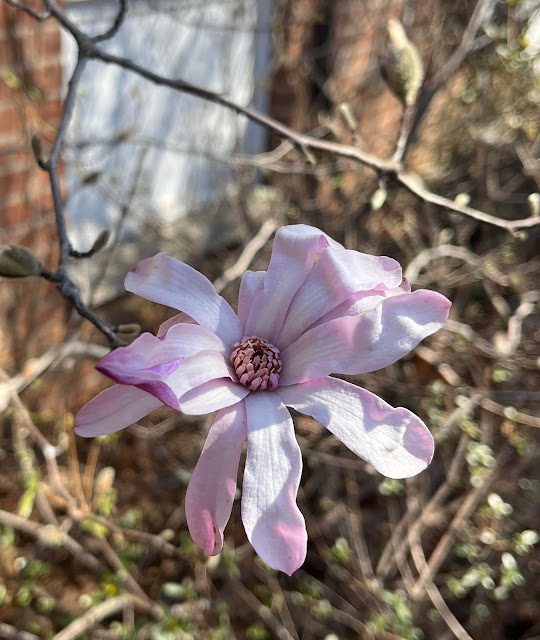
The Saucer Magnolia (pictured above) is looking particularly lovely. The early blooms that opened on it last week got zapped by ice and snow over the weekend, turning them to brown rags, but those flowers still in bud at that point are opening up just fine now.

Be sure to follow @WDCgardener on Instagram for daily pics of what is blooming in my garden and other area gardens that we visit.

So what is blooming today in YOUR garden?

Saturday, March 12, 2022

GardenDC Podcast Episode 95: Willows


In this episode, we talk Michael Judd of Ecologia Design about all things related to willows. The plant profile is on Primroses and I share what's going on in the garden as well as some upcoming events.

BTW, YOU can become a listener supporter for as little as $0.99 per month! See how at: https://anchor.fm/gardendc/support.

Show Notes: 1:05 Meet Michael Judd of Ecologia Design and learn all about willows! 1:35 “It’s all willows right now.” — Michael talks about his garden 4:09 “ ‘Easy’ is going to be the word of this episode.” — Kathy 4:46 Michael talks about Ecologia Design’s site near Frederick, MD — “It’s quite a spectacular spot!” 6:17 Michael describes the willow arch at the entrance of Ecologia Design’s food forest 7:07 Willows are important for bees! 9:45 Male deers will rub on willows during the winter 11:12 Michael describes the look of willows after pollarding as a “funky hairdo” 13:33 “A lot of what I’m doing with the willows is to sort of re-enliven the culture of basketry.” — Michael 14:42 “The willow really is one of the most resilient regenerative species we have to work with.” — Michael 15:45 Kathy and Michael discuss the many uses of willows 17:31 Michael talks about the many types of willows — “There’s really an endless selection of willows.” 23:35 “Getting to know your willows a little bit can be helpful.” — Michael 24:14 Michael talks about pussy willows — “The Japanese ones are gorgeous!” 25:31 Birds love willows! 26:50 “Plants really like to be worked when it’s cool and moist.” — Michael 30:22 “I just love the look of a huge, old weeping willows.” — Kathy 33:21 Michael talks about the willows he’s growing now — “I feel like I’m so in love with so many of them.” 40:53 How to contact Michael 43:48 Learn about the primrose in this week’s Plant Profile! 45:18 What’s new in the garden: blooming ‘Jane’ saucer magnolia and daffodils! 46:02 News in the gardening world: upcoming plant sales 47:27 Look forward to “The Urban Garden: 101 Ways to Grow Food and Beauty in the City” by Teri Speight and Kathy 48:20 Celebrate spring at the National Garden Bureau online book party

If you liked this episode, you may also enjoy listening to:

~ GardenDC Podcast Episode 25: Michael Judd of Ecologia Design on growing Paw Paws

https://washingtongardener.blogspot.com/2020/08/gardendc-podcast-episode-25-michael.html

~ Plant Profile: Native Pussy Willows (Salix discolor)

https://washingtongardener.blogspot.com/2020/03/plant-profile-pussy-willows-salix.html


We welcome your questions and comments! You can leave a voice mail message for us at: https://anchor.fm/gardendc/message Note that we may use these messages on a future episode.

And be sure to leave us a 5-star review on your favorite platform so other gardeners can find us too!

Episode Credits:
Host and Producer: Kathy Jentz
Editing and Show Notes: Dorvall Bedford

PIN THIS FOR LATER!

Thursday, March 10, 2022

Heaths and Heathers Plant Profile


Heaths and Heathers Plant Profile

Heaths (Ericas) and heathers (Callunas) are members of the Ericaceae family. They are evergreen, with bell-like flowers, and share similar cultural needs. Winter-blooming heathers, the Ericas, are called heaths. The Heaths have needle-like leaves in whorls, while the Heathers have scale-like leaves, similar to junipers.

The flower colors range from white through light pink, into deep pinks, reds, and purples. The foliage comes in a wide range of green and bronze tones. They do well in rock gardens and on slopes. They are often used in groupings as a ground cover as well as a small specimen shrub at the front of a border or in containers.

They prefer acid soils like their relatives in the Ericaceae family -- the rhododendrons, azaleas, and blueberries. They are generally hardy to USDA Zones 4-7.

The best time to plant them is in early spring or fall to give them plenty of time to get established before the extreme heat or cold sets in. Water them well for their first year and keep them mulched. They are fairly drought-tolerant once established and do not require fertilizer.

Winter-blooming heaths need four things: good air circulation, excellent drainage, acid soil (a pH range of 4.5-6), and at least six hours of sun. They also like protection from drying winter winds and afternoon shade in hot regions.  

Heaths and Heathers can be found all over the world, except Antarctica. The Ericas we grow in our gardens come mainly from Western Europe and the Mediterranean.

Heaths and Heathers look great combined in the landscape with Witch Hazels, dwarf conifers, Crocus, Daffodils, Winter Aconite, Hellebores, and Snowdrops.

Prune just as this year’s flowers are ending and sheer them back all over for a fuller, more compact look. Cutting back at a later time results in the loss of blooms.

Heaths and Heathers are considered deer-resistant. They are loved by bees and are a great source of nectar in late winter.

Heaths and Heathers : You Can Grow That!

The video was produced by Washington Gardener Magazine.

Audio, Photos, and Text by Kathy Jentz

Video and Editing by Hojung Ryu


 If you enjoy this video, please give it a thumbs up and subscribe to our Youtube channel (thank you!)

Remember to TURN ON notifications to know when our new videos are out

 FIND Washington Gardener Magazine ONLINE

WashingtonGardener.blogspot.com

http://twitter.com/WDCGardener

https://www.instagram.com/wdcgardener/

~ Facebook.com/WashingtonGardenerMagazine

~ Podcast: GardenDC

 PIN THIS FOR LATER:


Featured Post

Holiday Gifts for Gardeners ~ Top Gardening Gifts ~ 21+ Cool Gardening Gift Ideas

The holiday season is here and I bet you have a gardener on your gift list, so we've   updated   our annual a Holiday Gifts for Gardener...

Most Popular Posts